In our previous lesson, we examined the Shirky Principle and saw how established institutions, from lingerie brands to relationship structures, can resist change because their identity is tied to being the solution to a specific problem. This naturally raises the question: if incumbent systems are so resistant, where do transformative ideas and better solutions originate? Today's lesson provides a direct answer by exploring Joy's Law.
Coined by Sun Microsystems co-founder Bill Joy, the law states: "No matter who you are, most of the smartest people work for someone else." This is not a cynical statement, but a profound observation about the distribution of knowledge and talent in the world. Your goal is to apply this law to recognize that the best lingerie design talent may lie outside your own company, and that the most insightful perspectives on relationship dynamics often come from outside your immediate polycule.
The Abundance of External Knowledge
Joy's Law is the foundational mindset behind the modern concept of "open innovation." It challenges the traditional, closed model where an organization believes all the best ideas and talent must reside within its own walls. Acknowledging that expertise is widespread allows an organization—or a relationship—to tap into a much larger pool of intelligence.
Let's begin by grounding ourselves in the principle itself.
[PDF] The Open Organization Field Guide
This guide explains Joy's Law in the context of modern organizations that rely on external communities and networks, such as the open-source software company Red Hat. It provides a strong foundation for understanding the law's strategic implications.
Please read the chapter "Networks, communities, and Joy's Law." Pay attention to these key ideas: The core statement of the law: the central tenet and the resulting challenge for any leader. The example of Red Hat, which depends on external contributors for its success. The personal journey of the CEO, who had to learn to embrace a culture where outside opinions were not just tolerated but valued. The concluding thought that in a hyperconnected world, its relevance is increasing.
The key takeaway is that treating the boundary of your organization or group as permeable is not a weakness but a strategic strength. It reframes the world from a landscape of competitors to a network of potential collaborators.
Application 1: Open Innovation in Lingerie Design
A lingerie brand operating under a "closed" model would rely exclusively on its in-house designers, pattern makers, and marketers. This model is inherently limiting. Joy's Law suggests a more powerful, "open" approach.
Henry Chesbrough, the academic who coined the term "open innovation," provides a clear framework for this.
Insight: Ideas for Change - Open Innovation - Henry Chesbrough
In this short video from the World Economic Forum, Henry Chesbrough defines open innovation and its core principles. It's a direct strategic application of Joy's Law.
Watch the following segments: First, grasp the two-way definition of open innovation: using external ideas internally and letting internal ideas go external here. Next, listen for his articulation of the necessary mindset change, which is a direct echo of Joy's Law: "not all the smart people work for us." Finally, note how this shift requires new ways of working and rewarding people, celebrating both internal and external achievements.
Applying this to your work in lingerie design, consider these two flows of innovation:
-
Outside-In Innovation: This is about actively sourcing external expertise.
- Talent: Instead of relying only on full-time staff, you could collaborate with a freelance designer renowned for their avant-garde aesthetic on a capsule collection. Or, you might hire a specialist consultant in ergonomics to perfect the fit of a new sports bra line.
- Technology: Perhaps a university's material science department has developed a new breathable, moisture-wicking fabric. An open-innovation approach would be to license this technology rather than trying to reinvent it in-house.
- Ideas: Running an open design competition can surface brilliant concepts from aspiring designers you would never have otherwise found.
-
Inside-Out Innovation: This involves monetizing internal assets that don't fit the core business.
- Imagine your team develops a novel magnetic clasp. You test it, but decide it isn't right for your brand's aesthetic. Instead of shelving it, you could license the patent to a company that makes adaptive clothing for people with dexterity issues, creating a new revenue stream from an "unused" idea.
By embracing Joy's Law, a lingerie business transforms from a closed fortress into an open hub, continuously benefiting from and contributing to a global ecosystem of talent and ideas.
Application 2: The Vee Relationship and the Wisdom of the Community
Now, let's apply Joy's Law to the Vee relationship structure. The "organization" here consists of three people: the husband, the wife, and her lover (the "metamours" being the two men). A common failure mode in any relationship, but especially in non-normative structures, is to become an inward-looking, closed system. The belief that "we should be able to solve all our own problems" is a relationship-level version of the closed innovation model.
Joy's Law powerfully suggests that the most insightful, experienced, and helpful people for navigating the complexities of polyamory are likely outside your specific Vee.

Why is external perspective so crucial?
- Objectivity: The three people inside the Vee are, by definition, not objective. Their perspectives are shaped by their own needs, fears, and emotional investments. When conflict arises, it's difficult to see the problem clearly from the inside.
- Experience: For many, polyamory is a new frontier. A couple opening their relationship, or a new lover joining a dynamic, may be encountering specific challenges for the very first time. The odds that someone, somewhere, in the global polyamorous community has faced the exact same problem are virtually 100%. To not seek out that experience is to choose to learn everything the hard way.
- Specialized Knowledge: Monogamous friends and family, while well-intentioned, often lack the framework to give useful advice. Their guidance is based on a different operating system. The "smartest people" on polyamory are those who live it, study it, and support it.
This is where the concept of community becomes a direct application of Joy's Law.
Polyamory community: why you need it - Relationships - Minka Guides
This article from Minka Guides makes a compelling case for the necessity of a broader community in polyamorous life, directly illustrating how to apply Joy's Law in a relationship context.
As you read, focus on how the community provides the "smart people" from outside the immediate relationship: The introduction establishes community as a critical support system. The section "Expand your support network" explains why relying only on your partners is insufficient and can lead to isolation. It highlights the need for an impartial viewpoint. Under "Share resources and experiences," note how the community provides access to shared wisdom, normalizing challenges and providing solutions: Monogamous friends can't help, so you need a network to share books, podcasts, and guidance. Finally, explore the "How to find..." sections, which provide practical ways to connect with these external experts, be it through local events or online forums like Reddit and dedicated Facebook groups.
Let's consider a concrete problem. The pie chart below shows common triggers for jealousy in polyamorous relationships.
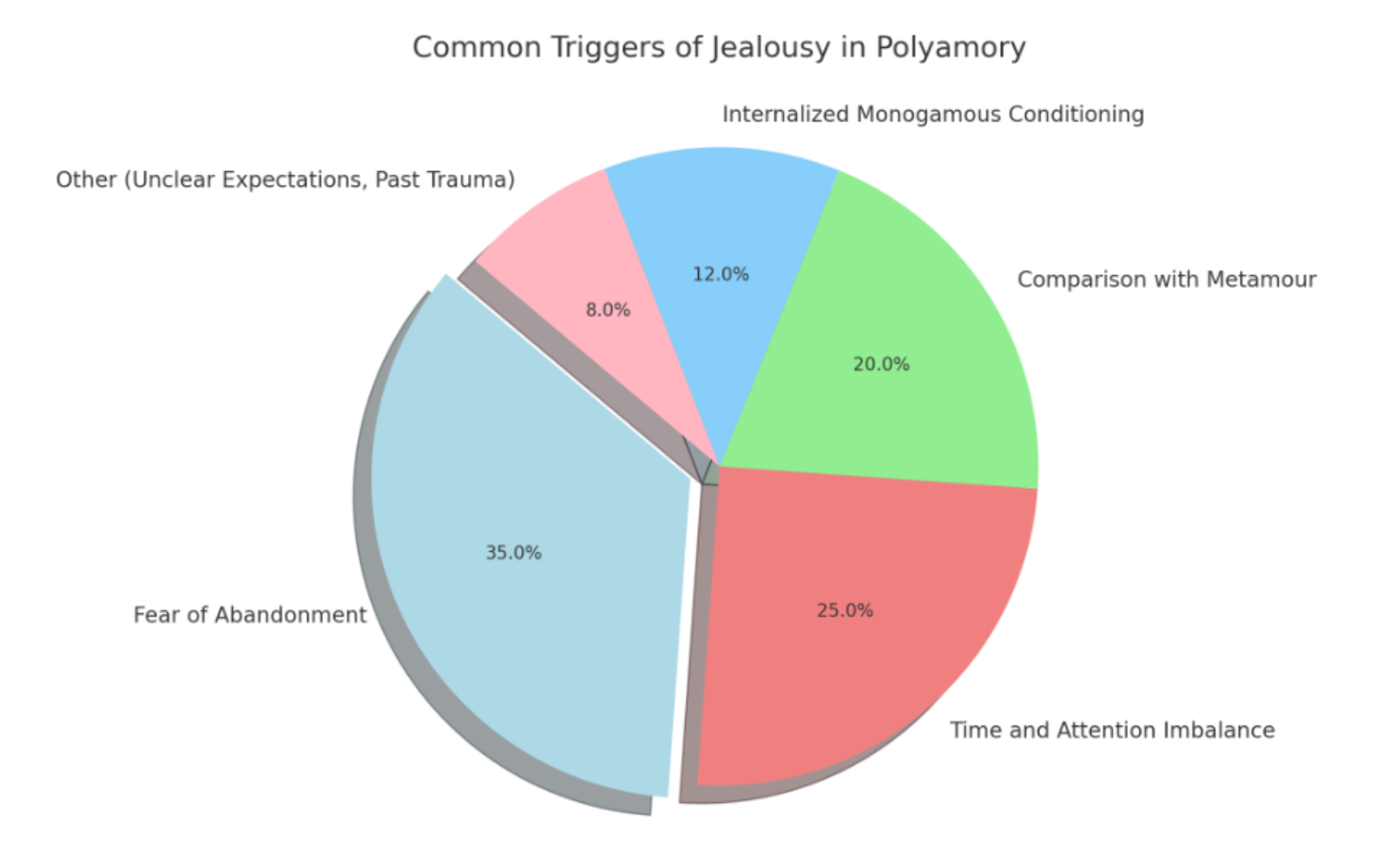
Imagine the husband in the Vee is struggling with feelings stemming from a "Time and Attention Imbalance" (25% of triggers). He feels the wife is spending "too much" time with her lover. A closed-system approach would involve endless, circular arguments between the husband and wife.
An "open innovation" approach, guided by Joy's Law, would be for the husband to:
- Acknowledge Internal Limits: Recognize that he and his wife are too enmeshed in the problem to solve it alone.
- Seek External Experts: He could join the
r/polyamorysubreddit mentioned in the article and post: "Hinge partners, how do you balance time to make both your partners feel secure? Metamours, what has helped you deal with feelings of being secondary?" - Integrate Knowledge: He would receive dozens of responses—the "smartest people" sharing their lived experience. He might learn about specific scheduling tools, communication techniques like "setting a date with your date," or simply feel validated that his feelings are normal. He can then bring these external, proven solutions back into his relationship to discuss with his wife.
As a relationship analyzer, you function as a living embodiment of Joy's Law for your clients—you are the "smart person" from outside their system who provides the perspective they cannot generate internally. The same logic dictates that even the most self-aware polycule needs access to a wider community for support and wisdom.
Conclusion
Joy's Law is a principle of humility and strategic openness. It reminds us that no matter how skilled we are, the vast majority of talent and knowledge resides outside our immediate sphere.
Key Takeaways:
- Joy's Law: Acknowledges that expertise is distributed and encourages looking beyond your own team or relationship for the best ideas and solutions.
- Lingerie Application: In a business context, this translates to "Open Innovation"—strategically collaborating with external designers, licensing outside technology, and even allowing your own unused ideas to be leveraged by others.
- Vee Relationship Application: In a relationship context, this means actively building a support network and engaging with the wider polyamorous community to gain objective perspectives, shared experiences, and proven strategies for navigating complex emotional challenges.
In our next lesson, we will examine Sayre's Law, which observes that "in any dispute, the intensity of the dispute is inversely proportional to the value of the stakes at issue." We will shift from analyzing where solutions come from to dissecting the often-paradoxical nature of conflict itself.