Welcome back. In our last lesson, we examined Conway's Law, discovering how the communication structure of an organization—be it a design team or a relationship—inevitably shapes the systems it creates. We saw that to change the system's architecture, one must first change the social architecture.
Today, we confront the friction that often accompanies such change. We will explore the Shirky Principle, which provides a powerful explanation for institutional inertia. The principle states that institutions will try to preserve the problem to which they are the solution. Your objective for this lesson is to apply this principle to understand why an established lingerie brand might resist adopting new, more effective fitting methods, and why a stable relationship structure might oppose changes that threaten its existing roles and power dynamics.
The Problem of Being the Solution
At its core, the Shirky Principle exposes a fundamental conflict of interest baked into the DNA of many organizations and systems. When an institution's identity, power, and revenue are tied to solving a particular problem, it has a subconscious, and sometimes conscious, incentive to ensure that problem persists.
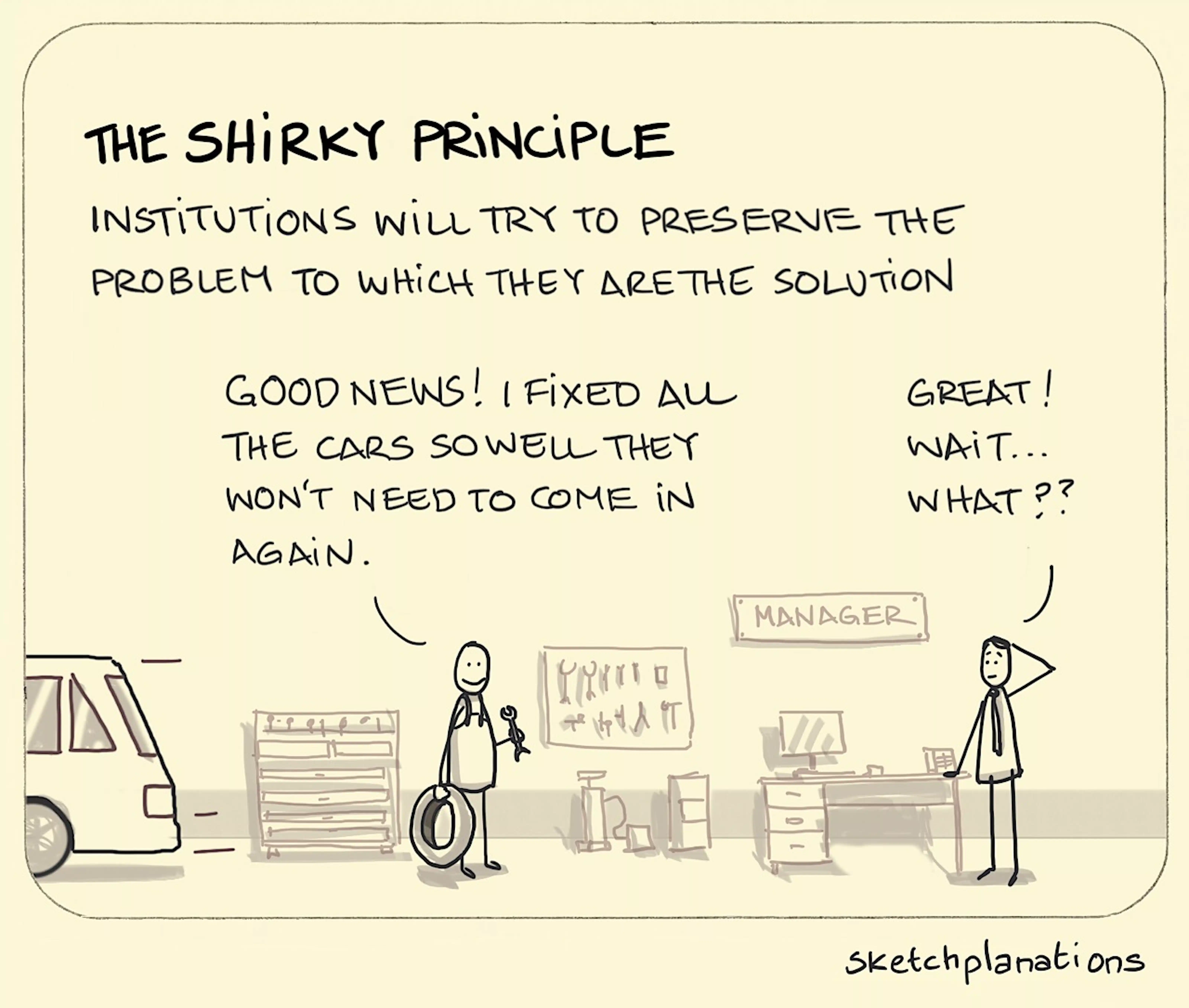
To apply this principle effectively, it helps to break it down into its core components.
Shirky Principle | FunBlocks AI
This article from FunBlocks AI provides a clear and structured analysis of the Shirky Principle. It will give us the analytical framework needed for our application scenarios.
First, read the introduction to grasp the formal definition: the core tenet. Then, move to the "Core Concepts Analysis" section and familiarize yourself with the four key components that drive this dynamic: Institutional Purpose Solution Entrenchment Shifting Landscapes Preservation Imperative Focus on how these four concepts build on each other to create powerful organizational inertia.
As the article explains, institutions are created to solve a problem. They become deeply invested in their particular solution, and when the landscape shifts, a preservation imperative kicks in. The focus moves from solving the external problem to preserving the internal institution.
Application 1: Resistance in the Lingerie Industry
Let's analyze a legacy lingerie brand through this lens, using the decline of Victoria's Secret as a case study.
- The Institution: A dominant, decades-old lingerie brand.
- The Original Problem: Women need help finding bras that fit properly and make them feel attractive according to prevailing beauty standards.
- The Established Solution: A complex and often inconsistent sizing system that requires in-person "expert" fittings. The brand positions itself as the sole authority, the gatekeeper of the "correct" fit and the arbiter of "sexiness." This business model depends on the problem (bra fitting is hard) remaining difficult, ensuring customers must repeatedly return for the "solution" (an expert fitting).
- The Shifting Landscape: As the Vogue article compellingly documents, the landscape has fundamentally changed.
- New Customer Priorities: The market has shifted from a male-gaze definition of "sexiness" to a woman-centric desire for comfort, fit, and authenticity.
- New Needs: Demand has grown for inclusive sizing, post-surgical (mastectomy) bras, and maternity bras—problems the brand's narrow solution doesn't address.
- New Technology: Online fit-finders, body-scanning apps, and direct-to-consumer models offer simpler, more accurate, and more private solutions.
- The Preservation Imperative: The brand resists adapting because a genuine solution would render its entire institutional structure obsolete.
The Vogue article provides direct evidence of this resistance.
Victoria's Secret decline marks end of one-size-fits-all lingerie | Vogue
This article details the specific ways in which Victoria's Secret failed to adapt, perfectly illustrating the Shirky Principle in action.
As you read, focus on these points: The brand's deep entrenchment in its old solution, even when customers explicitly demanded change: ignoring their customers' wishes. The leadership structure's role in preserving the status quo: a mostly male board. This group's power and identity were tied to the old definition of "sexiness." The consequences of this inertia, as new institutions arise to solve the problems the incumbent is ignoring: the emergence of Everviolet for mastectomy bras. The redefinition of the core problem itself, moving away from the brand's established solution: made for men.
Victoria's Secret was built to solve the problem "How do I look sexy for men?" Its solution was push-up bras and angel wings. When the market's problem became "How do I find a comfortable, well-fitting bra for my own body and life?" the company faced a choice: adapt and build a new institution, or preserve the old one. By ignoring calls for mastectomy bras and focusing on its televised fashion show long past its cultural relevance, the company chose to preserve the problem to which it was the solution. Adopting a truly accurate, easy-to-use fitting system would destroy its reliance on in-store "experts" and devalue its physical retail footprint. Acknowledging the need for mastectomy bras would mean admitting its definition of "woman" was radically incomplete. The institution fought to protect its solution, even as the problem changed underneath it.
Application 2: Resistance to Change in the Vee Relationship
Now let's apply this to the dynamics of a Vee relationship. As an efficiency expert and relationship analyzer, you'll recognize the incentives embedded in the structure.
- The Institution: An established Vee relationship with a "Parallel Polyamory" structure, where the hinge partner manages all communication and logistics between the two "arms" (e.g., the husband and the wife's lover).
- The Original Problem: How can three people with intertwined lives coordinate schedules, share resources, and manage emotional needs without creating chaos or direct conflict between the two arms of the Vee?
- The Established Solution: The hinge partner becomes the central processor. They are the problem-solver, the mediator, the scheduler, and the emotional switchboard. Their role is critical; their actions are the solution that maintains stability. This position grants the hinge significant influence and a clear sense of purpose within the relationship structure.
- The Shifting Landscape: A change is proposed. For example, the husband suggests that he and the lover start communicating directly to coordinate plans for the wife's birthday party. Or, the lover expresses a desire for everyone to have a group dinner once a month to foster a greater sense of community (a shift towards "Kitchen Table Polyamory").
- The Preservation Imperative: The hinge partner, whose identity is deeply intertwined with being "the solution," may resist this change. This is not necessarily malicious. It is an instinct to preserve a system that has, until now, worked and has reinforced their importance.
- The proposed change—direct communication between the arms—threatens to make the hinge's role as the indispensable central coordinator partially redundant.
- If the husband and lover can solve logistical problems directly, the "problem" of coordination, which the hinge's role was created to solve, is diminished.
- The hinge might voice this resistance with practical-sounding arguments: "It's just less complicated if everything goes through me," or "I'm worried you two might misunderstand each other without me there to clarify," or "This is the way we've always done it, and it works."
- These are all manifestations of the Shirky Principle. They are arguments to preserve the problem (the need for a central coordinator) because the existing solution (the hinge's central role) is comfortable, familiar, and a source of their influence within the relationship dynamic. The institution (the relationship's established structure) is attempting to preserve the problem to which one of its key members is the solution.
A Strategy for Overcoming Resistance
The Shirky Principle is a diagnosis, not a life sentence. Understanding it allows you to anticipate resistance and strategize accordingly. Instead of a direct assault on the entrenched institution, a more effective approach is to create a "pull" towards the new way of doing things. Simon Sinek's work on the diffusion of innovations provides a useful model.
How to Create Change | Simon Sinek
In this video, Simon Sinek explains a powerful strategy for introducing new ideas into resistant systems. This provides a practical toolkit for overcoming the inertia described by the Shirky Principle.
First, watch the segment where Sinek explains why the status quo is so defensive: defensiveness of the status quo. Next, understand his core framework, the law of diffusion of innovations: the bell curve. This categorizes people as innovators, early adopters, majority, and laggards. Finally, and most importantly, watch his real-life example of implementing change. He doesn't try to convince the majority. He identifies and empowers the early adopters, creating demand that pulls the rest of the organization along: a real-life example.
Sinek's strategy is to bypass the resistant majority and focus on the small percentage of "early adopters" who are open to the new idea.
- In the Lingerie Market: The new, disruptive brands didn't try to reform Victoria's Secret. They targeted the "early adopters"—the millions of women who were already dissatisfied and actively seeking better solutions. By serving this group exceptionally well, they created demand and proved the viability of a new model, causing the "tipping point" that now forces the legacy brand to change or disappear.
- In the Vee Relationship: The partner proposing the change (the "innovator") should not try to force a complete structural overhaul on the resistant hinge (the "majority"). Instead, they can:
- Find the "Early Adopter": In a Vee, this might mean finding the aspect of the other partner that is most open to the new idea.
- Start with "Why": Frame the proposal around a shared value. "I believe we'll all feel more secure and connected if we have moments together," is more effective than, "We need a new rule for communication."
- Run a Small Experiment: Propose one low-stakes group dinner, not a permanent change to the rules. Make it voluntary and easy to say yes to.
- Create Demand: If the small experiment is a success and genuinely enhances the relationship, the experience itself will create a "pull" for more. The resistant partner may see the benefit and become more open to further change, not because they were forced, but because they experienced a better alternative.
Conclusion
The Shirky Principle reveals a crucial dynamic in human systems: institutions often become self-preserving entities, sometimes at the expense of their original mission. Their resistance to change is not just stubbornness; it is a survival instinct tied to their identity as the "solution" to a specific problem.
Key Takeaways:
- Shirky Principle: Institutions will try to preserve the problem to which they are the solution. This creates a powerful inertia against change.
- Lingerie Application: An established brand like Victoria's Secret resisted new fitting methods and inclusive products because these innovations threatened its core identity and business model, which was built around being the exclusive "expert" on a narrowly defined problem.
- Vee Relationship Application: A relationship structure, particularly one where a hinge partner's role is defined as the central problem-solver, will naturally resist changes that distribute that problem-solving function and diminish the hinge's unique importance.
- Strategic Response: Overcoming this inertia is rarely achieved by direct confrontation. It is more effectively managed by identifying and empowering "early adopters" to create small wins, generating demand that pulls the rest of the system toward a new, better solution.
In our next lesson, we will explore Joy's Law, which states, "no matter who you are, most of the smartest people work for someone else." This will expand on today's theme by showing how the solutions to an institution's problems often lie outside its own walls, further explaining why disruptive newcomers are so often the agents of change.