Welcome back. In our last lesson, we explored Joy's Law, concluding that the most effective solutions often come from looking outside our immediate teams or relationships. This lesson turns our focus inward, from finding solutions to understanding the nature of the problems themselves. You've likely noticed that some of the most emotionally charged arguments, both in business and in personal life, erupt over matters that seem, in hindsight, remarkably insignificant.
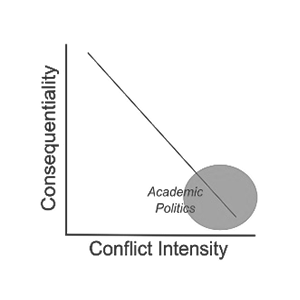
Today, we will dissect this phenomenon using Sayre's Law. Formulated by political scientist Wallace Sayre, the law states: "In any dispute, the intensity of feeling is inversely proportional to the value of the stakes at issue." Our goal is to apply this principle to understand why trivial lingerie design choices can generate heated debates, and why low-stakes disagreements in a Vee relationship can provoke disproportionate conflict.
Let's begin by grounding ourselves in the formal statement of this paradoxical law.
Sayre's law: required wisdom for all academics - Anthony Bonato
This blog post by Anthony Bonato, a mathematician and university administrator, provides a concise and practical introduction to Sayre's Law, born from his experience mediating disputes in academia—a classic setting for the law to manifest.
Please read the first three paragraphs of the article to grasp the core principle. Focus on the formal definition and the author's observation that this counterintuitive dynamic plays out predictably, especially in environments like the academy where stakes can be relatively low.
The law describes an inverse relationship: as the objective importance of an issue decreases, the passion invested in arguing about it tends to increase. This is neatly captured in the following graph.
But why does this happen? Two related psychological concepts provide powerful explanations: the Law of Triviality (also known as "bikeshedding") and the "narcissism of small differences."
The Psychology of Trivial Disputes: Bikeshedding
The term "bikeshedding" comes from an analogy about a committee tasked with approving two things: a billion-dollar nuclear power plant and a simple bike shed. The committee, overwhelmed by the complexity of the nuclear plant, approves it with little discussion, assuming the experts have it covered. However, the bike shed is something everyone understands. They proceed to argue for hours about its color, materials, and placement.
This is the essence of Parkinson's Law of Triviality: people give disproportionate weight to trivial issues because they are easier to grasp and debate than complex ones.
Bikeshedding in Software Engineering
This video by software engineer Bran van der Meer clearly explains the concept of bikeshedding and its origins.
Please watch the following segments to understand this key mechanism behind Sayre's Law: The introduction links the concept to its formal name, the Law of Triviality. The core analogy explains why a committee will endlessly debate a bike shed but quickly approve a nuclear power plant. The key insight is that people gravitate toward topics where they feel competent to contribute. This section connects bikeshedding to feelings of insecurity about more complex topics, suggesting that focusing on trivia can be a defense mechanism.
Application 1: The Lingerie Design "Bike Shed"
Imagine a product development meeting for a new lingerie line. Your team must make decisions on two main items:
- The "Nuclear Plant": A new, patented underwire system designed to provide unprecedented lift and comfort for larger cup sizes. This involves complex stress-strain calculations, analysis of material fatigue, and a high-cost tooling process.
- The "Bike Shed": The choice of font for the brand name printed on the care label inside the bra.
In line with Sayre's Law and the bikeshedding effect, the discussion about the underwire system might be brief. The engineering is complex, and most of the team will defer to the technical designer and materials expert.
However, when the topic shifts to the care label font, the conflict intensity skyrockets.
- The marketing lead insists on using the brand's official "aspirational" script font.
- The production manager argues for a simple, bold sans-serif font for maximum legibility.
- The finance analyst points out that using the default font from the printing machine would save a fraction of a cent per unit.
The stakes are objectively trivial—the font on an internal label will have virtually no impact on sales or function. Yet the argument becomes heated because, unlike wire tensile strength, typography is something everyone feels qualified to have an opinion on. It's an accessible topic, and so it attracts a disproportionate amount of argumentative energy.

As an efficiency expert, your role is to prevent the team from getting stuck in this "bike shed." A useful tool, adapted from the software world, is a hierarchy of priorities. Just as the video mentioned a "pyramid of code," you can establish a Pyramid of Lingerie Design Priorities:
- Level 1: Fit & Support (The Foundation): Does the product perform its primary mechanical function correctly and safely? (e.g., Does the band support? Do the wires stay in place?)
- Level 2: Comfort & Durability (The User Experience): Is the product comfortable to wear for extended periods and will it withstand normal use? (e.g., Is the fabric breathable? Are the seams robust?)
- Level 3: Aesthetics (The Polish): Does the product align with the brand's visual identity? (e.g., lace patterns, bow colors, label fonts).
You can steer the conversation by stating, "This is a great discussion, but it's a Level 3 issue. Let's confirm we've fully resolved all Level 1 and 2 concerns before we allocate more time to aesthetics." This reframes the debate and redirects energy to where the stakes are highest.
Application 2: Low Stakes, High Conflict in the Vee
Now let's apply Sayre's Law to the Vee relationship. Here, the dynamic is often different from bikeshedding. The trivial issue isn't just an easy target for opinions; it becomes a proxy for a much larger, unaddressed emotional issue.
Imagine a Vee relationship (husband, wife, wife's lover) that is stable in all the "big picture" ways. They agree on their financial arrangements, their long-term commitments, and the ethical foundations of their polyamorous structure. These are their "nuclear plant" agreements.
However, a fierce, recurring conflict erupts over the wife consistently leaving her teacup on the coffee table instead of taking it to the kitchen. From the outside, the stakes are nearly zero. But the husband's reaction is one of intense anger and frustration, far beyond what a misplaced cup would seem to warrant.
This is Sayre's Law in action. The low objective stakes of the teacup are coupled with extremely high conflict intensity. Why? Because the teacup is not the real issue. It has become a symbol.
Renowned relationship therapist Esther Perel provides the tools to unpack this.
Fight Smarter: Avoid the Most Common Argument Patterns - Esther Perel
In this video, Esther Perel deconstructs common, dysfunctional argument patterns that cause minor issues to escalate into major fights.
Her insights reveal why Sayre's Law is so prevalent in relationships: First, absorb her opening advice: don't appoint yourself the judge of what is "worthy of being upset about." This acknowledges that a partner's intense reaction to a 'small' thing is valid data, even if you don't understand it. Next, understand how we misinterpret motives through the attribution error: when we make a mistake (leave a cup out), it's because of circumstances ("I was distracted"). When our partner does it, it's because of their character ("You're inconsiderate"). Finally, see how conflict removes nuance, leading to "pseudo-factual" accusations like 'You always' or 'You never'. This turns a single, trivial event into an indictment of the person's entire character.
In our scenario, the husband's internal monologue, filtered through these cognitive distortions, might be:
- "When I forget something, it's because I'm busy managing our family's finances. When she forgets the teacup, it's because she doesn't respect our home now that she has her lover. It's a character flaw." (Attribution Error)
- "She always does this. She never thinks about the work I do to keep the house nice." (Loss of Nuance)
The teacup becomes a proxy for his fear of being de-prioritized or disrespected within the new relationship structure. The fight is not about the cup; it's about his sense of security and value.
Another powerful lens is the "narcissism of small differences," a concept that explains why groups in broad agreement often fracture over minor points.
Ray Dalio Warns Against 'Narcissism of Small Differences' in ...
This article summarizes investor Ray Dalio's advice on a common trap in groups and relationships: focusing on minor disagreements at the expense of major shared values. This provides a strategic framework for mitigating the conflicts described by Sayre's Law.
As you read, focus on these points: The core concept: how groups that agree on fundamentals often end up fighting over trivialities. Dalio's name for this is the 'narcissism of small differences'. The primary antidote is to consciously maintain perspective and focus on the big picture, valuing the overarching agreements.
As a relationship analyzer, your role is to help the partners see past the teacup. The mitigation strategy is to shift the conversation from the trivial proxy to the real, high-stakes emotion.
- Move from accusation to expression: Guide the husband away from "You're so inconsiderate" (a character attack about the cup) to "When I see the cup left out, it triggers a feeling in me that I'm being forgotten, and that makes me feel insecure."
- "See the big picture": Remind the couple of their shared values and the strength of their "big thing" agreements. Is this teacup disagreement more important than their mutual commitment and love? This contextualizes the trivial issue and drains its symbolic power.
Conclusion
Sayre's Law reveals a fundamental quirk of human interaction: we often invest the most energy in the things that matter least. Understanding the mechanisms behind this—bikeshedding in group tasks and proxy conflicts in relationships—is key to managing it.
Key Takeaways:
- Sayre's Law: The intensity of a dispute is often inversely proportional to the objective value of the stakes.
- Application to Lingerie Design (Bikeshedding): Trivial issues like fonts or colors generate heated debate because they are accessible to everyone, unlike complex technical problems. The solution is to create a clear hierarchy of priorities and focus energy on what is truly consequential for the product.
- Application to Vee Relationships (Proxy Conflict): A trivial issue like a misplaced teacup can trigger intense conflict because it becomes a symbol for a deeper, unaddressed emotional need or fear (e.g., security, respect). The solution is to identify and address the underlying emotion rather than arguing about the trivial proxy.
In our next lesson, we will move from the psychology of small-group conflict to the mathematical modeling of competition. We'll explore Lanchester's Laws, which analyze how the numerical strength of competing forces influences their power and chances of success.