Hello again. In the last lesson, you calculated a realistic weekly study capacity by protecting recovery time and keeping a buffer. Capacity tells you how much work can fit. This lesson decides what the work is connected to.
Your current semester has seven substantial subjects: Linear Control Systems, Antenna and Wave Propagation, DSD/VHDL, Microcontrollers, Digital Communications, Digital Image Processing, and Computer Networks. Rather than treating them as seven unrelated demands, you will classify each by its overlap with:
- GATE ECE preparation,
- placement coding and software-interview preparation, or
- college-specific requirements such as internal exams, lab records, and syllabus-specific assignments.
The important idea is that a subject can receive more than one label. Classification is not yet a decision about how many hours each subject deserves—that comes in the next lesson.
Do not force each subject into only one box
A course can serve several purposes, but not equally strongly. For example:
- Studying Control Systems transfer functions directly supports college exams and GATE.
- Writing a microcontroller C program supports a lab, builds low-level programming ability, and is useful for embedded roles—but it is not the same as solving DSA problems in Python.
- Learning Computer Networks may not map directly to the current GATE EC syllabus, but it is a common software-placement interview topic.
- A DIP assignment might be college-focused for GATE purposes, while still giving you material for a Python-based project portfolio.
Use these four labels in your notes:
| Label | Meaning | Example |
|---|---|---|
| G—Direct GATE overlap | The topic is explicitly listed in the GATE EC syllabus. | Feedback, Routh criterion, PCM, Karnaugh maps |
| G—Partial / adjacent overlap | Foundational ideas overlap, but the complete college subject is not fully covered. | Microcontroller concepts linked to computer organization |
| P—Placement overlap | Supports coding tests, DSA, programming fluency, projects, or interview theory. | Python, C, Computer Networks |
| C—College-specific requirement | Needed mainly for semester marks, labs, records, or a university-specific unit. | VHDL lab submission format, internal-test units |
A task can therefore be marked, for example, G + C, P + C, or occasionally G + P + C.
This prevents two common planning mistakes:
- Double-counting: assuming every college hour automatically counts as placement preparation.
- Ignoring leverage: studying a direct GATE topic only for the next internal exam, then forgetting it after the test.
Use the official syllabus as the GATE reference
For GATE classification, do not rely on a coaching-video topic list or a senior’s memory. Start with the official EC syllabus. The current official syllabus gives direct support to your semester through Digital Circuits, Control Systems, Communications, and Electromagnetics; it also includes selected Computer Organization topics relevant to Microcontrollers.
[PDF] EC Electronics and Communication Engineering - GATE 2026
Read the official GATE EC syllabus from IIT Guwahati. Your goal is not to memorize it now, but to notice which current-semester topics appear explicitly under Digital Circuits, Control Systems, Communications, and Electromagnetics.
In the PDF, go to Section 5: Digital Circuits, then continue through Section 6: Control Systems, Section 7: Communications, and Section 8: Electromagnetics. Read from the discussion of the directly relevant GATE topics. As you read, underline terms that match your syllabus: Karnaugh maps, flip-flops, transfer functions, stability, PCM, digital modulation, Maxwell's equations, waves, transmission lines, and antennas. Also note the Computer Organization material in Section 5, especially machine instructions, addressing modes, ALU, data path, and control unit.
The syllabus used here is for GATE 2026, so treat it as your present planning reference rather than a guarantee that every wording will be identical for GATE 2027. When the GATE 2027 information bulletin and syllabus are released, verify the final official version. The broad subject structure is a useful guide now; the later official document is the authority.
Your semester overlap map
Here is a practical first classification of your current subjects.
| Current subject | GATE ECE overlap | Placement-coding overlap | Primary classification for this term |
|---|---|---|---|
| Linear Control Systems | Direct: transfer functions, block diagrams, transient and steady-state response, Routh criterion, frequency response | Not DSA directly; useful for core ECE technical interviews | G + C |
| Antenna and Wave Propagation | Direct: Maxwell’s equations, plane waves, transmission lines, waveguides, optical fiber, dipole/monopole antennas, arrays | No direct software-coding link; valuable for communication/RF-oriented core roles | G + C |
| DSD/VHDL | Direct for digital design: Boolean algebra, Karnaugh maps, combinational/sequential circuits, flip-flops, setup/hold time, FSMs | VHDL is hardware-description coding, not placement DSA coding | G + C, with core-VLSI relevance |
| Microcontrollers | Partial: GATE covers Computer Organization concepts such as instructions, addressing modes, ALU, datapath, and control unit, but not necessarily the full device-specific syllabus | Strong for C, bitwise operations, registers, and embedded coding; not a substitute for DSA | G partial + P applied coding + C |
| Digital Communications | Direct: PCM, digital modulation, ASK/PSK/FSK/QAM, bandwidth, noise, BER, error control | No direct DSA overlap; useful for communications-related core interviews | G + C |
| Digital Image Processing | Not explicitly named in the EC GATE syllabus | Useful as a Python/numerical-computing project domain; not itself DSA practice | C + P project bridge |
| Computer Networks | Not explicitly listed as a GATE EC subject | Important software-placement interview theory; distinct from coding-problem practice | P interview theory + C |
A few conclusions should stand out.
1. Control Systems and Digital Communications are high-leverage GATE subjects
Your semester already contains two large, direct GATE areas:
- Control Systems
- Digital Communications
When college teaches these well, your best approach is not to run two completely separate tracks called “college study” and “GATE study.” Instead, learn the concept carefully for college, then use GATE-style numerical problems and later previous-year questions to make the understanding durable.
For instance, if Control Systems class introduces a closed-loop transfer function, that session can eventually serve three goals:
- understand it for the lecture,
- solve it for a semester exam,
- apply it under GATE conditions.
That is a genuine overlap, not just a motivational slogan.
2. DSD/VHDL has two different layers
Your Digital System Design content maps strongly to GATE Digital Circuits:
- Boolean simplification,
- Karnaugh maps,
- combinational circuits,
- flip-flops,
- counters and registers,
- finite-state machines,
- timing constraints.
However, VHDL syntax, simulation workflow, entity/architecture structure, and lab-specific test benches are usually more college- and core-placement-oriented than GATE-oriented. They still matter—especially if you later explore VLSI or FPGA work—but do not assume that writing VHDL automatically improves Python DSA performance.
A useful notation for your planner is:
DSD theory: G + C
VHDL lab implementation: C + core-skill
3. Microcontrollers build programming ability—but of a particular type
Microcontrollers are valuable because they make C programming concrete. Registers, GPIO ports, bit masks, timers, and interrupts connect a program to hardware behavior. That will help with the C foundation later in this course.
But distinguish the following carefully:
| Activity | What it develops |
|---|---|
| Writing a C loop to blink an LED or poll a port | Embedded logic, bitwise programming, hardware interaction |
| Writing Python to find duplicates in an array | DSA pattern recognition and placement-test problem solving |
| Writing VHDL for a multiplexer | Digital-design expression and simulation |
| Explaining an addressing mode | GATE and embedded/core interview understanding |
All are forms of technical work. They are not interchangeable.
Placement coding is broader than “learning a language”
The DSA roadmap below is useful as a reminder that placement coding develops in a sequence: programming fundamentals first, then complexity, data structures, algorithms, reusable patterns, and problem-solving practice.
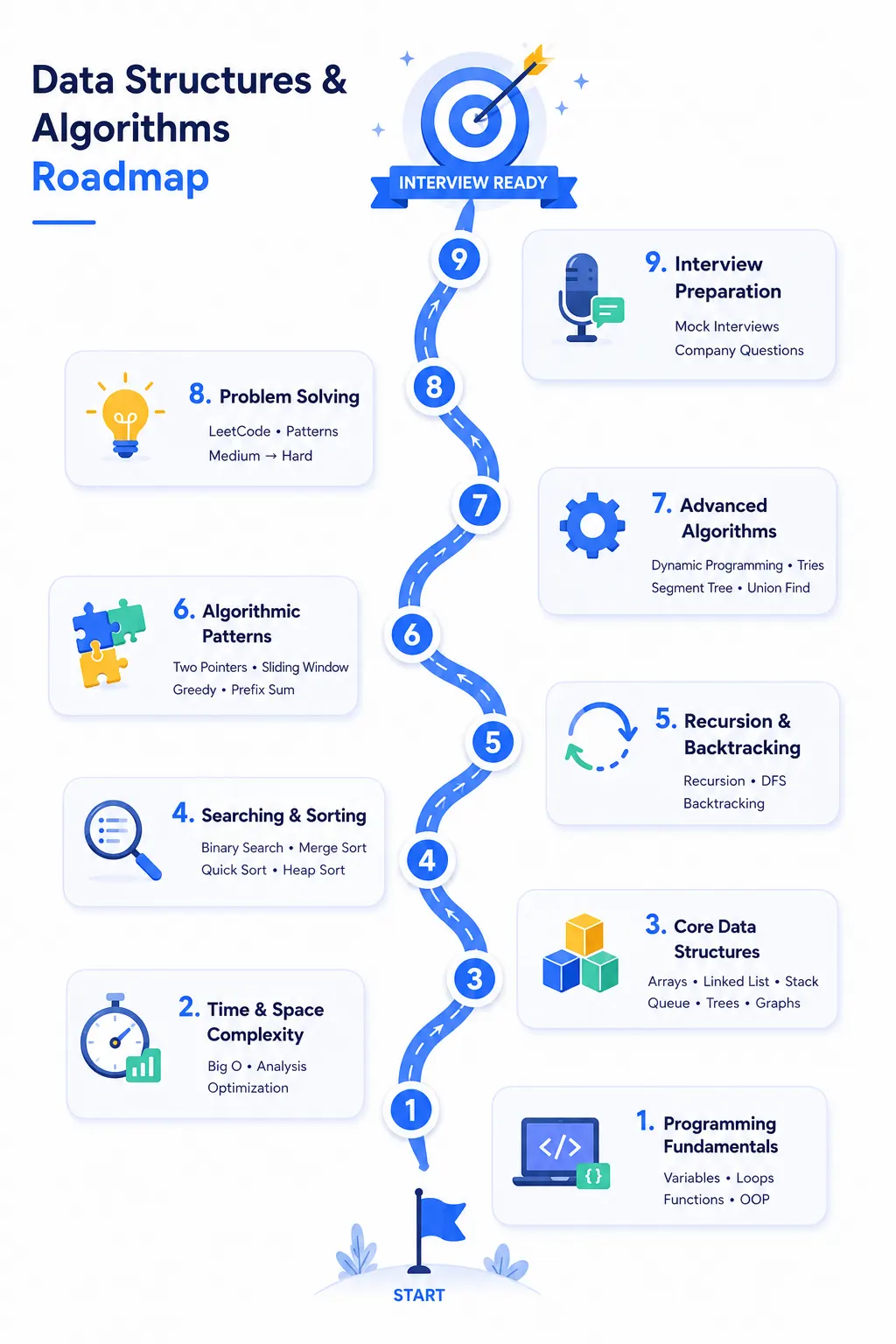
For placement preparation, separate three related but different areas:
-
Placement coding / online assessments
Python fundamentals, DSA, complexity analysis, and timed problem solving.
This course will build this stream explicitly. -
Placement interview theory
Computer Networks, DBMS, Operating Systems, OOP concepts, and the ability to explain projects.
Your current Computer Networks course contributes here. -
Core ECE technical preparation
Control Systems, Digital Design, Communications, Microcontrollers, circuits, and related subjects.
GATE preparation often reinforces this category.
A placement-preparation guide from GeeksforGeeks lists data structures and algorithms as a central interview subject, while also naming Computer Networks among the CS subjects worth preparing. Use that distinction: DSA is coding practice; Networks is usually interview theory.
A Step by Step Guide for Placement Preparation | Set 1 - GeeksforGeeks
Read the short overview from GeeksforGeeks to distinguish programming language fluency, DSA, and Computer Networks as different elements of software-placement preparation.
In the opening numbered list, read items 2 through 4: “Programming Language,” “Subject basics,” and “Other important CS subjects.” Focus on the statement that DSA is central, then compare it with the separate mention of DBMS, Operating System, and Computer Networks. For your plan, record DSA as active coding practice and Computer Networks as interview-theory preparation.
This distinction matters because a week with many Computer Networks lectures does not mean you should cancel DSA. It means your placement-related effort may be partly covered by Networks, while Python/DSA remains a separate small but consistent commitment.
What “college-only” really means
“College-only” should not be read as “unimportant.” It means:
This work is necessary for marks or course completion, but it does not create a strong direct gain for GATE ECE or placement coding.
Usually, this label applies more precisely to tasks inside a subject than to an entire subject.
Examples from your semester:
| Task | Suggested label | Why |
|---|---|---|
| Deriving a closed-loop transfer function in Control Systems | G + C | Directly supports GATE and semester learning |
| Completing a Control Systems assignment in your college’s required format | C, plus the underlying concept may be G | Formatting earns marks; concept creates long-term value |
| Simplifying a Boolean expression using a Karnaugh map | G + C | Explicit GATE Digital Circuits content |
| Debugging a VHDL test bench for a lab demonstration | C + core-skill | Useful design practice, but not direct DSA or typical GATE syntax content |
| Writing C code to configure a simulated GPIO register | P applied coding + C | Builds embedded C skill and supports the lab |
| Studying an 8051-specific peripheral diagram | C, with possible G partial foundations | Device details may be college-specific; registers/instructions support broader understanding |
| Learning image histogram operations for a DIP practical | C + P project bridge | Not direct GATE EC content, but useful for a Python project |
| Revising TCP/IP layers and routing concepts | P interview theory + C | Relevant to placement discussions and your course, not direct GATE EC coverage |
This is why you should classify at two levels:
- Subject level: what long-term tracks the course broadly supports.
- Task level: whether today’s particular activity creates GATE, coding, placement, or only semester value.
Build your one-page subject map
Take 10 minutes after this lesson to make a page in a notebook, spreadsheet, or notes app with three columns:
| GATE ECE | Placement / coding | College-specific execution |
|---|---|---|
| Control Systems | Python and DSA practice | Lab records and submissions |
| Antenna and Wave Propagation | Computer Networks interview basics | Internal-test-specific units |
| DSD theory | Microcontroller C and bit masks | VHDL test benches and simulations |
| Digital Communications | DIP Python project work | Assignment formatting and viva preparation |
| Digital-design theory |
Then add the actual topics you are studying this week. For example:
- “Routh stability criterion” goes under GATE ECE and college work.
- “Python variables and input/output” goes under placement coding.
- “DIP practical record due Thursday” goes under college-specific execution, while its image-processing logic can also be noted as project material.
- “Computer Networks: OSI model” goes under placement interview theory and college work.
Do not turn these labels into hours yet. The next lesson will use this map, your weekly capacity, and any approaching deadlines to decide what receives high, medium, or maintenance-level attention.
Key takeaways
Your semester is not seven separate obstacles. It contains several bridges:
- Direct GATE overlap: Linear Control Systems, Antenna and Wave Propagation, DSD theory, and Digital Communications.
- Partial GATE plus applied coding overlap: Microcontrollers.
- Placement interview overlap: Computer Networks.
- Project-oriented coding overlap: Digital Image Processing.
- College-specific tasks: lab records, submission formats, device-specific details, and internal-exam requirements.
Keep the distinction between DSA coding, placement interview theory, and core ECE knowledge clear. Microcontroller C and VHDL are worthwhile technical skills, but they do not replace deliberate Python and DSA practice.
Next, you will use this overlap map to assign weekly priority levels to college work, GATE preparation, DSA practice, and coding projects.