Hello again. In the previous lesson, you separated your week into fixed commitments, deadlines, flexible study blocks, and recovery time. That classification is the input for today’s calculation: only after classes, labs, travel, meals, sleep, and real life are visible can you know how much study time you actually have.
This lesson helps you turn a changing college timetable into a realistic weekly number. The aim is not to fill every blank square with GATE, DSA, or coding. It is to identify your gross usable time, deliberately reserve a buffer, and commit only the remaining time as your study capacity.
Capacity is not the same as empty time
A timetable may show several “free” hours between lectures, but not all of them are useful study capacity. Some of that time is needed for travel, lunch, recovering after a lab, preparing for the next class, laundry, or simply being a person rather than a machine.
Use three separate quantities:
| Quantity | Meaning | Can you schedule study into it now? |
|---|---|---|
| Gross study windows | Time that appears usable after fixed commitments and essential recovery | Possibly |
| Buffer time | Intentionally blank capacity for delays, urgent tasks, fatigue, and underestimated work | No—leave it open |
| Committed study capacity | The time you can responsibly assign to college, GATE, DSA, or coding | Yes |
The relationship is:
For example, suppose a week appears to offer hours of potential study time. Planning all hours assumes:
- every class ends on time;
- no lab runs over;
- every task estimate is accurate;
- you remain equally focused each evening;
- no surprise quiz, group meeting, illness, travel issue, or family responsibility appears.
That is not a plan; it is a best-case fantasy. A sustainable plan might reserve hours as buffer and commit only:
The hours are your weekly study capacity. The hours are not wasted. They are what prevents one difficult Tuesday from ruining the entire week.
Start with a calendar, not a target number
It is tempting to decide, “I will study 4 hours every weekday and 8 hours each weekend day.” That may be a useful aspiration, but it becomes meaningful only after you check it against the current week’s timetable.
The Stanford Center for Teaching and Learning recommends treating a calendar as a flexible decision-making tool: plan realistically, overestimate task duration, and retain blank space rather than scheduling continuous work.
Weekly Planning: Time Blocking Method | Center for Teaching and Learning
Read Stanford Center for Teaching and Learning’s “Weekly Planning: Time Blocking Method.” It gives a practical order for mapping commitments before attempting to place study work, and it makes the case for visible buffer time.
In the opening guidance beneath “Main content start,” read the planning principles, ending just before the numbered tips conclude. Focus especially on being realistic, moving work when circumstances change, and leaving blank time. Then, under “A step-by-step time blocking example,” review Steps 1–4: personal non-negotiables come first, followed by classes, appointments, and a separate list of work to do. Finally, read the final step to see why broad tasks should be made concrete before estimating them.
The order matters:
- Recovery and life maintenance: sleep, meals, hygiene, exercise, travel, and important personal commitments.
- Fixed commitments: lectures, labs, tutorials, appointments, scheduled tests, and meetings.
- Usable study windows: genuinely open periods that remain.
- Buffer: time intentionally kept blank.
- Committed capacity: only the remainder.
A deadline itself does not take hours from the calendar. “DIP assignment due Sunday” is a date. But the work required before Sunday absolutely does consume capacity, so it must fit inside your committed study hours.
Mark usable windows accurately
Use a weekly view with 30-minute slots. The blank weekly planner below is suitable for this calculation because it makes short gaps and long uninterrupted blocks easy to see.
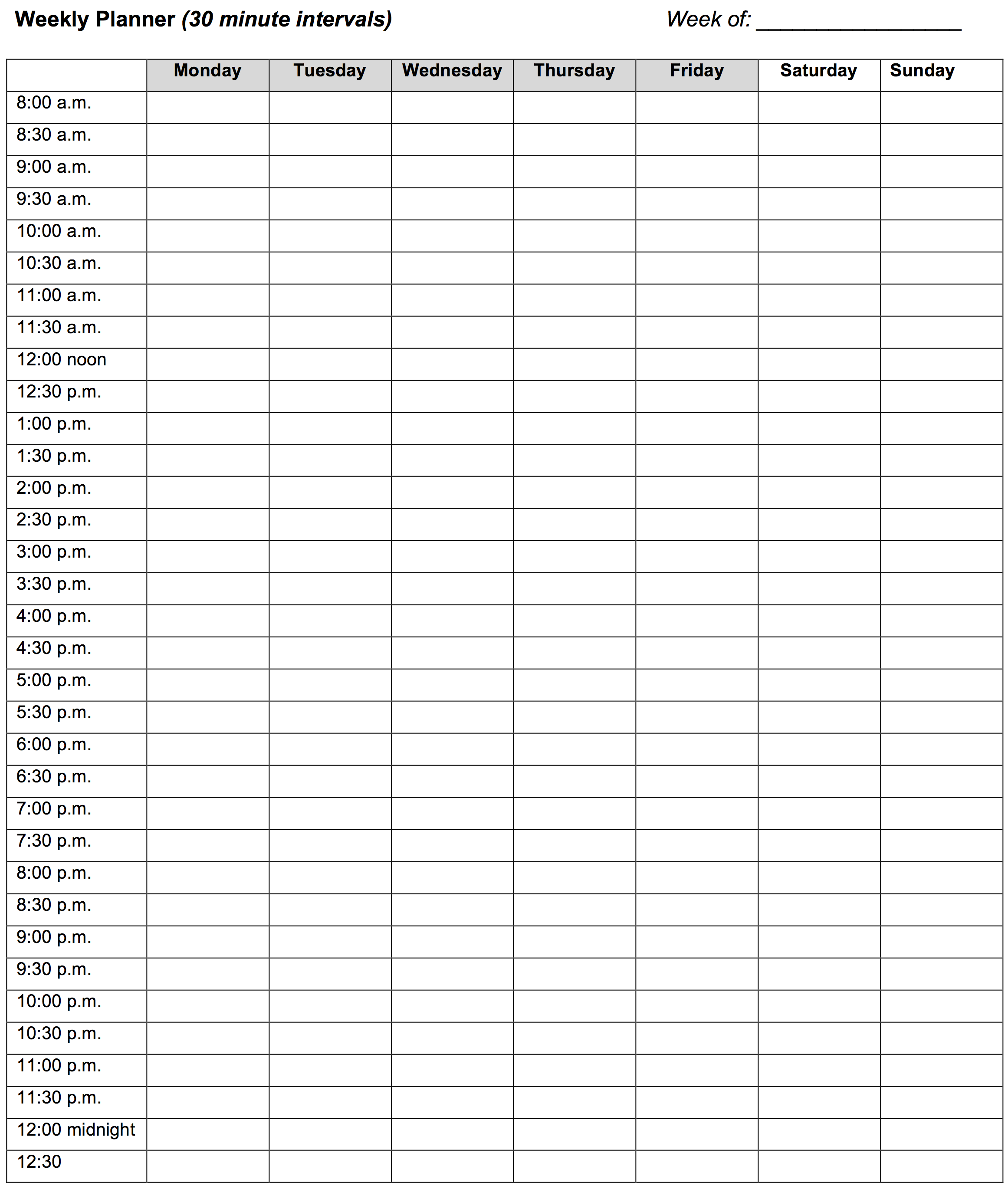
For the coming week, enter the actual version of your timetable, not the usual one. Check college notices, subject groups, and lab schedules for changes such as:
- a rescheduled DSD/VHDL lab;
- an extra Control Systems tutorial;
- a Digital Communications quiz;
- a group-project meeting;
- travel home for the weekend;
- a placement test or coding contest.
Then look at each open period and decide whether it qualifies as a usable study window.
A window counts when it is genuinely usable
A period is a candidate study window when it is:
- free of fixed commitments;
- long enough to begin and finish a meaningful study session;
- not needed for travel, food, sleep, or recovery;
- realistically available at your likely energy level.
For example, if a lecture ends at 1:00 p.m., your next class begins at 2:00 p.m., and it takes 15 minutes to reach the canteen, that is not a full uninterrupted hour of study. It may contain a short review opportunity, but it should not be counted as a full deep-work block for difficult GATE mathematics or a new DSA topic.
A useful practical rule is:
| Open period | Count it as |
|---|---|
| Less than 30 minutes | Transition or break; do not count it as study capacity |
| 30–45 minutes | Light-work fragment: formula review, flashcards, reading notes, debugging one small program |
| 60–90 minutes | A full study block |
| More than 90 minutes | Potentially strong capacity, but include a break rather than treating it as uninterrupted focus |
This distinction is particularly useful for your current situation. A 90-minute weekend session may be a good place for learning Python or solving a beginner DSA problem. A 30-minute gap after an ECE lecture is better reserved for reviewing that lecture’s key ideas, organizing notes, or resting before the next commitment.
Calculate the week in three passes
Do not begin by assigning “GATE on Monday” or “DSA on Tuesday.” First calculate the total.
Pass 1: Total your gross study windows
For each day, add only the realistic study windows you identified.
Here, is the usable study-window time on a given day.
Suppose this week roughly matches the availability you described:
| Day type | Usable study-window estimate | Number of days | Weekly total |
|---|---|---|---|
| Weekday | hours | hours | |
| Weekend day | hours, using the midpoint of your – hour range | hours | |
| Gross study windows | hours |
This does not mean you should promise yourself hours of completed work. It means that, after your initial timetable check, the week contains approximately hours that could be used for study.
If Saturday is actually occupied by a family commitment for two hours, or a Friday lab expands unexpectedly, reduce the relevant day’s number. Do not pretend the original estimate still applies.
Pass 2: Reserve buffer before allocating work
For a normal college week, start by keeping roughly of gross study windows uncommitted. When the week has several uncertainties—practicals, quizzes, project submissions, travel, or poor sleep—use closer to .
For a -hour gross week:
Round up, not down:
Then:
A good initial interpretation is therefore:
“This is a 27-hour committed-study week with about 7 hours held in reserve.”
Stanford’s guidance suggests aiming for substantial blank space—up to 15 hours across the entire weekly calendar. That broader blank space can include free evenings, personal time, and unassigned time outside your study windows. Your study buffer is the portion of your potentially available study time that you consciously refuse to pre-fill.
Pass 3: Test the number against the week’s uncertainty
Before accepting your capacity estimate, run three quick checks:
- Timetable check: Did you include every known lecture, lab, tutorial, test, commute, and appointment?
- Recovery check: Are sleep, meals, and at least some genuine downtime protected rather than assumed to be optional?
- Uncertainty check: Is the buffer larger in a week with submissions, vivas, practicals, or changing class schedules?
If your gross calculation is hours but the week includes a Friday placement test and a major Digital Image Processing submission, committed hours may still be too ambitious. Keep the buffer intact and lower the planned workload rather than trying to reclaim every spare hour.
A changing timetable changes capacity—not your self-worth
Capacity should be recalculated each week because your ECE semester is not uniform. One week may have a Microcontrollers record submission; another may be quiet except for classes; an exam week will look different again.
Imagine these changes occur after you first calculate a -hour gross week:
- an extended VHDL lab consumes extra hours;
- a group meeting for a Networks assignment uses hour;
- Saturday travel reduces usable time by hour.
Your revised gross study windows become:
If you retain a -hour buffer, your revised committed capacity is:
Round this down when planning:
The correct response is not to squeeze five missed hours into already demanding evenings. It is to acknowledge that this is a 23-hour study week and choose work that fits. Some lower-priority tasks will need to move, be shortened, or wait.
This is the central habit: when fixed commitments increase, planned study capacity decreases unless you consciously make a trade-off elsewhere.
Keep buffer visible and protected
Buffer fails when it exists only as a vague thought such as “I can catch up sometime.” Put it on the planner as blank space or mark it lightly as “Buffer / catch-up.” Do not label it “GATE backlog” or “extra DSA problems,” because then it has already been spent.
The following short segment shows a practical version of the same logic: place fixed commitments first, estimate difficult work realistically, and retain room for unexpected demands.
My weekly planning routine (college student edition)
Watch “My weekly planning routine (college student edition)” by The Bliss Bean for a concise explanation of estimating work, placing demanding tasks thoughtfully, and preserving capacity for work that appears unexpectedly.
Watch time blocking, where fixed commitments are mapped first and demanding work is placed after estimating its duration. Then watch buffer advice, which explains why time estimates improve through observation and why unassigned time is necessary for sudden academic work and everyday tasks.
A buffer has only two valid uses:
- Absorb a disruption: a class runs late, an assignment takes longer, a group member needs a meeting, or you are too tired to do difficult work as planned.
- Optional end-of-week use: if it remains untouched, use a small part for low-pressure revision, catching up, or rest.
It should not become a hidden promise to study seven additional hours every week.
Your weekly capacity audit
Set aside about 15 minutes at the end of the week or on Sunday before classes begin. Use the same procedure every week.
- Write the dates of the coming Monday–Sunday week on your planner.
- Add all fixed college commitments and one-off changes.
- Add sleep, meals, travel, exercise, and important personal commitments.
- Mark usable study windows in each day.
- Add their duration to obtain , your gross study windows.
- Reserve a buffer of roughly , rounded upward; increase it for unusually uncertain weeks.
- Write the result prominently:
For your initial baseline, if your real timetable supports roughly 4 usable hours on weekdays and 6–8 on each weekend day, expect a committed range around 25–27 hours rather than an assumed hours of perfectly productive study. That is still substantial capacity—but it is capacity you have a chance of sustaining.
For the first two weeks, make a small note whenever your plan changes:
- What changed? Lab overran, assignment underestimated, fatigue, travel, distraction, surprise quiz.
- How much time did it cost?
- Did buffer absorb it, or did planned work spill over?
This record will gradually replace guesses with your own data.
Key takeaways
A realistic weekly study plan begins with a current timetable, not a motivational target.
- Gross study windows are genuinely usable periods after fixed commitments and essential recovery.
- Buffer time is deliberately blank capacity for disruptions and underestimated work.
- Committed study capacity is the remainder after buffer is removed.
- With roughly gross available hours, reserving hours of buffer gives about committed study hours.
- When classes, labs, tests, or personal responsibilities expand, reduce your capacity calculation rather than forcing the original plan to survive.
Next, you will classify your current-semester subjects—Control Systems, Digital Communications, DSD/VHDL, Microcontrollers, and others—by how they overlap with GATE ECE, placement coding, and college-only requirements.