Welcome back. In our last two lessons, we built the Support Vector Machine from the ground up. We started with the core idea of finding a maximum-margin hyperplane, introduced the soft-margin concept to handle noisy data, and then unlocked the algorithm's true power with the kernel trick for solving non-linear problems.
Now that you have a solid understanding of how SVMs work, it's time to address a crucial question for any practitioner: when and why should you use one? This lesson focuses on a critical evaluation of the SVM algorithm. We will systematically explore its key strengths and weaknesses, giving you the knowledge to make informed decisions about its suitability for different machine learning tasks.
Recapping the Core SVM Concepts
Before we dive into the pros and cons, let's quickly recall the fundamental components of an SVM.

As we've discussed, SVMs aim to find this optimal hyperplane. For data that isn't perfectly separable, the soft-margin (C parameter) allows for some misclassifications. And for non-linear data, the kernel trick maps the data to a higher dimension to find a linear separator there, which corresponds to a non-linear boundary in the original space.
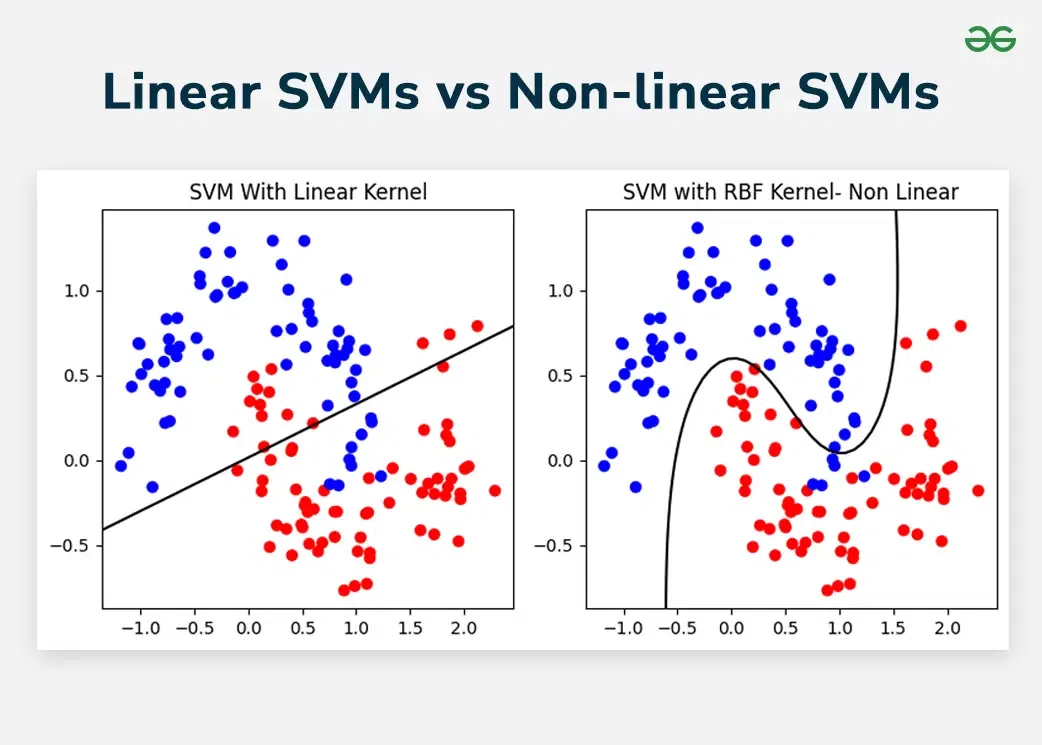
With these concepts in mind, let's analyze the practical implications.
Strengths of Support Vector Machines
SVMs are a popular and powerful algorithm for several compelling reasons. We'll explore the most significant ones, many of which are summarized in the "Advantages" section of the GeeksforGeeks article on SVMs.
Support Vector Machine (SVM) Algorithm
This section provides a concise list of the primary advantages of using SVMs.
Please read the list under the heading "Advantages of Support Vector Machine (SVM)". We will discuss these points in more detail below.
As you just read, SVMs have several key strengths:
-
Effective in High-Dimensional Spaces: One of the most celebrated features of SVMs is their performance in high-dimensional spaces. This is particularly relevant in fields like bioinformatics or text classification, where you might have thousands of features. The reason for this effectiveness is subtle but important: the complexity of the trained SVM model depends on the number of support vectors, not the number of features. Even if you have a vast feature space, if the separating boundary can be defined by a relatively small number of support vectors, the model remains effective and can avoid overfitting.
-
Memory Efficiency: This is a direct consequence of the previous point. Since the decision function is defined only by the support vectors, we only need to store these specific data points to make predictions. For a large dataset where the number of support vectors is a small fraction of the total data, this makes the trained model very memory-efficient compared to algorithms that might require retaining the entire dataset.
-
Versatility with Kernels: As we saw in the last lesson, the kernel trick is the SVM's superpower. The ability to use different kernels (Linear, Polynomial, RBF, etc.) makes SVMs highly flexible. The RBF kernel, in particular, is capable of creating arbitrarily complex decision boundaries, making it a strong general-purpose choice when you don't have prior knowledge about the data's geometric distribution.
-
Robustness to Outliers (Soft Margin): The original "hard-margin" classifier was extremely sensitive to outliers. A single outlier could drastically change the decision boundary. By introducing the soft-margin slack variables and the regularization parameter
C, SVMs can gracefully handle outliers by allowing some points to be misclassified or to fall within the margin. This makes the model more robust and better at generalizing to new, unseen data.
Weaknesses of Support Vector Machines
No algorithm is perfect, and SVMs have notable drawbacks that you must consider. A poor choice of algorithm or improper setup can lead to suboptimal results. The same GeeksforGeeks article also provides a good summary of these limitations.
Support Vector Machine (SVM) Algorithm
This section lists the main disadvantages of SVMs, which are critical to understand for practical application.
Now, read the list under the heading "Disadvantages of Support Vector Machine (SVM)".
Let's unpack these weaknesses, paying special attention to the most critical one for implementation.
1. Crucial Weakness: Sensitivity to Feature Scaling
This is arguably the most important practical consideration when using SVMs. As the article states, "Proper feature scaling is essential." Let's understand why.
The SVM algorithm is based on calculating distances between data points to find the maximum margin. The RBF kernel, , is explicitly based on the Euclidean distance between points. If your features are on vastly different scales (e.g., one feature ranges from 0 to 1, and another from 0 to 10,000), the feature with the larger range will completely dominate the distance calculation. The algorithm will effectively ignore the feature with the smaller scale, leading to a poor-quality model.
Therefore, before training an SVM, it is imperative that you scale your features. The two most common methods, which you've seen before, are standardization (Z-score scaling) and normalization (min-max scaling). Given your background, you'll recognize the importance of ensuring all inputs to a distance-based function are on a comparable scale.
The following article provides an excellent explanation and a practical demonstration of this exact issue.
Why Feature Scaling in SVM? | Baeldung on Computer Science
This Baeldung article explains and demonstrates why feature scaling is non-negotiable for SVMs.
First, read the introduction in Section 1 and 2 to understand the theoretical reason for scaling. Next, follow the Python example. Look at the results without scaling in Section 3, where the accuracy is around 75%. Finally, see the dramatic improvement in Section 4, where applying a StandardScaler boosts accuracy to 98%. Pay attention to how the number of support vectors also changes, indicating a completely different model was found.
2. Computational Complexity and Training Time
SVMs can be very slow to train on large datasets. The training complexity is often polynomial in the number of samples, typically between and , where is the number of samples. This makes them less suitable for datasets with hundreds of thousands or millions of samples, where algorithms like Logistic Regression, Naive Bayes, or tree-based ensembles (like LightGBM) would be much faster.
3. Parameter Tuning and Interpretability
SVMs are not a "plug-and-play" algorithm. Performance is highly dependent on the choice of kernel and the tuning of its hyperparameters. For an RBF kernel, you must carefully tune both the regularization parameter C and the kernel coefficient gamma.
Ccontrols the trade-off between a smooth decision boundary and correctly classifying training points.gammadefines the influence of a single training example.
Finding the optimal combination often requires an exhaustive search (e.g., Grid Search) with cross-validation, which can be computationally expensive. Furthermore, the resulting model, especially with an RBF kernel, is a "black box." Unlike a linear regression model where you can inspect coefficients or a decision tree that you can visualize, it's very difficult to interpret why an SVM made a particular prediction.
Summary: When to Use SVMs
Here is a quick reference table to consolidate these points.
| Characteristic | Strength / Weakness | Implication & When to Consider |
|---|---|---|
| Dimensionality | Strength: Effective in high-dimensional spaces. | Use for problems with many features, such as text classification (bag-of-words) or bioinformatics. |
| Dataset Size | Weakness: Computationally expensive for large numbers of samples. | Avoid for very large datasets (>100k samples). Prefer for small to medium-sized datasets where training time is acceptable. |
| Non-linearity | Strength: Kernel trick provides great flexibility for non-linear boundaries. | An excellent choice for complex classification problems where a linear boundary is insufficient. RBF is a good default. |
| Interpretability | Weakness: Models (especially with RBF kernel) are difficult to interpret. | Avoid when you need to explain the model's decisions. Prefer models like Logistic Regression or Decision Trees for that. |
| Feature Preprocessing | Weakness: Highly sensitive to the scale of features. | Always apply feature scaling (Standardization or Normalization) before training an SVM. |
| Outliers | Strength: Soft-margin formulation provides robustness to outliers. | A good choice for datasets that may contain some noise or anomalous data points. |
| Parameter Sensitivity | Weakness: Performance is very sensitive to C and kernel (gamma) parameters. |
Always plan to perform hyperparameter tuning using cross-validation to find the optimal settings. |
Conclusion
You now have a balanced view of the Support Vector Machine algorithm. You know its strengths—effectiveness in high dimensions, memory efficiency, and flexibility via kernels—and are also aware of its significant weaknesses, particularly its sensitivity to feature scaling and its computational cost on large datasets. This knowledge is crucial for moving from a theoretical understanding to effective practical application.
Key Takeaways:
- Strengths: SVMs excel in high-dimensional spaces, are memory-efficient, and can model complex non-linear relationships using kernels. The soft-margin formulation makes them robust to outliers.
- Weaknesses: SVMs are slow to train on large datasets, their predictions are hard to interpret, and performance is highly dependent on hyperparameter tuning.
- The Golden Rule: You must scale your features before training an SVM. Failure to do so will almost certainly result in a poor model.
In our next lesson, we will put this all together. You will apply an SVM classifier to a real-world dataset, where you'll have to perform the necessary preprocessing (including scaling!) and experiment with different kernels and hyperparameters to see these concepts in action.