Hello! In our last lesson, we developed a framework for choosing the right clustering algorithm, noting that methods like DBSCAN can struggle in high-dimensional spaces. This observation opens up a fundamental question in machine learning: what exactly happens when we have a lot of features, and why is it a problem?
This lesson addresses that question directly. We will explore a concept known as the curse of dimensionality. You will learn about the counter-intuitive properties of high-dimensional spaces, understand why our low-dimensional intuition fails us, and see how these properties negatively impact the performance and reliability of machine learning algorithms. This will establish a crucial foundation for understanding why techniques for dimensionality reduction are not just useful, but often necessary.
The Core Problem: An Exponential Need for Data
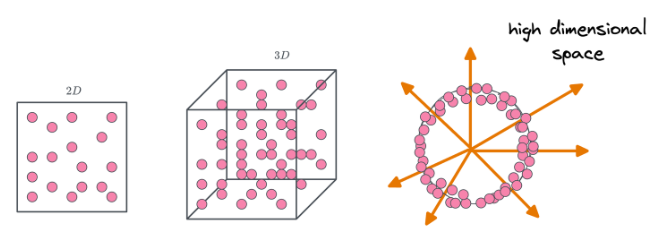
At its heart, the curse of dimensionality refers to the exponential growth in the volume of space as you add more dimensions (features). To build a reliable model, your training data needs to adequately "cover" this feature space. As the space expands, the amount of data required to maintain the same level of coverage explodes.
The following video from Georgia Tech provides a classic and highly intuitive explanation of this core problem.
Curse of Dimensionality Two - Georgia Tech - Machine Learning
Watch this video to build an intuition for why data requirements grow exponentially with dimensionality. The instructors use a simple analogy of covering a line, then a square, then a cube with a fixed number of data points.
Please watch the entire video. Pay close attention to the central argument: Covering a 1D line: To cover a 1D line segment with a certain resolution, you need 10 points. Extending to 2D: To achieve the same resolution or "coverage diameter" in a 2D square, you now need 10^2 = 100 points. The exponential curse: This pattern continues. A 3D cube requires 10^3 = 1000 points, and a D-dimensional hypercube requires 10^D points. General ML problem: The video concludes by emphasizing that this is a fundamental problem for machine learning in general, not just a specific algorithm. The term was coined by Richard Bellman.
This exponential requirement means that for a dataset with many features, it becomes practically impossible to collect enough data to achieve dense coverage of the feature space. Your data points become isolated islands in a vast, empty ocean. This is known as data sparsity.
The Strange Geometry of High-Dimensional Space
The exponential expansion of volume leads to several geometric properties that defy our 3D intuition. Understanding these is key to grasping the full impact of the curse. The article "Curse of Dimensionality: An Intuitive Exploration" provides a great overview of these phenomena.
Curse of Dimensionality: An Intuitive Exploration
This article will walk you through the key challenges that arise from high dimensionality, including data sparsity and the breakdown of distance metrics. It also provides a satisfying mathematical intuition for why these things happen.
Please read the following parts of the article: Start with the introduction and the section on Data Sparsity. This reinforces the concept we've just discussed. Next, read the section Distance Metric Problems. This introduces the critical idea that distance itself becomes less meaningful. Finally, read the section that explains why this happens: the reasoning behind equidistant points. Focus on the connection to the Law of Large Numbers and the concept of vectors becoming "almost orthogonal."
Let's break down two of the most significant consequences discussed in the reading.
1. Most of the Volume is in the Corners
In two or three dimensions, a ball or sphere inscribed inside a box or cube takes up a significant portion of the volume. In high dimensions, this is no longer true. The volume of an inscribed hypersphere approaches zero relative to the volume of the containing hypercube. This means that almost all of the volume is concentrated in the "corners" of the hypercube. For your data, this implies that most data points will live in the outer regions of the data distribution, far from the center.
2. Distance Concentration
As you just read, perhaps the most counter-intuitive property is that in high dimensions, the distances between pairs of randomly chosen points become almost identical. The distinction between the "nearest" neighbor and the "farthest" neighbor vanishes.
This happens because the Euclidean distance calculation involves summing squared differences across many dimensions. Given your background in probability, you can think of this in the context of the Law of Large Numbers. Each squared difference is like a random variable; as you add more and more of them (i.e., increase dimensions), their sum (and thus the distance) converges toward an expected value with decreasing relative variance. Consequently, all distances start looking alike.
The Practical Consequences for Machine Learning
These geometric oddities are not just mathematical curiosities; they have severe, practical implications for machine learning algorithms. The mind map below provides a great summary of the problems that arise.

Let's focus on the most critical impacts, using the comprehensive analysis from the Domino Data Lab blog post.
Curse of dimensionality: Challenges & impact in high ...
This article uses simulations to demonstrate four destructive properties of high-dimensional data. The visualizations of algorithm failure are particularly powerful.
Focus on the following three "properties" and their simulated impacts: Property 1: Read the section Points move far apart. Notice how adding noisy dimensions completely destroys the clusters that were obvious in 1D. This directly relates to our previous lessons on clustering. Property 3: Read the section Distances become the same. Pay close attention to the plot showing the relative difference between max and min distance converging to zero. The simulation showing the k-NN error rate approaching 50% (random guessing) is a stark warning. Property 4: Read the section Model accuracy approaches 100%. This demonstrates the danger of overfitting. The example of a model learning to "predict" even vs. odd rows from purely random data is a classic illustration of how models can find spurious patterns in high-dimensional noise.
Synthesizing these points, we can identify three major consequences:
-
Failure of Distance-Based Algorithms: Algorithms that rely on the concept of "nearness," such as K-Nearest Neighbors (kNN), DBSCAN, and to some extent K-Means, fundamentally break down. If all points are roughly equidistant from each other, the concept of a "neighborhood" becomes meaningless. As the Domino Data Lab article showed, a k-NN classifier's performance can degrade to that of a random guess.
-
Overfitting and Spurious Patterns: With so many features, a model has more degrees of freedom. This makes it dangerously easy for the model to find apparent "patterns" in the random noise of your training data that do not exist in reality. The model effectively memorizes the training set instead of learning a generalizable signal. The result is a model that performs exceptionally well on data it has seen before but fails miserably on new, unseen data.
-
Increased Computational Cost: This is a more obvious consequence. More dimensions mean more data to store and more calculations for the algorithm to perform during training. This leads to longer training times and higher memory usage, making model development slower and more expensive.
The Way Out: Dimensionality Reduction
So, how do we fight this curse? While collecting more data is always helpful, it's often impractical due to the exponential requirement. The primary strategy is dimensionality reduction.
The goal of dimensionality reduction is to project the data from its original high-dimensional space down to a lower-dimensional space while preserving as much of the relevant structure and information as possible.
There are two main families of techniques:
- Feature Selection: We identify and keep only the most relevant original features, discarding the rest.
- Feature Extraction: We create new, lower-dimensional features by finding combinations of the original features. These new features (or components) are designed to summarize the original data.
These methods help mitigate the curse by reducing sparsity, making distance metrics more meaningful, and lowering the risk of overfitting, all while reducing computational load.
Conclusion
In this lesson, you have explored the curse of dimensionality, one of the most fundamental challenges in machine learning. You've seen that as the number of features grows, our low-dimensional intuition breaks down, and the geometry of the feature space exhibits strange, counter-intuitive properties.
Key Takeaways:
- Exponential Data Requirement: To maintain constant data density, the number of required data points grows exponentially with the number of dimensions. This leads to data sparsity.
- Distance Concentration: In high-dimensional spaces, the distances between all pairs of points tend to become nearly equal, making distance-based concepts like "nearest neighbor" lose their meaning.
- Practical Consequences: The curse of dimensionality directly leads to the failure of distance-based algorithms (like kNN and DBSCAN), a high risk of overfitting as models learn spurious patterns, and increased computational cost.
- The Solution: The primary way to combat the curse is through dimensionality reduction, which aims to represent the data with fewer features while preserving important information.
What's Next:
Now that you understand why dimensionality reduction is so important, we will begin exploring how to do it. In the next lesson, you will learn about the most widely used dimensionality reduction technique: Principal Component Analysis (PCA). You will understand how it works to find the directions of maximum variance in the data and use them to create a lower-dimensional representation.