Hello! Welcome to the next lesson in your journey to becoming a skilled ethical hacker.
In the last lesson, you brought your virtual hacking lab to life by confirming that your Kali Linux attacker VM and your Metasploitable2 target VM can communicate. With that crucial step complete, your lab is now fully operational and ready for action.
Today, we take our first step into the actual process of a penetration test. This lesson covers the foundational first phase: Reconnaissance. You will learn to distinguish between passive and active reconnaissance and, most importantly, understand the critical legal and ethical boundaries that separate a professional from a criminal. This is a vital, theory-focused lesson that lays the groundwork for all the hands-on hacking you'll do later.
1. The Hacking Lifecycle: What is Reconnaissance?
Every professional penetration test, and indeed every sophisticated attack, follows a structured methodology. Reconnaissance is always the first phase.
Think of it like a military operation. You wouldn't launch an assault without first scouting the terrain, identifying the enemy's strengths and weaknesses, and mapping out potential entry points. In cyberspace, this scouting process is called reconnaissance, or "recon." It's the information-gathering phase where you learn as much as possible about your target.
The image below shows the general steps of an ethical hack. As you can see, reconnaissance is step one, but the most important element on the slide is the one circled in red.
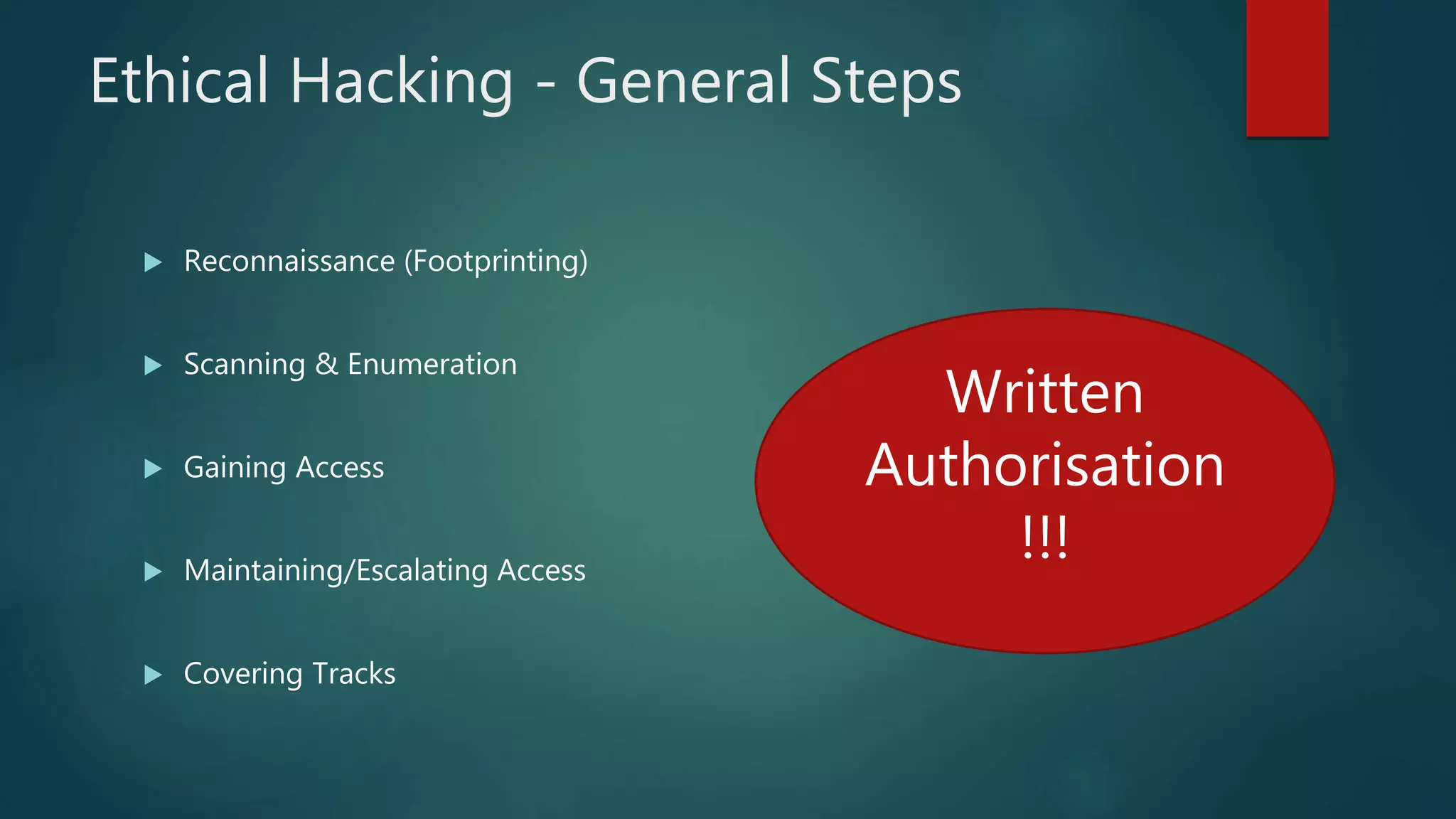
This concept of authorization is the dividing line in our work, and we will return to it shortly.
To get a quick overview of what the reconnaissance phase entails, watch this brief introductory clip.
Reconnaissance - SY0-601 CompTIA Security+ : 1.8
Professor Messer, a respected source for cybersecurity training, provides a concise introduction to the reconnaissance phase in this video.
Watch the first 41 seconds of the video. It clearly explains the purpose of reconnaissance: to footprint the target and understand its security posture before an attack.
Reconnaissance is broadly divided into two categories based on how you interact—or don't interact—with the target: passive and active.
2. Passive Reconnaissance: The Silent Observer
Passive reconnaissance is the art of gathering information without directly interacting with the target's systems. You are like a detective gathering clues from public records, news articles, and secondhand sources. The target has no idea you are gathering intelligence because your activities are indistinguishable from any other internet user's.
Reconnaissance - SY0-601 CompTIA Security+ : 1.8
Let's return to Professor Messer's video for a clear definition and examples of passive reconnaissance, which he calls 'passive footprinting'.
Watch from 00:57 to 04:04. Pay attention to the examples he gives: looking at corporate websites, social media, online forums, and using open-source intelligence (OSINT) frameworks.
To deepen your understanding, let's explore the methods, advantages, and disadvantages of this stealthy approach.
Breaking Down Active and Passive Reconnaissance
This article from Black Hat Ethical Hacking, 'Breaking Down Active and Passive Reconnaissance', provides an excellent written breakdown of the topic.
Please read the section titled 'Passive Reconnaissance Techniques'. Focus on the definition, the common methods, and the pros and cons listed under 'Advantages' and 'Disadvantages'.
In essence, passive reconnaissance involves using publicly available information. This includes:
- WHOIS databases: To find out who owns a domain and their contact details.
- Search engines (Google Hacking): To find sensitive documents or login pages that have been accidentally indexed.
- Social media and job boards: To learn about employees, technologies used, and internal project names.
- Public financial reports: For publicly traded companies, these can reveal details about business structure and key personnel.
This type of reconnaissance is low-risk, undetectable, and always your first move.
3. Active Reconnaissance: Knocking on the Door
Active reconnaissance involves directly interacting with the target's systems to gather information. You are no longer observing from afar; you are actively probing the target. This is like walking up to a building and checking which doors are unlocked, which windows are open, and what kind of locks are on the doors.
This direct interaction is "noisy" and can be logged and detected by security systems like Intrusion Detection Systems (IDS) and firewalls.
Red Team Reconnaissance Techniques
Now, let's watch two short clips that define active reconnaissance. Hearing the definition from two expert sources will help solidify the concept.
First, watch this clip from HackerSploit from 02:15 to 03:58. He clearly defines active recon and importantly mentions the need for permission.
Reconnaissance - SY0-601 CompTIA Security+ : 1.8
Next, let's see Professor Messer's take on active reconnaissance.
Watch from 04:04 to 04:58. He highlights that these actions are detectable and gives examples like ping scans and port scans.
Active reconnaissance provides much more detailed and accurate technical information. To explore this further, let's return to the article.
Breaking Down Active and Passive Reconnaissance
The Black Hat Ethical Hacking article also details the active approach.
Read the section titled 'Active Reconnaissance Techniques'. Again, focus on the definition, common methods, and the listed advantages and disadvantages.
Examples of active reconnaissance include:
- Ping sweeps: Using the
pingcommand (which you used in the last lesson) to see which hosts are online. - Port scanning: Using tools like
nmapto discover which network services (e.g., web servers, email servers) are running on a machine. - Vulnerability scanning: Using tools like
niktoorNessusto automatically check for known weaknesses in services.
Because you are touching the target's systems, this phase provides high-quality data but comes with significant risk and responsibility.
4. Side-by-Side Comparison
The best way to understand the difference is to compare them directly. The following image provides a fantastic summary of the key distinctions.

This next resource, a table from a research paper, offers another concise and structured comparison.
[PDF] Ethical Hacking: Techniques and Legal Implications
The paper 'Ethical Hacking: Techniques and Legal Implications' contains a useful table summarizing the two methodologies.
Review 'Table 1. Reconnaissance Methodologies and Technical Characteristics'. This provides a compact, academic summary of the techniques, the information obtained, and the detection status for both passive and active recon.
In a typical penetration test, you start with passive recon to build a broad map of the target, then use that information to conduct surgical, targeted active recon.
5. The Bright Red Line: Legal and Ethical Boundaries
This is the most important part of the lesson. Understanding this distinction is what makes you an ethical hacker.
- Passive Reconnaissance: Generally legal. The information you are gathering is public. This is akin to investigative journalism or market research.
- Active Reconnaissance: Illegal without permission. The moment you send a packet to a system you do not own and do not have explicit, written consent to test, you may be breaking the law (e.g., the Computer Fraud and Abuse Act in the US).
Your lab environment with Kali and Metasploitable2 is your safe sandbox. Here, you own all the systems, so you have permission to do whatever you want. You must never perform active reconnaissance on any system outside of your lab without getting permission first.
Breaking Down Active and Passive Reconnaissance
The Black Hat Ethical Hacking article has a dedicated section on this critical topic.
Read the section 'Legal and Ethical Considerations'. This clearly explains why consent is non-negotiable and discusses the ethics of active reconnaissance.
For a more formal view, the table below summarizes the key legal and ethical elements that govern our profession.
[PDF] Ethical Hacking: Techniques and Legal Implications
Let's refer back to the academic paper for a final summary of the legal and ethical framework.
Review 'Table 4. Legal and Ethical Framework Considerations'. This table outlines the importance of Authorization, a key statute (CFAA), Professional Ethics, and Responsible Disclosure.
The key takeaway is simple: Authorization is everything. In a professional engagement, this takes the form of a signed contract called a "Rules of Engagement" document, which explicitly defines what you are allowed to test, how, and when.
Conclusion
In this lesson, you've learned the fundamental theory of reconnaissance, the first and most critical phase of hacking. You now understand the "what" and, more importantly, the "why" behind how information is gathered.
Key Takeaways:
- Reconnaissance is the information-gathering phase of a penetration test.
- Passive Reconnaissance is stealthy, uses publicly available information, and does not involve direct contact with the target's systems. It is low-risk and generally legal.
- Active Reconnaissance is noisy, involves directly probing the target's systems, and provides detailed technical data. It is high-risk and is illegal without explicit, written authorization.
- The fundamental difference between an ethical hacker and a criminal is permission.
Next Lesson Preview:
Now that you understand the theory and the rules of the road, it's time to get your hands dirty. In the next lesson, you will perform your first passive reconnaissance exercises. You will learn how to use tools like whois and advanced Google search techniques (Google dorking) to gather intelligence on a target without them ever knowing you were there.