Hello! Welcome to your next lesson in cybersecurity.
In our last session, we discussed the CIA Triad (Confidentiality, Integrity, Availability), which answers the why of security—it defines what we are trying to protect. You learned that attackers aim to cause Disclosure, Alteration, or Denial (DAD) to break these principles.
Today, we shift from the why to the how. This lesson will equip you with the fundamental vocabulary used to describe the mechanics of an attack. We will cover the learning outcome: Define and differentiate between a vulnerability, an exploit, and a payload. Mastering these terms is non-negotiable for anyone serious about penetration testing, as they form the language of every attack you will study and perform from here on out.
1. The Building Blocks of an Attack
Every successful hack follows a logical pattern. It starts with a weakness, uses a method to take advantage of that weakness, and finally, performs a malicious action. These three steps correspond directly to our key terms: vulnerability, exploit, and payload.
Let's start by defining each one with a simple analogy before diving into technical details.
Threats Vulnerabilities and Exploits
This short video from IBM Technology uses a great analogy of a bank robbery to introduce these concepts. It provides a clear, high-level overview.
Please watch from 01:29 to 03:11. Focus on how the video defines a 'vulnerability' (a weakness like a glass window) and an 'exploit' (a tool or method like throwing a rock).
Now, let's formalize those definitions.
A. Vulnerability: The Flaw
As the video explained, a vulnerability is a weakness. In cybersecurity, it's a flaw in a system's design, implementation, or configuration that can be used by an attacker to compromise that system.
- Analogy: A crack in a castle wall, an unlocked door, or the glass window from the video.
- Technical Examples:
- A bug in a web server's software that doesn't properly check user input.
- An unpatched operating system missing critical security updates.
- A misconfigured firewall rule that allows unintended access.
- Using a default, well-known password like
adminfor a sensitive system.
For a more formal definition, let's turn to a textual resource.
Threats, Vulnerabilities, Exploits and Their Relationship to Risk
The F5 Labs article 'Threats, Vulnerabilities, Exploits and Their Relationship to Risk' provides concise, industry-standard definitions. We'll use it to clarify each term.
Read the short section titled 'Vulnerability'. It uses the story of the Three Little Pigs to illustrate the concept.
B. Exploit: The Method
An exploit is the specific method used to take advantage of a vulnerability. It can be a piece of code, a sequence of commands, or a specific technique.
- Analogy: The rock thrown through the glass window, the battering ram against the cracked wall, or the act of simply turning the knob on the unlocked door.
- Technical Examples:
- A script that sends a specially crafted string of characters to a web server to trigger a buffer overflow vulnerability.
- A command that leverages a misconfiguration in
sudoto gain root privileges. - The Metasploit Framework, which you'll learn about later, is a massive collection of exploits (as tools).
Let's refer back to the F5 article for its definition.
Threats, Vulnerabilities, Exploits and Their Relationship to Risk
Now, let's get the formal definition of 'exploit' from the same F5 article. Notice its dual meaning as both a verb (an action) and a noun (a tool).
Read the section titled 'Exploit'. Pay attention to how it defines the exploit as the tool and introduces the payload as what the tool delivers.
C. Payload: The Malicious Cargo
The payload is the part of the attack that actually performs the malicious action after the exploit has been successful. It's the ultimate goal of the attack.
- Analogy: The actions the robber takes after breaking the window and entering the bank—stealing money, accessing the vault, etc.
- Technical Examples:
- Code that opens a reverse shell, giving the attacker command-line access to the victim's machine.
- Ransomware that encrypts all the files on the victim's hard drive.
- Spyware that logs keystrokes or exfiltrates sensitive data.
- A script that adds a new administrative user to the system.
This final article provides an excellent, focused definition of a payload and a clear way to distinguish it from an exploit.
What is Payload in Cybersecurity?
This article from Huntress focuses entirely on the payload. It uses a fantastic analogy to differentiate it from an exploit.
First, read the introductory section 'What is a Payload in Cybersecurity?'. Then, jump to the section 'Difference Between Payload and Exploit'. The analogy of the thief picking the lock is a key takeaway.
2. The Attack Chain: How They Work Together
Now that we have defined the three components, let's visualize how they fit together in an attack sequence.
An exploit takes advantage of a vulnerability to deliver a payload.
This diagram shows the relationship: the exploit is the container that carries the payload, and it's aimed at a vulnerability in the target system.
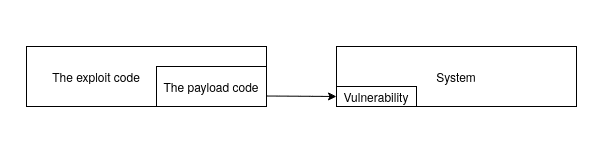
The following flowchart illustrates the typical process an attacker follows. This sequence should make the relationship between the terms very clear.

3. A Real-World Example: Log4Shell
Let's make this concrete with one of the most significant vulnerabilities of the last decade: Log4Shell (or Log4j). This was a vulnerability in a very common Java logging library.
The video below does an excellent job of breaking down a real Log4Shell attack string and identifying the exploit, the shellcode, and the payload.
How Hackers Exploit Software Vulnerabilities
This video from The CISO Perspective breaks down a real attack. It introduces a fourth term, 'shellcode,' which we'll clarify next. For now, focus on how the attack is built from distinct pieces.
Please watch the following segments: The Log4j Exploit (01:12 - 02:26): See how a single line of text contains the exploit and instructions for the next stage. Shellcode (04:19 - 05:14): Understand what the 'shellcode' part of the command does. Payload (05:53 - 06:28): See what the final payload is in this attack and how it achieves the attacker's goal.
Clarifying Exploit, Shellcode, and Payload
As you saw in the video, the terms can sometimes seem to overlap. Let's clarify the hierarchy, especially with the introduction of "shellcode."
- Vulnerability: The flaw in the Log4j library that allowed it to execute code from user-supplied text.
- Exploit: The specially formatted string
jndi:ldap://.... This is the tool that leverages the vulnerability. - Shellcode: In this context, the shellcode is a small, initial payload. Its job in the Log4j example was a simple PowerShell command to download another, larger file. Think of it as a "stage 1" payload. Its only purpose is to prepare the way for the main event.
- Payload: The final, "stage 2" payload. In the video's example, this was the crypto-mining trojan that the shellcode downloaded. This piece of malware accomplished the attacker's ultimate goal.
So, while shellcode is technically a type of payload, in multi-stage attacks, it's often useful to distinguish between the initial, lightweight shellcode and the final, feature-rich payload.
Conclusion
You've now learned the precise definitions and the critical relationship between the three core components of any cyberattack. Understanding this is fundamental to your journey in ethical hacking. When you analyze a system or a report, you can now dissect the attack into its constituent parts.
Key Takeaways:
- A Vulnerability is a weakness or flaw in a system.
- An Exploit is the code or technique that takes advantage of a vulnerability.
- A Payload is the malicious code delivered by the exploit that performs the desired action (e.g., stealing data, granting access).
- The attack sequence is: an exploit leverages a vulnerability to deliver a payload.
- In complex attacks, a small initial payload (shellcode) may be used to download a larger, final payload.
Next Lesson Preview:
With this essential vocabulary under your belt, you are ready to move from theory to practice. In the next module, we will begin by discussing the formal phases of a penetration test. You'll then get your hands dirty by setting up your own virtual hacking lab, complete with an attacker machine (Kali Linux) and a vulnerable target machine, preparing you for your first hands-on exercises in reconnaissance and scanning.