Hello! Welcome to your next lesson.
In our last few lessons, we've been deep in the practical side of things, building firewalls with iptables and inspecting network packets with Wireshark. We've been focused on the how. Today, we're taking a step back to understand the fundamental why behind all information security. This conceptual foundation is what separates a script kiddie from a security professional.
This lesson addresses the learning outcome: Explain the CIA triad (Confidentiality, Integrity, Availability) and how attacks target each principle. We will define these three core pillars of security and then explore how attackers systematically try to break them. Understanding this framework helps you think like a defender, which is essential for learning how to become an effective attacker.
1. Introduction to the CIA Triad
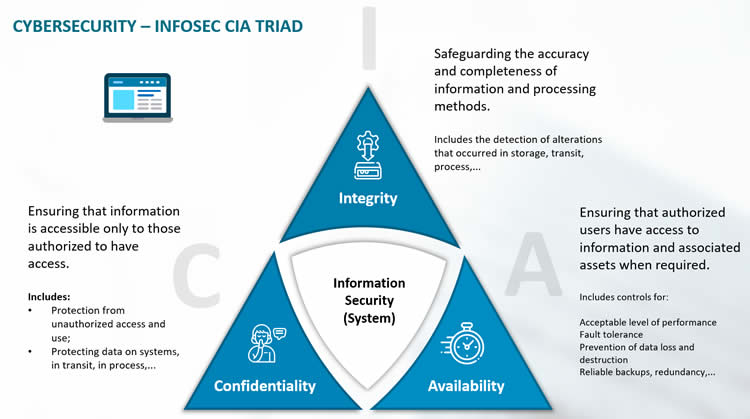
At the core of information security is a model known as the CIA triad. This isn't the intelligence agency; it's a framework that defines the three most critical goals for protecting information and systems.
- Confidentiality: Keeping secrets.
- Integrity: Ensuring information is trustworthy and has not been tampered with.
- Availability: Ensuring systems and data are accessible when needed.
Every security control you encounter, and every attack you will learn, is related to upholding or breaking one or more of these principles.
To start, let's get a comprehensive overview from a leading tech company. This video breaks down each component with excellent visuals and examples.
Cybersecurity Architecture: Fundamentals of Confidentiality, Integrity, and Availability
This video from IBM Technology provides a great introduction to all three principles of the triad. We will watch it in sections as we discuss each component.
First, watch the brief introduction from 00:10 to 00:17.
Now, let's dive into each principle one by one.
2. The Three Pillars
A. Confidentiality: Keeping Data Private
Confidentiality is about restricting access to information. It ensures that data is not disclosed to unauthorized individuals, programs, or processes. When an attacker steals a database of user passwords or a company's secret project files, they have breached confidentiality.
To see how this is achieved in practice, let's return to the video.
Cybersecurity Architecture: Fundamentals of Confidentiality, Integrity, and Availability
This segment of the IBM video explains how confidentiality is enforced using two main techniques: access control and encryption.
Watch from 00:17 to 03:54. Pay attention to the distinction between authentication ('Who are you?') and authorization ('What are you allowed to do?').
As the video explained, confidentiality is typically enforced through:
-
Access Controls: These are the rules and mechanisms that control who can access what.
- Authentication: Proving your identity, often with a password, a security key, or biometrics. Multi-factor authentication (MFA) is a strong form of this.
- Authorization: Determining if your proven identity has the permission to access the requested resource. This is often managed through roles (e.g., "admin," "user," "guest"). In Linux, this is the user/group/other permission model you've already studied.
-
Encryption: This involves scrambling data so that it can only be read by someone who has the correct key. This protects data "at rest" (stored on a disk) and "in transit" (moving across a network).
B. Integrity: Keeping Data Accurate
Integrity is the assurance that information is trustworthy and accurate. It means data has not been modified in an unauthorized way, whether by a malicious actor or an accidental error. If an attacker can change the price of an item on an e-commerce site or alter a financial transaction, they have compromised integrity.
Let's see how this is explained in the next part of the video.
Cybersecurity Architecture: Fundamentals of Confidentiality, Integrity, and Availability
This section of the video uses the examples of tampering with system logs and modifying blockchain records to illustrate the importance of integrity.
Watch from 03:54 to 06:49. Notice the mention of cryptographic functions like digital signatures, which are used to detect changes.
Maintaining integrity relies on being able to detect unauthorized changes. The key mechanisms for this are:
- Hashing: A hash function creates a unique, fixed-size string of characters (a "hash") from any piece of data. If even one bit of the data changes, the hash will change completely. You can verify a downloaded file's integrity by comparing its hash to the one provided by the source.
sha256sumis a common Linux command for this. - Digital Signatures: These use cryptography to verify not only that the data hasn't been changed (integrity) but also who it came from (authenticity).
- Version Control: Systems like Git are built around integrity. Every commit has a unique hash, creating a verifiable history of all changes.
An attacker who gains root access and deletes their activity from /var/log/auth.log is directly attacking the integrity of the system's records.
C. Availability: Keeping Systems Accessible
Availability ensures that systems, services, and data are operational and accessible to authorized users when they need them. For a business, a loss of availability can mean lost revenue and reputation. For a hospital, it can be a matter of life and death.
The final segment of the video covers this principle and the most common attack against it.
Cybersecurity Architecture: Fundamentals of Confidentiality, Integrity, and Availability
This final segment explains availability and details one of the most famous types of attacks against it: the Denial of Service (DoS) attack, including the classic SYN flood.
Watch from 06:49 to 11:35. The explanation of a SYN flood attack (starting at 09:04) leverages concepts from the TCP handshake. This is a classic technique that exploits how network protocols are designed.
As the video showed, availability is all about resilience. The primary threats are:
- Denial-of-Service (DoS) / Distributed Denial-of-Service (DDoS) Attacks: The goal is to overwhelm a system with so much traffic or so many requests that it can no longer serve legitimate users.
- Ransomware: By encrypting a system's files, an attacker makes them unavailable until a ransom is paid.
- Hardware/System Failures: This includes everything from a cut network cable to a server power outage.
Defenses focus on redundancy (backup systems), failover (automatic switching to a backup), and robust infrastructure that can handle traffic spikes.
3. Attacks on the Triad: The DAD Perspective
Now that we understand the goals of the CIA triad, let's flip it around and look at it from an attacker's perspective. For every security principle, there is a corresponding type of attack. This is sometimes called the DAD triad: Disclosure, Alteration, and Denial.
- Disclosure is a breach of Confidentiality.
- Alteration is a breach of Integrity.
- Denial is a breach of Availability.
The following article provides a clear breakdown of how specific attacks map to these principles.
Threats Targeting CIA Principles
This article from Lumos clearly defines the DAD triad and provides excellent, modern examples of attacks that target each principle.
Please read the section titled 'Threats Targeting CIA Principles'. It introduces the DAD triad (Disclosure, Alteration, Denial) and maps each to a CIA principle with attack examples like phishing, Man-in-the-Middle, and DDoS.
To solidify this, here's a summary table connecting these concepts. Notice how some attacks can violate multiple principles.
| CIA Principle | Violated by... | DAD Counterpart | Attack Examples |
|---|---|---|---|
| Confidentiality | Unauthorized Access | Disclosure | Phishing, Man-in-the-Middle (MitM) attacks, data breaches, insider threats |
| Integrity | Unauthorized Modification | Alteration | Website defacement, malware injection, ransomware (by encrypting files) |
| Availability | Disruption of Access | Denial | Distributed Denial of Service (DDoS) attacks, ransomware (by locking systems) |
The Bitsight article, "Examples of CIA Triad Attacks," gives more real-world examples. It mentions the Colonial Pipeline attack as a failure of availability and the SolarWinds breach as a catastrophic failure of integrity, where malicious code was inserted into legitimate software updates. These high-profile events show the massive impact of violating these core principles.
Conclusion
You've now learned about the foundational model of information security: the CIA triad. You can define Confidentiality, Integrity, and Availability and, crucially, you can explain how specific attacks are designed to undermine each of these principles.
This framework is your new lens for viewing security. When you analyze a system, you can ask:
- What data needs to be kept secret? (Confidentiality)
- What data must not be changed? (Integrity)
- What services must remain online? (Availability)
As an aspiring penetration tester, your job will be to find and demonstrate weaknesses in these three areas.
Key Takeaways:
- The CIA triad consists of Confidentiality, Integrity, and Availability, the three core goals of information security.
- Confidentiality is about preventing unauthorized disclosure of information, enforced by access controls and encryption.
- Integrity is about ensuring data is accurate and trustworthy, verified through hashing and digital signatures.
- Availability is about ensuring systems are accessible, defended by redundancy and robust infrastructure.
- Attacks can be categorized by the principles they violate: Disclosure (Confidentiality), Alteration (Integrity), and Denial (Availability).
Next Lesson Preview:
Now that we know what we're trying to attack (Confidentiality, Integrity, or Availability), our next lesson will focus on the specific terminology of how an attack happens. We will define and differentiate between a vulnerability, an exploit, and a payload. This will give us the precise language needed as we move closer to hands-on exploitation.