Hello! Welcome to the final lesson in our "Fundamentals of Communication" module.
In our last session, we drew a clear line between analog and digital signals. We saw that analog signals are continuous, like the sound waves from my voice, while digital signals are discrete, like the stream of 1s and 0s that make up an MP3 file.
Today, we will explore a concept that applies to both signal types and is fundamental to any communication system: bandwidth. Think of it as the "capacity" or "width" of the information highway. Our goal is to explain the concept of bandwidth for both signals and the communication channels that carry them. By the end of this lesson, you'll understand what bandwidth is, why different signals need different amounts of it, and why a communication channel must have enough bandwidth to carry the signal you want to send.
1. What is Bandwidth? The Core Concept
In everyday language, you might hear "bandwidth" used to mean internet speed, but in physics and engineering, it has a more specific definition.
Bandwidth is the range of frequencies contained within a signal or the range of frequencies that a transmission medium can pass.
Imagine a highway. A single-lane road can only handle a few cars at a time. A six-lane highway can handle much more traffic. Bandwidth is like the number of lanes on the information highway. It is measured in Hertz (Hz).
A signal is rarely just a single, pure frequency. It's usually a composite of many frequencies. Bandwidth simply describes the difference between the highest and lowest frequencies in this composite.
Bandwidth =
The image below gives a simple graphical representation of this idea.
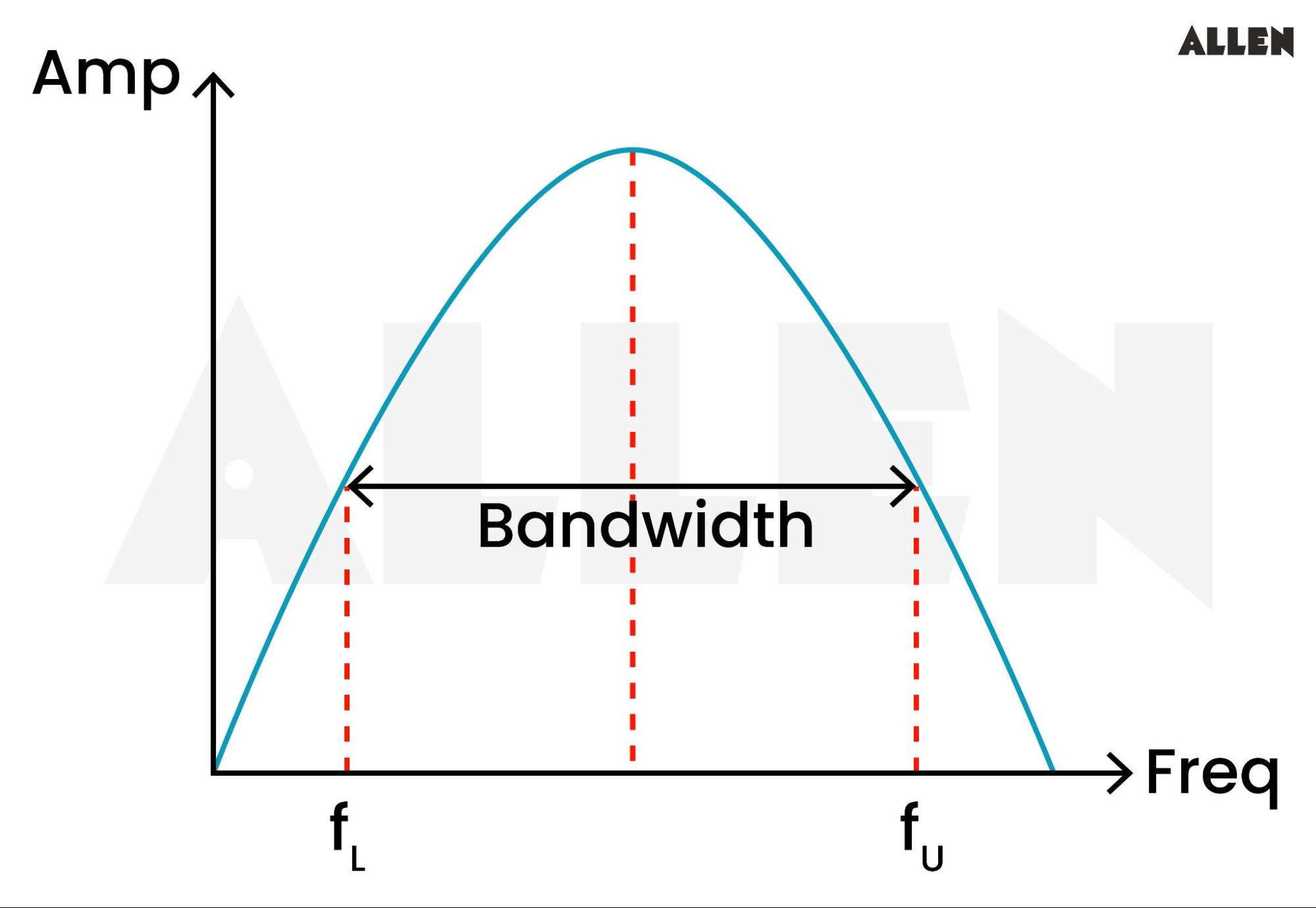
To solidify this definition, let's look at how it's formally defined.
Bandwidth of a Signal: Definition, Formula & Measurement
The following resource from Vedantu offers a very clear and concise FAQ section. It's perfect for quickly grasping the essential definitions.
Please read the first two questions in the 'FAQs on Bandwidth of a Signal Explained' section: 'What is meant by the bandwidth of a signal in Physics?' 'How is the bandwidth of a signal measured and what is its unit?' Focus on the core definition and the formula.
2. The Bandwidth of Different Signals
Different types of information require different bandwidths. A simple voice call doesn't contain as much information as a full orchestral piece of music, which in turn contains far less information than a high-definition video. Let's see how this translates to their bandwidth requirements.
The following video provides an excellent conceptual overview of signal bandwidth.
Class 12th – Bandwidth of Signals | Communication | Tutorials Point
This video from Tutorials Point uses clear, everyday examples to explain why different signals, like speech, music, and video, have different bandwidths.
Watch the video from the beginning up to 15:30. Pay close attention to the typical bandwidth values given for speech, music, and TV signals, and the explanation of what happens when a device's bandwidth is too small for the signal.
As the video explained, here are the key takeaways:
- Speech Signals: For a clear telephone conversation, you only need to transmit frequencies from about 300 Hz to 3100 Hz. This gives a required bandwidth of ~2800 Hz (or 2.8 kHz).
- Music Signals: Music is much more complex. It includes low frequencies from bass drums and very high frequencies from cymbals and harmonic overtones from all instruments. To capture this richness, you need a much wider bandwidth of about ~20,000 Hz (or 20 kHz).
- Video Signals: A television signal contains not only audio but also a massive amount of rapidly changing picture information. This requires an enormous bandwidth. A single TV channel needs about 6,000,000 Hz (or 6 MHz).

3. Bandwidth for Analog vs. Digital Signals
This brings us back to our previous lesson. How does bandwidth differ for analog and digital signals?
An analog signal, like a pure musical note, can be a simple sine wave with a well-defined and relatively small bandwidth.
A digital signal, however, is a square wave. As a fascinating consequence of a mathematical principle called the Fourier theorem, any repeating non-sinusoidal wave can be described as a sum of simple sine waves. A perfect square wave is actually made of a fundamental sine wave plus an infinite number of odd harmonics (sine waves at 3x, 5x, 7x... the fundamental frequency).
This has a huge implication: to transmit a perfect digital signal, you would need infinite bandwidth!
In practice, we don't need a perfect square wave. We just need one that is "square enough" for the receiver to distinguish between a '1' and a '0'. But even so, to preserve the sharp edges of the wave, we must transmit many of its higher harmonics. This means digital signals inherently require a much larger bandwidth than analog signals carrying similar information.
The next part of the video you watched earlier explains this visually.
Class 12th – Bandwidth of Signals | Communication | Tutorials Point
Let's return to the Tutorials Point video to see a visual demonstration of how adding high-frequency harmonics together builds a square-like digital wave.
Watch the segment from 16:38 to 23:46. Observe how adding more sine waves (harmonics) makes the resulting wave look more and more like the target 'box' or digital signal.
4. Signal Bandwidth vs. Channel Bandwidth
So far, we've only talked about the bandwidth of the signal itself. But for communication to happen, we need a medium to send it through. This is the communication channel.
A crucial distinction to make is:
- Signal Bandwidth: A property of the information you want to send.
- Channel Bandwidth: A property of the medium you are using to send it.
For communication to be successful, a simple rule must be followed:
The bandwidth of the channel must be greater than or equal to the bandwidth of the signal.
If you try to push a high-bandwidth signal (like a 6 MHz TV signal) through a low-bandwidth channel (like a 2.8 kHz telephone line), most of the information will be lost. This is like trying to drive a wide truck through a narrow tunnel.
Different transmission media have vastly different channel bandwidths, which is why they are used for different purposes.
Bandwidth of a Signal: Definition, Formula & Measurement
Let's return to the FAQ section from Vedantu, which perfectly summarizes the distinction between signal and channel bandwidth and explains why different media have different capacities.
Please read questions 5 and 6 in the 'FAQs on Bandwidth of a Signal Explained' section: 5. 'How does signal bandwidth differ from the bandwidth of a communication channel?' 6. 'Why do different transmission media like optical fibres and coaxial cables offer vastly different bandwidths?'
This explains why optical fibers are the backbone of the modern internet. Their enormous channel bandwidth (over 100 GHz) allows them to carry thousands of high-bandwidth video, music, and data signals simultaneously.
Test your understanding!
An FM radio station wants to broadcast high-fidelity music, which has a signal bandwidth of about 20 kHz. The government regulator, however, only allocates them a channel with a bandwidth of 15 kHz. What will be the likely result for the listeners, and why?
Show answer
The listeners will likely experience poor audio quality. The music might sound "flat" or "tinny," lacking richness.
Why? The channel bandwidth (15 kHz) is less than the signal bandwidth (20 kHz). This means the channel will "cut off" the highest frequencies of the music signal (from 15 kHz to 20 kHz). These high frequencies are crucial for the clarity of certain instruments (like cymbals) and the harmonic overtones that give instruments their unique timbre. The fundamental rule Channel Bandwidth ≥ Signal Bandwidth is violated, leading to information loss.
Conclusion
Today, we've defined bandwidth and explored its critical role in communication systems. This concept bridges the gap between the information we want to send and the physical limitations of the systems we use to send it.
Key Takeaways:
- Bandwidth is the range of frequencies (measured in Hz) present in a signal or that can be passed by a channel.
- Signal Bandwidth depends on the complexity of the information: Speech (~3 kHz) < Music (~20 kHz) < Video (~6 MHz).
- Digital signals require significantly more bandwidth than analog signals because they are composed of many high-frequency harmonics.
- Channel Bandwidth is a property of the transmission medium. Optical fiber has a massive bandwidth, while copper wires have a much smaller one.
- For successful communication, the channel bandwidth must be at least as large as the signal bandwidth.
Preview of the Next Lesson:
We have now completed our module on the fundamentals of communication! We've covered the basic elements of a system, modulation (AM/FM), signal types (analog/digital), and bandwidth.
Our next module, "Modes of Communication," will explore how these signals physically travel from transmitter to receiver. We will see that the frequency of a signal is a key factor in determining whether it travels along the ground (ground wave), bounces off the ionosphere (sky wave), or travels in a straight line to a satellite (space wave). Our understanding of frequency and bandwidth will be essential as we begin this new topic.