Hello! Welcome to the first lesson in our new module, "Modes of Communication."
In our last lesson, we wrapped up the fundamentals by exploring bandwidth. We learned that the frequency content of a signal is crucial, and that a communication channel needs enough bandwidth to carry the signal. That discussion ended with a key question: how do signals of different frequencies actually travel from a transmitter to a receiver?
Today, we begin to answer that question by exploring the first of three main propagation modes. Our goal is to describe the characteristics and typical frequency ranges for ground wave propagation. This topic is all about building a strong conceptual model, so we'll focus on visual intuition and the underlying physics rather than complex mathematics, which aligns with your goal of gaining a deep understanding of communication systems.
Let's begin our journey along the Earth's surface.
1. What is Ground Wave Propagation?
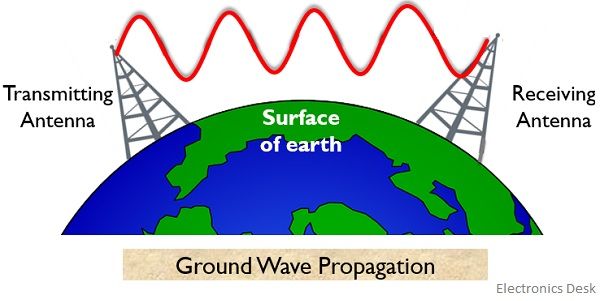
At its simplest, ground wave propagation is a mode where electromagnetic waves travel along the surface of the Earth, following its curvature. This is why it's also commonly called surface wave propagation.
Imagine a radio antenna broadcasting a signal. Instead of shooting straight out into space, the signal "hugs" the ground, bending around the curve of the planet to reach a receiver that might be over the horizon.
To get a feel for this process, let's watch a short introductory clip.
Ground Wave Propagation (Basics, Ground Effect, Banding of EM wave & Polarization) Explained
The following video from the Engineering Funda channel provides a clear visual and verbal introduction to the concept of ground wave propagation.
Please watch from 00:47 to 02:09. Focus on the basic definition, the alternative name 'surface wave propagation', and the placement of the antennas.
As you saw, the antennas for ground wave communication are placed close to the Earth's surface, which makes sense since the wave is guided by the surface itself.
2. The Physics of Following the Curve
This "hugging" of the Earth's surface isn't magic. It's a result of a phenomenon you've studied before in optics: diffraction.
Recall that diffraction is the bending of waves as they pass an obstacle or go through an aperture. In this case, the curve of the Earth itself is the "obstacle" that the radio waves diffract around.
A key principle of diffraction is that it is most significant when the wavelength of the wave is comparable to the size of the obstacle. For a wave to bend around the entire planet, it needs a very long wavelength. And, as we know from the fundamental wave equation , a long wavelength implies a low frequency.
This is the primary reason why ground wave propagation is only effective for signals in the Low Frequency (LF) and Medium Frequency (MF) bands, typically up to about 2 MHz. At higher frequencies (and shorter wavelengths), the diffraction effect is too weak, and the waves simply travel in a straight line off into space rather than following the Earth's curvature.
The following video segment explains this relationship between bending, wavelength, and frequency very clearly.
Ground Wave Propagation (Basics, Ground Effect, Banding of EM wave & Polarization) Explained
Let's return to the Engineering Funda video to see the explanation for how waves bend and why this limits the frequency range.
Watch the segment from 05:33 to 07:26. Pay close attention to the link between wave bending (diffraction), wavelength, and frequency.
3. Attenuation: Why the Ground Matters
As a ground wave travels, it continuously interacts with the Earth's surface. This interaction isn't perfect; some of the wave's energy is absorbed by the ground, causing the signal to weaken over distance. This weakening is called attenuation.
The amount of attenuation depends on two main factors: the frequency of the wave and the electrical properties of the ground.
Frequency and Attenuation
As the wave glides over the surface, it induces electric currents in the ground. Since the ground has electrical resistance, these currents dissipate energy as heat, robbing the wave of its strength. This effect becomes much more pronounced at higher frequencies.
The Engineering Funda video provides an excellent analogy for this, modeling the Earth as a "leaky capacitor". The key takeaway is that at higher frequencies, the ground more effectively "shorts out" the signal, causing rapid attenuation. This is another critical reason why the practical limit for ground waves is around 2 MHz.
Ground Conductivity
The electrical properties of the surface itself are also crucial.
- Good Conductors: Surfaces with high conductivity, like seawater, allow the induced currents to flow easily and absorb relatively little energy. Ground waves can therefore travel very long distances (hundreds or even thousands of kilometers) over the ocean.
- Poor Conductors: Surfaces with low conductivity, like dry desert sand or ice, have high resistance. They absorb a lot of energy, and the ground wave signal attenuates very quickly.
This concept is explained well in the next video.
Radio Wave Propagation #1. How EM Waves Travel Along Earth’s Surface – Ground Wave Explained!
This video from Technologies Discussion highlights how the type of ground surface affects propagation distance.
Watch the two segments: first from 04:59 to 05:59, and then from 08:03 to 09:34. Focus on how ground conductivity impacts wave travel and the practical examples given, like ship-to-shore communication.
4. Vertical Polarization: A Critical Requirement
One of the most important characteristics of ground waves is that they must be vertically polarized.
Remember that polarization refers to the orientation of the wave's electric field. For a vertically polarized wave, the electric field oscillates up and down, perpendicular to the Earth's surface.
Why is this necessary? Imagine what would happen with a horizontally polarized wave, where the electric field is parallel to the ground. Since the Earth's surface is conductive, this horizontal electric field would be in direct contact with it, causing the field to be short-circuited and its energy to be absorbed almost immediately.
By using vertical polarization, the electric field is kept perpendicular to the surface, minimizing this short-circuiting effect and allowing the wave to propagate.
For a concise summary of the key characteristics we've discussed, including frequency range and polarization, please read the following text from a Wikipedia article.
Read the 'Overview' section. It's a dense but very informative summary of the factors influencing ground wave propagation, including frequency, surface conductivity, and polarization.
Test your understanding!
Imagine two scenarios:
- Engineers want to set up a reliable communication system between ships at sea over a distance of 500 km.
- A company wants to provide radio coverage across a vast, dry desert region of the same size.
In which scenario would ground wave propagation (at, say, 1 MHz) be a more suitable choice, and why?
Show answer
Ground wave propagation would be far more suitable for the ship-to-ship communication at sea (Scenario 1).
Reasoning: The primary factor here is ground conductivity. Seawater is a very good electrical conductor. This means that as the ground wave travels over the ocean's surface, it induces currents easily and loses very little energy to attenuation. It can therefore cover very long distances.
In the desert (Scenario 2), the dry sand is a poor electrical conductor (high resistance). It would absorb a significant amount of the wave's energy, causing rapid attenuation. The signal would likely become too weak to be useful long before it covered the required 500 km.
Conclusion
In this lesson, we have explored our first mode of communication, learning how some radio waves can use the Earth itself as a guide.
Key Takeaways:
- Ground Wave Propagation involves EM waves that follow the Earth's curvature, also known as surface waves.
- This mode is effective only at low frequencies (up to ~2 MHz) because it relies on diffraction, which requires long wavelengths.
- Attenuation (signal loss) increases with frequency and is highly dependent on ground conductivity. Propagation is best over seawater and worst over dry land.
- Ground waves must be vertically polarized to prevent the electric field from being short-circuited by the conductive Earth.
- Common applications include AM radio broadcasting and maritime communication.
Preview of the Next Lesson:
We've established that ground waves are limited to low frequencies. So, what happens when we use higher frequencies? These signals have too much energy to be bound to the ground. In our next lesson, we will explore sky wave propagation, a fascinating mode where radio waves in the HF band (roughly 3-30 MHz) journey up to the ionosphere—an electrically charged layer of the upper atmosphere—and reflect back down to Earth, enabling communication over vast intercontinental distances.