Hello! Welcome to our next lesson on the modes of communication.
In our previous lesson, we explored ground wave propagation and discovered that it's most effective for low-frequency signals (below 2 MHz) that can hug the Earth's surface. A key takeaway was that higher frequency signals don't follow this path. So, where do they go, and how can we use them for communication?
Today, we'll answer that by looking skyward. We will investigate sky wave propagation, a fascinating mode that allows for communication over thousands of kilometers. Our goal is to describe the characteristics and role of the ionosphere in sky wave propagation. Since you're interested in the deep conceptual underpinnings of communication systems, we'll focus on the physics behind this phenomenon, exploring how the upper atmosphere acts as a giant natural mirror for radio waves.
1. The Ionosphere: Earth's Natural Mirror
Sky wave propagation is possible because of a special region in our upper atmosphere called the ionosphere. It extends from about 60 km to over 650 km above the Earth. It's not a solid layer, but rather a region where the air is "electrified" or ionized.
This ionization happens because of the Sun. Intense solar radiation, particularly in the ultraviolet spectrum, strikes the sparse gas molecules in the upper atmosphere with enough energy to knock electrons free. This process creates a mixture of positively charged ions and free electrons, forming a plasma. While the ions give this region its name, it's the free electrons that are crucial for interacting with radio waves.
This ionization isn't uniform. It forms peaks at different altitudes, which we classify into layers.
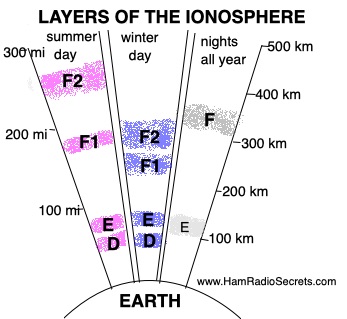
The key layers for radio communication are:
- D-Layer (60-100 km): The lowest and densest (in terms of air molecules, not free electrons) layer. It exists only during the daytime and disappears at night. As we'll see, its main effect is to absorb radio waves, especially at lower frequencies.
- E-Layer (100-125 km): Present during the day and, to a lesser extent, at night. It can refract radio waves back to Earth.
- F-Layer (200-400+ km): This is the most important layer for long-distance communication. During the day, it often splits into two sub-layers, F1 (lower) and F2 (higher). At night, they merge into a single F-layer. This layer is the primary "reflector" for most sky wave signals.
To understand how these layers are formed and how they affect radio waves, watch the following comprehensive explanation.
The following video from Rohde & Schwarz provides an excellent conceptual overview of how the ionosphere is formed and how each layer interacts differently with radio signals.
Watch the segment from 04:52 to 09:00. Pay close attention to the distinction between the D-layer's role as an absorber and the E and F-layers' roles as refractors.
2. The Mechanism of Sky Wave Propagation
You may have heard that the ionosphere "reflects" radio waves. While this is a useful simplification, the physical process is actually refraction. It's the same principle that makes a straw in a glass of water appear bent.
As a radio wave travels upward from Earth and enters the ionosphere, it moves into a medium with a different refractive index (caused by the free electrons). The wave continuously bends as the electron density changes. If the frequency and angle of entry are right, the wave bends so much that its path curves back down towards the Earth.

This process is highly dependent on the wave's frequency:
- Low Frequencies (< 3 MHz): During the day, these waves are heavily absorbed by the D-layer and don't make it to the refracting E and F layers.
- High Frequencies (HF Band, 3-30 MHz): This is the sweet spot for sky wave propagation. These signals are strong enough to pass through the D-layer with little absorption but are bent back to Earth by the E or F layers.
- Very High Frequencies (VHF, > 30 MHz): These waves have too much energy. The ionosphere bends them only slightly, and they pass right through into outer space.
To get a clear understanding of this refraction process and the appropriate frequency range, let's watch another short clip.
Sky Wave Propagation (Basics, Ionosphere Layers, Multi Hope Propagation, Issues & Parameters)
This video from Engineering Funda clearly explains how refraction is the underlying mechanism for sky wave propagation and defines the frequency range involved.
Watch from 00:45 to 03:07. Focus on the explanation of how refraction causes the apparent reflection and the specific frequency range (2-30 MHz) for sky waves.
Key Concepts: Skip Distance and Critical Frequency
Two important concepts arise from this propagation method:
- Skip Distance: As shown in the "Sky Wave Propagation Path" image, this is the distance along the ground from the transmitter to the point where the first sky wave returns to Earth.
- Skip Zone (or Dead Zone): This is the region between where the ground wave becomes too weak and where the first sky wave lands. In this zone, the signal cannot be received.
The ability of the ionosphere to return a wave to Earth depends on its ionization density. We can measure this with the Critical Frequency (). This is the highest frequency that will be returned to Earth if transmitted straight up (90° incidence). Any frequency above sent straight up will escape into space. For waves sent at an angle (oblique incidence), the highest frequency that can be used for a given path is the Maximum Usable Frequency (MUF). Conceptually, the MUF is always higher than the critical frequency.
3. A Dynamic and Ever-Changing Medium
The ionosphere is not static; its characteristics are in constant flux, primarily driven by the Sun. This makes sky wave propagation a dynamic and sometimes unpredictable mode of communication.
Day vs. Night
The most significant change occurs on a daily cycle.
-
During the Day:
- The D-layer is present and strong. It absorbs lower HF frequencies (e.g., 3-7 MHz), making them less effective for long-distance communication.
- The F-layer splits into F1 and F2. The higher, more intensely ionized F2 layer can refract higher HF frequencies (e.g., 14-30 MHz) over very long distances.
-
At Night:
- The D-layer disappears completely. This is crucial! With the absorbing D-layer gone, lower HF frequencies can now travel unimpeded to the F-layer.
- The F1 and F2 layers recombine into a single, higher F-layer. This higher altitude allows for a longer skip distance for each "hop."
This day/night cycle explains a common experience: being able to hear distant AM radio stations at night that you can't hear during the day. Standard AM broadcast frequencies are in the Medium Frequency (MF) band (~1 MHz), which are completely absorbed by the D-layer during the day. At night, the D-layer vanishes, and these signals can travel via sky wave.
For a concise written summary of how the layers behave, you can refer to the following resource.
Radio Waves and the Ionosphere
The document 'Radio Waves and the Ionosphere' provides a clear textual description of the different layers and their day/night behavior.
Please read the section titled 'Layers' (which describes D, E, and F layers) and the section titled 'The E and F Layers'. Focus on the day/night changes and how the F-layer is responsible for long-distance communication.
Test your understanding!
An amateur radio operator wants to communicate with someone on another continent, about 4000 km away. They have two options: try on a frequency of 7 MHz in the middle of the day, or wait until night to use the same frequency. Which option is more likely to succeed, and why?
Show answer
Waiting until night is far more likely to succeed.
Reasoning:
- During the day, the 7 MHz frequency (which is in the lower end of the HF band) would be significantly absorbed by the D-layer. The signal would be severely weakened before it even reached the F-layer for refraction.
- At night, the D-layer disappears. This allows the 7 MHz signal to travel to the F-layer with minimal loss. The F-layer, now a single layer at a higher altitude, can then refract the signal back to Earth over a very long skip distance, making the 4000 km contact possible.
Conclusion
Today, we've journeyed into the upper atmosphere to understand how it enables long-distance radio communication. You now have a strong conceptual model of sky wave propagation and the vital role of the ionosphere.
Key Takeaways:
- Sky wave propagation uses the ionosphere to refract radio waves in the HF band (3-30 MHz) back to Earth.
- The ionosphere consists of layers (D, E, F) ionized by solar radiation. The D-layer primarily absorbs waves, while the E and F layers refract them.
- The process is one of refraction, not simple reflection, where the wave path is bent as it travels through the ionized medium.
- Propagation is highly dynamic, depending critically on frequency, time of day (due to the appearance/disappearance of the D-layer), and long-term solar activity.
Preview of the Next Lesson:
We've established that signals with frequencies above the MUF (generally > 30 MHz) are not refracted back to Earth; they slice through the ionosphere and continue into space. This might seem like a limitation, but it's actually the key to our third and final mode of communication. In the next lesson, we'll explore space wave propagation, where we use these high-frequency signals for line-of-sight communication, FM/TV broadcasting, and a little something called satellite communication.