Hello! Welcome to our next lesson in the "Fundamentals of Communication" module.
In our previous lesson, we compared Amplitude Modulation (AM) and Frequency Modulation (FM). We learned that while they use different methods, they are both ways of encoding information onto a continuously varying wave. These are known as analog techniques.
Today, we're going to zoom out and explore a more fundamental distinction that underpins all of modern electronics: the difference between analog and digital signals. Your phone, the internet, and digital television all rely on the principles we'll discuss today.
As you requested for this part of the course, our focus will be entirely on building a deep conceptual understanding. Our goal is to distinguish between analog and digital signals, and by the end of this lesson, you'll be able to identify them, explain their core properties, and understand the key advantages that made digital the dominant technology.
Part 1: What Are Analog and Digital Signals?
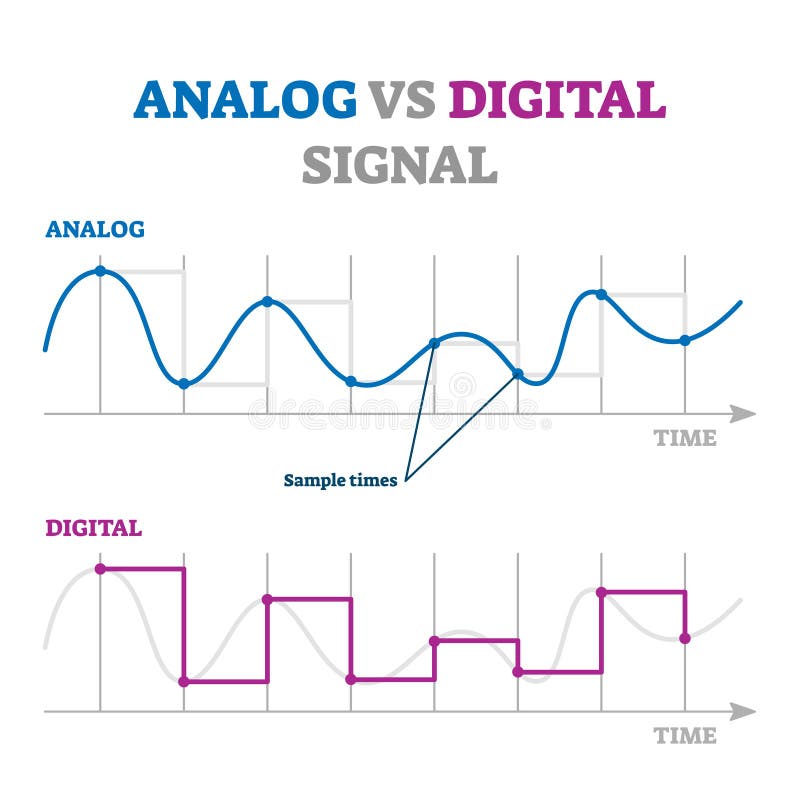
At the most basic level, the difference is about continuity. An analog signal is continuous, meaning it can have an infinite number of values over time, just like the real-world phenomena it often represents (like sound, light, or temperature). A digital signal is discrete, meaning it is non-continuous and can only take on a finite number of values.
Let's look at a clear visual representation.

To solidify these definitions, let's turn to a short reading.
Analog vs. Digital - SparkFun Learn
The article 'Analog vs. Digital' from SparkFun Learn provides clear, concise definitions for both signal types. It's a great starting point for our discussion.
Please read the sections titled 'Analog Signals' and 'Digital Signals'. As you read, focus on the keywords used to describe each type of wave (e.g., smooth, continuous, infinite for analog; stepping, square, finite for digital).
So, to recap the core idea:
- Analog: A continuous representation of information. Think of a smooth ramp.
- Digital: A discrete representation of information. Think of a staircase.
Part 2: Seeing Analog and Digital in the Real World
These concepts can feel abstract, so the best way to understand them is through everyday examples. The following video does an excellent job of connecting the theory to the technology you use daily.
Analog vs. Digital Signals Lesson
The video 'Analog vs. Digital Signals Lesson' by Minimalist Physicist walks through numerous examples that make the distinction very clear.
Watch the video from 01:22 to 03:12 for a detailed explanation of the differences. Then, skip ahead and watch from 04:28 to 07:42 to see five excellent real-world comparisons (clocks, phones, music, radio, and TV).
As the video illustrated, you can see this distinction everywhere:
- Clocks: An old clock with sweeping hands is analog. A modern clock showing numbered digits is digital.
- Music: A vinyl record, with its continuous physical groove, is analog. An MP3 file, which stores music as a series of numbers, is digital.
- Telephones: A landline, which transmits your voice as a continuous electrical wave, is analog. A mobile phone, which converts your voice into a stream of 1s and 0s, is digital.
Test your understanding!
Think about a light switch in your home.
- A standard on/off flip switch. Is it a better analogy for a digital or an analog system? Why?
- A dimmer switch that you can rotate to make the light smoothly brighter or dimmer. Is this more like a digital or an analog system? Why?
Show answer
- A standard light switch is a perfect analogy for a digital system. It has only two discrete states: ON (1) or OFF (0). There is no in-between.
- A dimmer switch is a great analogy for an analog system. It allows for a continuous range of brightness levels, from fully off to fully on, and an infinite number of settings in between.
Part 3: The Biggest Advantage of Digital: Noise Immunity
If the real world is analog, why go through the trouble of converting everything to digital? One of the most important reasons is noise. In the last lesson, we saw how electrical noise (static) easily corrupts an AM signal because the receiver can't tell the difference between the intended signal and the noise. Digital signals are far more resilient.
Let's see why.
Analog vs. digital signals | Waves | Middle school physics | Khan Academy
This Khan Academy video provides a simple but powerful demonstration of why digital signals are so much more robust against noise and interference than analog signals.
Watch from 00:47 to 03:56. Notice how the same interference that makes the analog signal unreadable barely affects the digital signal.
The key takeaway is that a digital receiver doesn't need to reproduce a complex, perfect wave. It only needs to answer a very simple question at any given moment: "Is the voltage high (a '1') or low (a '0')?"
Even if noise slightly distorts the signal—pushing the voltage up or down a bit—it's usually still easy to tell a high state from a low state. This allows for near-perfect reconstruction of the original 1s and 0s, resulting in a crystal-clear signal free of static. This is why a digital TV picture is either perfect or gone completely; there's rarely a "snowy" in-between like with old analog TVs.
Part 4: Bridging the Worlds: ADC and DAC
Since the world we experience is analog (sound waves, light waves) but our computers are digital, we need a way to translate between these two languages. This is done with two types of converters:
-
Analog-to-Digital Converter (ADC): Takes a real-world analog signal (like the sound of a voice into a microphone) and converts it into a stream of digital values (like an MP3 file). It does this by measuring, or sampling, the analog wave at regular, tiny intervals.
-
Digital-to-Analog Converter (DAC): Takes a stream of digital values and converts it back into an analog signal that we can perceive. A DAC in your phone, for instance, turns the 1s and 0s of an MP3 file back into a continuous electrical signal that your headphones can turn into sound waves.
The image below shows how an ADC approximates a smooth analog wave with discrete digital "steps."
The process of converting from analog to digital and back again was also mentioned in the "Minimalist Physicist" video when discussing MP3s and cell phones. It's a fundamental process happening constantly in almost all the technology we use.
Summary: Analog vs. Digital at a Glance
We've covered the definitions, examples, and key advantages. To bring it all together, let's use a clear, side-by-side comparison.
Difference between Analog and Digital Signal
This article from BYJU'S provides an excellent summary table that contrasts the key features of analog and digital signals.
Carefully study the table under the heading 'Difference between Analog and Digital Signal'. It's a great way to review and consolidate everything we've discussed.
Conclusion
Today, we've explored the crucial difference between the continuous world of analog signals and the discrete world of digital signals. This distinction is one of the most important concepts in modern technology.
Key Takeaways:
- Analog signals are continuous waves with an infinite range of values, directly representing information (e.g., a vinyl record groove). They are prone to noise.
- Digital signals are discrete, using a finite set of values (typically 0 and 1) to represent information in a coded form (e.g., an MP3 file). They are highly resistant to noise.
- We use ADCs to convert real-world analog information into a digital format for processing and storage.
- We use DACs to convert digital information back into an analog format for us to see and hear.
Preview of the Next Lesson:
Now that we've established these two fundamental signal types, our next lesson will explore a property they both share: bandwidth. We touched on this when comparing AM and FM, but now we'll do a deeper dive. We will explain the concept of bandwidth for both signals and communication channels, which is essential for understanding how much information can be sent from one place to another.