Hello! Welcome to our final lesson on Wave Interactions and Sound.
In our previous lessons, we've individually covered the core concepts of this module: the principle of superposition, the formation of standing waves, the frequency shift of the Doppler effect, and the periodic loudness of beats. As you know, success in the NEET exam requires not just understanding these concepts in isolation, but also being able to apply them quickly and accurately in complex problems that often combine multiple ideas.
Today's lesson is designed to meet your request for a "vigorous" problem-solving session. Our learning outcome is to solve a variety of NEET-style problems involving superposition, standing waves, and the Doppler effect. We will tackle challenging, multi-concept problems, focusing on the strategies needed to break them down and solve them efficiently. Let's consolidate your knowledge and sharpen your skills for the exam.
1. Advanced Problems in Standing Waves
Let's begin by reviewing the key formulas for standing waves on a string fixed at both ends, which you've seen before.
- Wavelength of the nth harmonic:
- Frequency of the nth harmonic:
- Wave speed on the string:
Here, is the harmonic number (1, 2, 3...), is the string length, is the wave speed, is the tension, and is the linear mass density (mass/length).
NEET problems often require you to combine these formulas. Let's analyze a comprehensive example.
Standing Waves on a String, Fundamental Frequency, Harmonics, Overtones, Nodes, Antinodes, Physics
This video, 'Standing Waves on a String' from The Organic Chemistry Tutor, works through several excellent examples. We'll focus on a problem that integrates wave speed, frequency, string length, mass, and tension - a typical multi-step NEET question.
Watch the section from 24:56 to 30:52. The video solves a two-part problem. First, it finds the length of a string given its speed, harmonic number (5 loops), and frequency. Second, it calculates the tension force required, given the string's mass.
Let's break down the logic from the video's first problem (starting at 24:56):
-
Given: Speed ( m/s), number of loops (), frequency ( Hz).
-
Goal: Find length () and tension ().
-
Step 1: Find Wavelength (). The fundamental relationship is the starting point.
-
Step 2: Find Length (). Now use the standing wave condition .
-
Step 3: Find Linear Density (). To find tension, we first need . The problem gives mass ( g = 0.04 kg).
-
Step 4: Find Tension (). Rearrange the wave speed formula to solve for T.
This example shows how you must fluidly move between different formulas to connect the given information to the desired unknown.
2. Mastering Doppler Effect Scenarios
The biggest challenge in Doppler effect problems is correctly applying the signs in the general formula:
where is the apparent frequency, is the source frequency, is the speed of sound, is the observer's speed, and is the source's speed.
A reliable way to get the signs right is to think about the physical outcome:
- Numerator (Observer): If the observer moves towards the source, they encounter more wavefronts per second, so frequency increases. Use + . If they move away, use - .
- Denominator (Source): If the source moves towards the observer, it "compresses" the waves, increasing frequency. To make the fraction larger, the denominator must be smaller. Use - . If it moves away, use + .
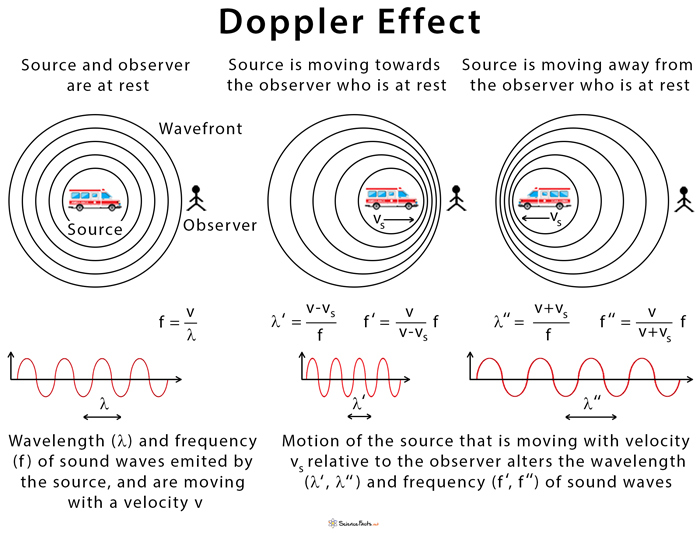
Let's tackle a common NEET variation: the Doppler effect with an echo.
Problem:
A police car with a siren of frequency 1000 Hz travels towards a tall building at a speed of 20 m/s. The speed of sound in air is 340 m/s. What is the frequency of the echo heard by the driver?
Solution Strategy: This is a two-step problem.
- Sound traveling from car to building: The car is the source, and the building is a stationary observer.
- Sound reflecting from building to car: The building acts as a stationary source emitting the frequency it just "heard," and the moving car is now the observer.
Step 1: Frequency reaching the building ()
- Source (car) is moving towards a stationary observer (building).
- Source speed m/s. Observer speed .
- Use '-' in the denominator for 'towards'.
Step 2: Frequency of the echo heard by the driver ()
- The building now acts as a stationary source () emitting at Hz.
- The driver (observer) is moving towards this stationary source at m/s.
- Use '+' in the numerator for 'towards'.
The driver hears an echo frequency of approximately 1125 Hz.
Test your understanding!
A train moving at 30 m/s blows a whistle of frequency 600 Hz. A stationary observer is by the tracks. What is the beat frequency heard by the observer between the direct sound and the echo from a large cliff that the train is moving away from? (Speed of sound = 330 m/s)
Show answer
-
Direct Sound (): The source (train) is moving away from the stationary observer.
-
Echo Sound (): This is a two-step process.
- Part A: Frequency reaching the cliff. The source (train) moves towards the cliff.
- Part B: Frequency heard by the observer from the cliff. The cliff is now a stationary source emitting at 660 Hz. The observer is also stationary. So, the observer hears the echo at Hz.
- Part A: Frequency reaching the cliff. The source (train) moves towards the cliff.
-
Beat Frequency:
(Note: This is too high to be perceived as distinct beats, but it is the correct mathematical answer).
3. NEET Strategy: Common Mistakes and Exam Tips
To succeed under exam pressure, it's crucial to know the common traps. An excellent resource for this is a forum post that compiles tips specifically for NEET aspirants.
How to prepare for Waves for NEET | Sathee Forum
To boost your exam performance, it's vital to be aware of common errors and have a solid strategy. This forum post provides excellent, targeted advice for the NEET.
Please read two sections from this resource. First, read the post titled 'Common Mistakes to Avoid'. Pay close attention to the points on applying Doppler effect formulas and the differences in harmonics for open and closed pipes. Second, read the post titled 'Exam Strategy', focusing on the 'Question-Solving Sequence' and 'Key Problem-Solving Tips'.
Here are the most critical takeaways from that resource for the topics we've covered:
- Doppler Signs: Don't just memorize the formula. Reason it out: does the frequency need to increase or decrease? That will tell you whether to make the fraction bigger or smaller.
- Standing Waves in Pipes: This is a very common point of error.
- String / Open Pipe: All harmonics are present ().
- Closed Pipe: Only odd harmonics are present ().
- Beats: The beat frequency is the difference (), not the sum or average.
4. Final Practice Set
Now, apply what we've reviewed. Attempt these NEET-style questions from the provided resources.
Question 1 (Standing Waves in Pipes)
Source: LINK, Exercise 1, Q17
A closed pipe and an open pipe have their first overtones identical in frequency. Their lengths are in the ratio:
(a) 1 : 2
(b) 2 : 3
(c) 3 : 4
(d) 4 : 5
Show Answer
Answer: (c) 3 : 4
- First overtone of a closed pipe: A closed pipe only has odd harmonics (1st, 3rd, 5th...). The fundamental is the 1st harmonic. The first overtone is the 3rd harmonic. Its frequency is .
- First overtone of an open pipe: An open pipe has all harmonics (1st, 2nd, 3rd...). The fundamental is the 1st harmonic. The first overtone is the 2nd harmonic. Its frequency is .
- Equating the frequencies:
The ratio of the length of the closed pipe to the open pipe is 3:4.
Question 2 (Doppler Effect)
Source: LINK, Section 6, Q3
A train moving at 30 m/s blows a whistle of frequency 600 Hz. The frequency heard by a stationary observer as the train approaches him is (speed of sound = 330 m/s):
(a) 660 Hz
(b) 600 Hz
(c) 550 Hz
(d) 720 Hz
Show Answer
Answer: (a) 660 Hz
- Identify the case: Source is moving towards a stationary observer. This should increase the frequency.
- Apply the formula:
- Substitute values:
Question 3 (Beats and Standing Waves)
Source: LINK, Exercise 2, Q66
A tuning fork of frequency 512 Hz makes 4 beats per second with the vibrating string of a piano. The beat frequency decreases to 2 beats per sec when the tension in the piano string is slightly increased. The frequency of the piano string before increasing the tension was:
(a) 510 Hz
(b) 514 Hz
(c) 516 Hz
(d) 508 Hz
Show Answer
Answer: (d) 508 Hz
- Initial possibilities: The piano string's frequency () could be , which means Hz or Hz.
- Analyze the change: The tension in the string is increased. The frequency of a string is given by . Since , increasing the tension increases the string's frequency.
- Test the possibilities:
- Case 1: Assume Hz. Increasing the tension will increase the frequency further (e.g., to 517 Hz). The new beat frequency with the 512 Hz fork would be beats/sec. This contradicts the observation that the beat frequency decreased to 2.
- Case 2: Assume Hz. Increasing the tension will increase the frequency (e.g., towards 509, 510 Hz...). If the frequency becomes 510 Hz, the new beat frequency with the 512 Hz fork is beats/sec. This matches the observation.
- Conclusion: The original frequency of the piano string was 508 Hz.
Conclusion
This session was a "sprint" through the types of problems you'll encounter on the NEET from this module. We've seen how to combine formulas for standing waves, navigate the tricky signs of the Doppler effect, and use logical deduction to solve problems involving beats.
Key Takeaways:
- NEET problems often require multiple steps and the combination of several formulas. Practice breaking them down into smaller, manageable parts.
- For Doppler effect, always determine if the relative motion should increase or decrease the frequency first, then choose your signs accordingly.
- Master the conditions for harmonics and overtones in different systems (strings, open pipes, closed pipes) as this is a frequent source of error.
- When a problem gives two scenarios (like in beat frequency problems), use the first to establish possibilities and the second to eliminate the incorrect ones.
Preview of the Next Lesson:
With this, we conclude our module on waves and sound. We will now shift gears significantly. Our next module, Reflection from Plane and Spherical Mirrors, marks the beginning of our journey into Ray Optics. We will start by applying the laws of reflection to trace light rays and construct ray diagrams to locate images, a foundational skill for all of optics.