Hello! Welcome to your first lesson in the "Wave Interactions and Sound" module.
In our previous lesson, we established the crucial link between path difference and phase difference. We learned how to calculate one from the other using the formula . Today, we will put that knowledge to immediate use.
This lesson is all about what happens when two or more waves meet in a medium. We will explore the Principle of Superposition, which is the fundamental rule governing wave interactions. Your learning outcome is to apply this principle to determine the resultant amplitude of interfering waves. This is a cornerstone concept for your NEET preparation, forming the mathematical basis for interference, a topic that spans both mechanical waves and wave optics.
1. The Principle of Superposition
What happens when two ripples in a pond overlap? Do they bounce off each other, or do they pass through one another? The answer lies in the Principle of Superposition.
This principle states that when two or more waves are simultaneously present at the same point in a medium, the resultant displacement at that point is the algebraic sum of the displacements of the individual waves.
Essentially, you just add them up. The waves pass through each other unaltered, but at the points where they overlap, a new, composite wave shape is formed. To see this in action, let's watch a brief conceptual introduction.
Adding waves with different phases
This video from UNSW Physics provides a clear, animated introduction to the Principle of Superposition.
Watch the first part of the video, from 00:00 to 01:49. Focus on the core idea: the resultant wave is simply the 'algebraic sum' of the individual waves at every point.
This simple addition can lead to two main outcomes:
- Constructive Interference: The waves add up to create a resultant wave with a larger amplitude.
- Destructive Interference: The waves cancel each other out, leading to a resultant wave with a smaller amplitude (or even zero).
Our goal now is to find a general mathematical formula that describes the amplitude of this resultant wave.
2. Deriving the Resultant Amplitude
Let's consider two coherent waves (same frequency, constant phase difference) traveling in the same direction. Your NEET problems will almost always involve such waves.
Let their equations be:
Here, and are their respective amplitudes, and is the phase difference between them. According to the superposition principle, the resultant displacement is .
The following resource provides a step-by-step derivation for the amplitude of this resultant wave. This is a standard derivation that is extremely important for you to understand.
Interference of waves, intensity, practice problems, FAQs
This article from Aakash, an institution focused on competitive exams like NEET, presents the derivation for the resultant amplitude and intensity. It is perfectly aligned with your preparation goals.
Please read the section titled 'Interference of wave'. Follow the mathematical steps that start from y = y1 + y2 and end with the formula for the resultant amplitude, A. The derivation uses a standard substitution method involving trigonometric identities.
The derivation you just studied leads to the single most important formula of this lesson. The amplitude of the resultant wave, , is given by:
This equation is your primary tool. It tells you that the resultant amplitude depends not only on the individual amplitudes and but critically on the phase difference between the waves.
3. A Visual Method: Phasor Diagrams
While the trigonometric derivation is essential, there is a more visual and often more intuitive way to think about adding waves: using phasors.
A phasor is a vector that rotates counter-clockwise with angular frequency . The projection of this vector onto the vertical axis represents the displacement of the wave. The length of the vector is the wave's amplitude , and the angle it makes with the horizontal axis is its phase .
Adding two waves is equivalent to performing vector addition on their phasors.
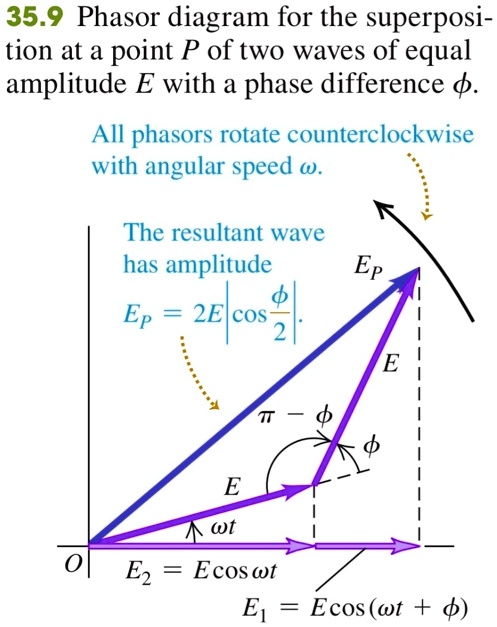
Using the law of cosines for vector addition on the diagram above, you arrive at the exact same formula:
This confirms our mathematical result and provides a powerful visual tool for solving problems, which can be much faster in an exam setting.
4. Special Case: Equal Amplitudes
A very common scenario in problems involves two interfering waves with the same amplitude. Let's set .
Substituting this into our general formula:
Now, using the trigonometric half-angle identity :
This gives us the simplified formula for the special case of equal amplitudes:
Notice the absolute value bars. Since amplitude must be a positive quantity, we take the absolute value of the cosine term.
To see this derivation again from a slightly different perspective, you can watch this segment.
Physics 19 Mechanical Waves (11 of 21) The Interference of Waves (Same Direction)
This video from Michel van Biezen walks through the mathematical derivation for the special case of two waves with equal amplitudes, using a clear, step-by-step approach.
Watch the segment from 02:06 to 05:50. The presenter uses the same superposition principle but applies the sum-to-product trigonometric identity, arriving at the same final expression for the resultant wave.
Test your understanding!
Two waves are described by and . What is the amplitude of the resultant wave?
Show answer
Here, the amplitudes are equal: . The phase difference is . We can use the special case formula:
Since ,
The resultant amplitude is 5. Interestingly, the resultant wave has the same amplitude as the individual waves.
Conclusion
In this lesson, we have formally defined the Principle of Superposition and derived the essential formulas to calculate the amplitude of a resultant wave.
Key Takeaways:
- Principle of Superposition: When waves meet, their displacements add algebraically.
- General Formula for Resultant Amplitude: For two waves with amplitudes , and phase difference , the resultant amplitude is . This is your go-to formula for NEET.
- Special Case (Equal Amplitudes): If , the formula simplifies to .
- Phasor Method: Adding waves can be visualized as vector addition, providing an intuitive way to understand the resultant amplitude.
Preview of the Next Lesson:
Now that we have the master formula for resultant amplitude, we are ready to analyze it. In the next lesson, we will investigate the conditions that make a maximum (constructive interference) and a minimum (destructive interference). We will connect these conditions back to phase and path differences and solve numerous problems on this topic.