Hello! Welcome to the final lesson in our first module on Oscillations and Waves.
In our last lesson, we mastered the fundamental wave relationship, , and learned how to extract a wave's physical properties from its equation. We saw that the frequency is determined by the source and remains constant even when a wave changes medium.
Today, we will focus on the "phase" component of a wave. We'll investigate what it means for different points on a wave to be "in step" or "out of step" with each other. This leads us to the crucial concepts of phase difference and path difference. Your learning outcome for this lesson is to be able to calculate phase differences and path differences between points on a wave.
Mastering this is absolutely essential for your NEET preparation, as it forms the bedrock for understanding wave interference—a topic that features heavily in both this chapter and in Wave Optics.
1. What are Phase and Path Difference?
Imagine a wave traveling along a rope. The phase of a point on the rope describes its position and direction of motion in its oscillation cycle (e.g., at a crest, in a trough, moving up through equilibrium).
When we compare two points, we are interested in their phase difference, which tells us how much one point's oscillation leads or lags behind the other. This is measured as an angle, in degrees or radians.
The path difference is simpler: it's the physical distance along the direction of wave travel between two points.
To build a solid intuition for these ideas, let's watch a short video segment.
A Level Physics Waves Revision: Superposition, phase difference, path difference and interference
This video from ZPhysics provides a clear conceptual overview of phase difference and path difference, linking them to the idea of interference, which we will study next.
Watch the segment from 01:40 to 05:10. Focus on understanding the definitions: Phase difference: How 'out of sync' two waves are, expressed as a fraction of a full cycle (360° or 2π radians). Path difference: The difference in the physical distance traveled by two waves to reach a point.
As the video explains:
- Two points are in phase if their phase difference is 0, 360° (2π rad), 720° (4π rad), etc. They are doing the exact same thing at the same time.
- Two points are in antiphase (or completely out of phase) if their phase difference is 180° (π rad), 540° (3π rad), etc. One is at a crest while the other is at a trough.
This image below helps visualize how different path differences lead to different types of alignment when waves meet.

2. The Mathematical Link
So, how do we convert a physical path difference into an angular phase difference? The key is to remember that one full wavelength () corresponds to a phase change of exactly radians (or 360°).
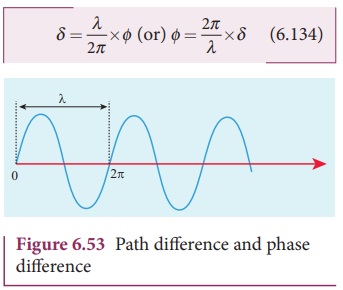
Based on this simple proportion, we can establish the most important formula for this lesson:
This formula tells us that the phase difference is simply the fraction of a wavelength that the path difference represents (), multiplied by the phase of a full wavelength ().
To see how to apply this formula and to get a concise summary, please review the following resource.
Relation Between Phase Difference and Path Difference
This article from Vedantu clearly lays out the core formula, its variations, and provides simple worked examples. This is your primary mathematical tool for this topic.
Please read the sections titled 'Standard Formula Connecting Path Difference and Phase Difference', 'Example Problems', and review the 'Table: Path Difference vs Phase Difference'. This will solidify your understanding of the main formula and its application.
Test your understanding!
A progressive wave has a wavelength of 8 meters. What is the phase difference, in radians, between two points on the wave that are 2 meters apart?
Show answer
-
Identify knowns:
- Wavelength, m
- Path difference, m
-
Apply the formula:
-
Calculate:
The phase difference is radians (or 90°). This means the two points are a quarter of a cycle out of sync.
3. Problem-Solving Techniques for NEET
For your exam, you'll encounter problems in various formats. Let's tackle two common and important scenarios.
Scenario 1: Finding Phase Difference from a Graph
Often, questions provide a displacement-time graph of two waves and ask for the phase difference. The key is to convert the time lag between the waves into a phase angle.
7.1e Ex3 MJ20 P12 Q22 Phase Difference Between Waves | AS | Cambridge A Level 9702 Physics
This video from ETphysics demonstrates a powerful ratio-based method for solving this exact type of problem. This technique is very efficient for multiple-choice questions.
Watch from the beginning to 03:18. Pay close attention to how a 'time difference' (\Delta t) between corresponding points on the two waves is identified and then converted to a phase difference (\Delta\phi) using the wave's period (T).
The method shown in the video can be summarized by this powerful ratio:
This is the temporal equivalent of the spatial formula we learned earlier. A similar relationship exists for position: .
Scenario 2: Path Difference and Initial Phase
More complex problems, especially those involving interference from multiple sources (like two speakers), might have sources that are not in phase to begin with. In this case, the total phase difference at a point of observation has two contributions:
- Phase difference due to path difference (): Calculated as .
- Initial phase difference between the sources (): An inherent difference in how the sources are oscillating.
The total phase difference is the sum of these two effects:
(Note: The sign depends on convention, but for NEET, focusing on the magnitude and the combined effect is key).
Let's analyze a problem that requires this level of thinking.
8.5: Superposition and Interference
This advanced example from LibreTexts is an excellent challenge problem. It requires you to work backwards to find an unknown initial phase difference and then use it to predict interference at another location. This is a great way to test deep understanding.
Focus only on 'Example 8.5.1' and its solution. Don't worry about the surrounding text. The crucial skill demonstrated here is using known interference outcomes (no sound, loud sound) to deduce the properties of the sources, which you then apply to a new situation.
Let's break down the logic of that example:
- Info 1: Speakers 1 & 2 cause destructive interference at point A. Since A is equidistant from 1 and 2, the path difference . For destruction to occur, the total phase difference must be (or ). This means the speakers themselves must be out of phase by . So, .
- Info 2: Speakers 2 & 3 cause constructive interference at point B. They calculate the path difference and know the total phase difference must be . Using the formula , they find that the initial phase difference between speakers 2 and 3 must be zero (). They are in phase.
- The Question: What happens at point C? You now know and . You can calculate the new path differences (, , etc.) for point C and use the total phase difference formula to find the final interference type.
This multi-step reasoning is exactly the kind of "vigorous" problem-solving that builds top-tier exam performance.
Conclusion
Today you have added two critical concepts to your physics toolkit: path difference and phase difference. You now understand not only what they mean conceptually but also how to calculate them and how they relate to each other.
Key Takeaways:
- Path difference () is a physical distance between points on a wave, measured in meters.
- Phase difference () is an angular measure of how "out of sync" the points are, measured in radians or degrees.
- The fundamental relationship connecting them is .
- For advanced problems, remember that the total phase difference can be a combination of path difference and any initial phase difference between the sources.
This lesson concludes our foundational module on waves. You are now perfectly prepared to tackle the next major topic: wave interactions.
Preview of the Next Lesson:
In our next lesson, we will begin Module 2 by formally introducing the Principle of Superposition. We will use the concepts of phase and path difference to derive the conditions for constructive and destructive interference, applying our knowledge to predict what happens when waves meet.