Hello! Welcome to the fifth lesson in our module on the Foundations of Oscillations and Waves.
In our last lesson, we focused on constructing and deconstructing the wave equation, . We saw how to translate between a wave's physical properties and its mathematical representation. As a preview, we also introduced the fundamental relationship connecting wave speed, frequency, and wavelength.
Today, we will dive deep into that relationship. Our goal is to master the ability to solve a wide variety of problems relating wave speed (), frequency (), and wavelength (). This is a cornerstone skill for the Waves section of your NEET exam, and proficiency here will be a huge asset.
Brief Recap:
- From the last lesson, you'll recall the wave speed formula derived from the angular frequency () and the angular wave number ():
- Substituting and , we get the most common form of the wave speed equation:
Let's start by solidifying our understanding of these core concepts.
1. The Fundamental Relationship: Speed, Frequency, and Wavelength
Before we jump into problem-solving, it's essential to have a clear conceptual grasp of the three key variables and how they connect.
13.2 Wave Properties: Speed, Amplitude, Frequency, and Period
Please read the following sections from the OpenStax 'Physics' textbook. This will provide a clear, formal definition of the wave variables and derive the relationship between them.
Read the sections 'Wave Variables' and 'The Relationship between Wave Frequency, Period, Wavelength, and Velocity'. Focus on understanding the definitions and the derivation of the equations v_w = λ/T and v_w = fλ.
To summarize the key points from the reading:
- Wavelength (): The "spatial period" of the wave. It's the distance over which the wave's shape repeats, for example, from one crest to the next. Its SI unit is meters (m).
- Frequency (): The number of complete wave cycles that pass a given point per second. Its SI unit is Hertz (Hz), where .
- Wave Speed (): The speed at which the disturbance (the wave itself) propagates through the medium. Its SI unit is meters per second (m/s).
The relationship that ties them all together is:
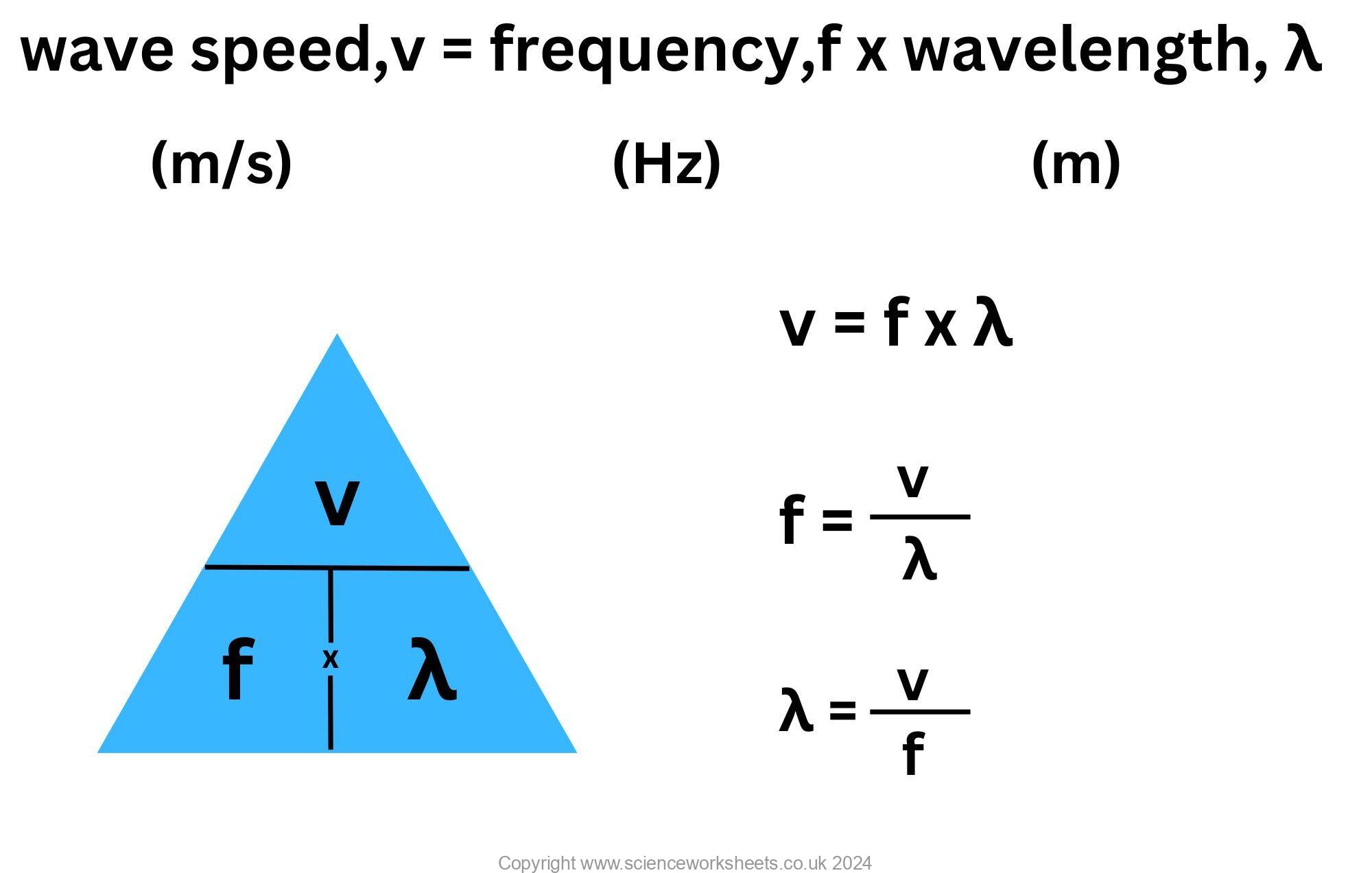
An important consequence of this relationship is that for a wave traveling in a medium where its speed () is constant, its frequency () and wavelength () are inversely proportional. If you increase the frequency, the wavelength must decrease, and vice-versa. Think of it like this: if you wiggle a rope up and down more quickly (higher frequency), the crests get bunched closer together (shorter wavelength).
2. Basic Calculations and Problem-Solving
Now, let's put the formula into practice with some direct applications. The following video works through several clear examples.
Period, Frequency, Amplitude, & Wavelength - Waves
This video from The Organic Chemistry Tutor demonstrates how to apply the wave speed formula in different scenarios, including handling unit conversions.
Watch the segment from 08:42 to 12:32. The first part (08:42 - 10:13) shows how to calculate wavelength given speed and frequency, including a conversion from kHz to Hz. The second part (10:13 - 12:32) demonstrates finding wave speed and frequency from wavelength and period, with conversions from cm to m and ms to s.
The video highlights the importance of unit consistency. Before you plug numbers into the formula, always ensure they are in SI units (meters, seconds, Hertz) to get the correct result.
Test your understanding!
A radio station broadcasts at a frequency of 101.5 MHz (MegaHertz). The speed of radio waves (a form of light) is approximately . What is the wavelength of the radio waves? (Remember: )
Show answer
-
Identify knowns:
-
Rearrange the formula to solve for wavelength ():
-
Calculate:
The wavelength of the radio waves is approximately 2.96 meters.
3. A Critical NEET Concept: Waves Changing Media
Here's a scenario that frequently appears in competitive exams. What happens when a wave passes from one medium into another? For example, a sound wave going from air to water, or a light wave from air to glass.
When a wave changes medium, its speed () changes because the properties of the medium are different. Consequently, its wavelength () must also change to satisfy the relationship.
However, the frequency () remains constant. The frequency is determined by the source of the wave. The source dictates how many cycles are produced per second, and the wave "remembers" this rate regardless of the medium it travels through.
So, the key takeaway is:
When a wave crosses a boundary between two media, is constant, while and change.
Since , we can write:
This implies a direct proportionality between speed and wavelength: .
Let's analyze a problem based on this concept.
ncert-exemplar-solutions-class-11-physics-chapter-15
This problem from the NCERT Exemplar directly tests the concept of a wave changing medium. Let's walk through it together.
Locate problem 2 in the 'Multiple Choice Questions – I' section. The problem describes a sound wave entering a new medium with a different speed.
Problem Analysis (NCERT Exemplar, Problem 2):
Sound waves of wavelength travelling in a medium with a speed of m/s enter into another medium where its speed is m/s. Wavelength of sound waves in the second medium is...
Solution:
- Identify the core principle: The wave is changing medium. Therefore, its frequency () remains constant.
- Set up the equations for both media:
- In medium 1:
- In medium 2: Let the new speed be and the new wavelength be . The equation is
- Equate the frequencies:
- Substitute the known values and solve for :
Cancel from both sides:
The new wavelength is . This makes sense: since the speed doubled and the frequency stayed the same, the wavelength must also double to maintain the relationship.
4. Extracting Parameters from the Wave Equation
Finally, let's connect today's lesson back to the previous one. A common task is to find and from a given wave equation.
Let's tackle a comprehensive problem from the NCERT Exemplar.
ncert-exemplar-solutions-class-11-physics-chapter-15
This problem requires you to deconstruct a given wave equation to find all its physical properties, including wave velocity. It's an excellent summary problem.
Find problem 35 in the PDF. The wave equation is given as y = 5sin(100πt - 0.4πx). We will find all the listed properties.
Problem Analysis (NCERT Exemplar, Problem 35):
Given the progressive wave where y and x are in m, t is in s. What is the... (b) wavelength, (c) frequency, (d) wave velocity?
Solution Strategy:
-
Standard Form Comparison: Write the given equation and the standard form one below the other. (Note: The order of and can be swapped, but the signs remain important).
Given:
Standard: -
Identify and :
- By comparison, rad/s.
- By comparison, rad/m.
-
Calculate Frequency () and Wavelength ():
- From :
- From :
- From :
-
Calculate Wave Velocity (): We have two methods, both of which are excellent checks on your work.
- Method 1 (Using and ):
- Method 2 (Using the shortcut):
- Method 1 (Using and ):
Both methods yield the same result, confirming our calculations.
Conclusion
You have now thoroughly explored the crucial relationship . This isn't just a formula to memorize; it's a fundamental principle that describes how all waves behave. Your ability to apply it in different contexts is key to success in this chapter.
Key Takeaways:
- The wave speed, frequency, and wavelength are linked by the simple equation .
- Always ensure your units are consistent (SI units are the standard) before performing calculations.
- Crucial Concept: When a wave passes from one medium to another, its frequency stays constant while its speed and wavelength change proportionally.
- You can efficiently find a wave's properties by comparing its equation to the standard form to extract and .
In our next lesson, we will build upon our understanding of wavelength to explore the concepts of phase difference and path difference, which are essential for understanding wave interference.