Hello! Welcome to the fourth lesson in our "Foundations of Oscillations and Waves" module.
In our last lesson, we did the heavy lifting of deriving the general mathematical expression for a progressive wave. We established that a wave's displacement y is a function of both position x and time t, represented by the versatile equation .
Today, we'll make this abstract equation concrete. Our goal is to master the practical skill of constructing the specific equation of a wave from its physical parameters (amplitude, wavelength, and frequency). This is a core competency for your NEET preparation, turning descriptive information about a wave into a powerful mathematical tool. We will also practice the reverse process: extracting physical information from a given wave equation.
Brief Recap:
From the previous lesson, remember these key relationships:
- General Wave Equation:
- Angular Wave Number (k): Relates to wavelength ().
- Angular Frequency (): Relates to period () and frequency ().
- Direction of Travel: The sign between
kxandωtmatters. A negative sign () means the wave travels in the positive x-direction, while a positive sign () means it travels in the negative x-direction.
Let's begin putting these pieces together.
1. The Recipe for a Wave Equation
Constructing a wave equation is like following a recipe. You need to gather a few key ingredients (the physical parameters) and combine them in the correct way.
To get a complete picture of the process, please watch the following video from Khan Academy. It masterfully builds the equation from the ground up, starting with a snapshot in space and then setting it in motion through time.
The equation of a wave | Physics | Khan Academy
This video, 'The equation of a wave', provides an excellent visual and conceptual walkthrough of how to build a wave equation using its physical properties.
Watch the video from the beginning to 14:38. Pay close attention to how the presenter first constructs the spatial part of the wave (y(x)) using amplitude and wavelength, and then incorporates the temporal part (y(t)) using the period to describe the wave's motion. The final example ties everything together.
As you saw in the video, to write the equation for a specific wave, you need to determine the following five components:
- Amplitude (): This is the maximum displacement from equilibrium. It's the number that multiplies the sine or cosine function.
- Waveform (sin or cos): This is determined by the wave's displacement at the origin () at the start time ().
- If and the wave goes up initially, use
sin. - If (a crest), use
cos. - If the starting condition is different, you'll need an initial phase (), which we will discuss more in complex problems. For most standard cases, you can start with sine or cosine.
- If and the wave goes up initially, use
- Angular Wave Number (): You'll almost always be given the wavelength . Calculate using .
- Angular Frequency (): You'll be given either the frequency or the period . Calculate using or .
- Direction of Travel: This determines the sign inside the brackets. Remember, for the form :
- Positive x-direction use a minus sign: .
- Negative x-direction use a plus sign: .
Once you have these five pieces, you assemble them into the final equation.
2. Practice: Constructing an Equation
Let's apply this recipe with a typical NEET-style problem.
Problem: A transverse wave on a string is traveling in the positive x-direction. It has an amplitude of 10 cm, a wavelength of 80 cm, and a frequency of 12 Hz. The displacement at and is zero. Write the equation describing this wave, using SI units.
Solution:
-
Convert to SI Units: This is a crucial first step.
- Amplitude:
- Wavelength:
- Frequency: (already in SI units)
-
Determine Parameters:
- Amplitude (A):
- Waveform: Since , we will use a sine function. This implies the initial phase .
- Angular Wave Number (k):
- Angular Frequency ():
- Direction: The wave travels in the positive x-direction, so we use a minus sign.
-
Assemble the Equation: Now, we plug these values into the standard form .
This is the final equation describing the wave in SI units.
Test your understanding!
A wave traveling in the negative x-direction has a maximum displacement of 5 cm. At , the particle at is at its maximum positive displacement. The distance between two consecutive crests is 2 m, and the wave completes 4 oscillations per second. Write the equation for this wave in SI units.
Show answer
-
Parameters from the problem:
- Amplitude:
- Direction: Negative x-direction.
- Initial condition: At , displacement is maximum (). This tells us to use a cosine function (or a sine function with an initial phase of ). Let's use cosine for simplicity.
- Wavelength: (distance between consecutive crests).
- Frequency: (4 oscillations per second).
-
Calculate and :
-
Assemble the Equation:
We use the form because it's a cosine wave traveling in the negative direction.
3. The Reverse Process: Deconstructing an Equation
Just as important as building the equation is being able to read one. In many problems, you'll be given the equation and asked to find the wave's properties. The process is simply a matter of comparison.
Your NCERT textbook provides an excellent guide and a worked example for this.
Please read the following sections from your NCERT textbook. They define the key parameters and then show a perfect example of how to extract these parameters from a given wave equation.
First, quickly review the sections titled 'Amplitude and Phase', 'Wavelength and Angular Wave Number', and 'Period, Angular Frequency and Frequency' to refresh your memory on the definitions of a, φ, k, and ω. Then, carefully study 'Example 14.2'. This example is a model for how you should approach these types of problems: by comparing the given equation directly to the standard form.
Let's summarize the strategy from the NCERT example:
Problem: A wave is described by , where all values are in SI units. Find its amplitude, wavelength, period, and frequency.
Solution Strategy:
-
Write the Standard Form: Write the general equation below the given one.
Given:
Standard: -
Compare and Identify: By direct comparison, you can see:
-
Calculate Physical Properties: Now use the definitions of and to find , , and .
- Wavelength (): Since , we have:
- Period (): Since , we have:
- Frequency ():
- Wavelength (): Since , we have:
This methodical comparison is your most reliable tool for these problems.
4. A Key Relationship: Wave Speed
Finally, let's briefly touch upon a concept that ties everything together and previews our next lesson: wave speed ().
You already know the fundamental relationship:
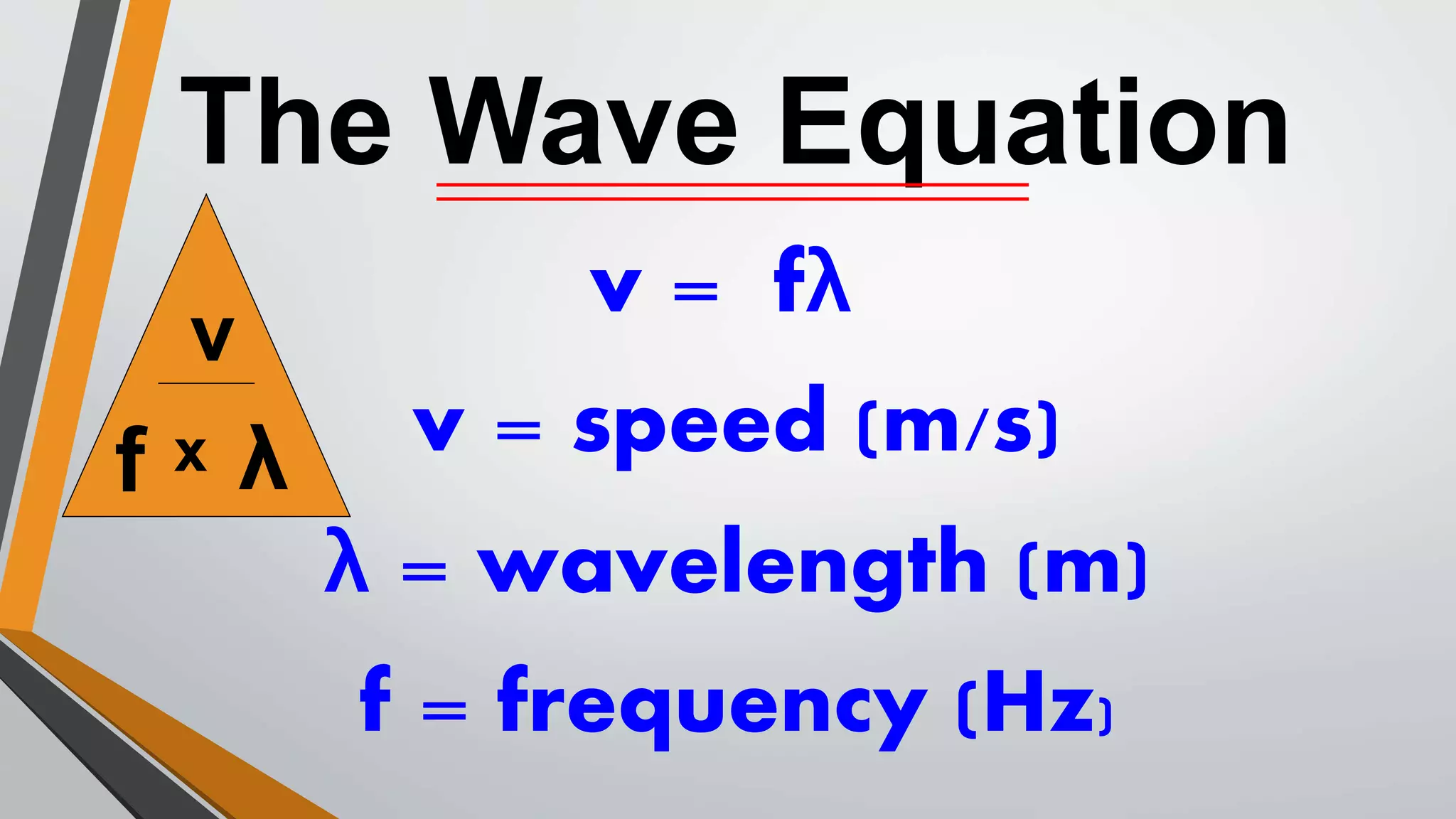
There is also a very useful shortcut for finding the wave speed directly from the equation's parameters, and :
You can derive this easily: . This formula is a massive time-saver in exams.
For the wave in our last example, , the wave speed is:
Conclusion
Today, you've learned the practical craft of translating between a wave's physical description and its mathematical one. This two-way skill is essential for solving a wide range of physics problems.
Key Takeaways:
- To construct a wave equation: You need its amplitude, wavelength, frequency, direction, and initial state (which determines the sine/cosine form).
- The recipe: Calculate and , determine the sign for direction, and assemble the equation .
- To deconstruct a wave equation: Compare it directly to the standard form to identify , , and . From these, you can calculate all other properties like , , , and .
- Wave speed shortcut: is a quick and powerful tool.
In our next lesson, we will focus more deeply on the relationship between wave speed, frequency, and wavelength () and solve a variety of problems related to it.