Hello! Welcome to your third lesson in the "Foundations of Oscillations and Waves" module.
In our previous lessons, we thoroughly explored the motion and energy of a single oscillating particle (Simple Harmonic Motion). Today, we take a significant step forward by examining how that oscillation propagates through a medium to form a wave. Our goal is to answer the question: how can we mathematically describe a wave that is traveling in space and evolving in time?
This lesson directly addresses the learning outcome: Derive the general equation for a one-dimensional progressive wave. Mastering this derivation is not just an exercise; it's about understanding the fundamental equation that governs all wave phenomena we will study later.
Brief Recap:
From our study of SHM, we know the displacement of a single particle at the origin oscillating vertically can be described by:
Here, is the displacement at time , is the amplitude, and is the angular frequency. This equation describes motion at a single point (). Today, we will extend this to describe the motion at any point .
1. From an Oscillating Particle to a Traveling Wave
Imagine you have a long rope. If you start shaking one end () up and down in simple harmonic motion, you'll see a wave travel down the rope. This is a progressive wave—a disturbance that travels or "progresses" through a medium.
The core idea is this: every particle on the rope performs the same SHM as the first particle, but with a time delay. A particle at some position will do exactly what the particle at the origin did, just a little bit later.
Let's build the equation step-by-step:
-
The Source: The particle at the origin () oscillates according to the SHM equation. Its displacement at any time is:
-
The Propagation: The wave travels along the positive x-axis with a constant speed, .
-
The Time Lag: How long does it take for the disturbance to travel from the origin to a point at a distance ?
-
The Motion at Point P: The particle at point will start its oscillation seconds after the particle at the origin. Therefore, its displacement at time must be the same as the displacement of the origin particle at the earlier time .
-
The Wave Equation: To find the displacement at at time , which we call , we take the equation for the source and substitute with :
This is the fundamental equation for a one-dimensional progressive wave traveling in the positive x-direction.
To see this derivation explained with clear visuals, watch the following video. It builds the logic exactly as we just did.
Derivation of displacement relation of a progressive wave • HERO OF THE DERIVATIONS.
This video from 'Hero of the derivations' provides a clear, step-by-step derivation of the progressive wave equation. It starts with the SHM of a single particle and introduces the concept of a time lag to describe the wave.
Watch from 01:45 to 11:20. The first part (until 07:19) establishes the equation for a single oscillating particle at the origin. The second part (from 07:19 onwards) is the crucial step where the time delay is introduced to derive the wave function for a point at distance 'x'.
2. The Many Faces of the Wave Equation
The equation we derived, , is correct but can be written in several other forms that are more common in physics problems. Let's explore them.
Introducing the Wave Number,
Let's expand the argument of the sine function:
Now, let's examine the term . We know the angular frequency (where is the time period) and the wave speed (where is the wavelength).
Substituting these gives:
This important quantity, , is called the angular wave number or simply the wave number, denoted by .
The wave number has units of rad/m. It represents the spatial frequency of the wave—it tells you how many radians of phase change occur per unit distance.
By substituting back into our equation, we get the most common form of the wave equation:
Here is a visual summary of this derivation logic.
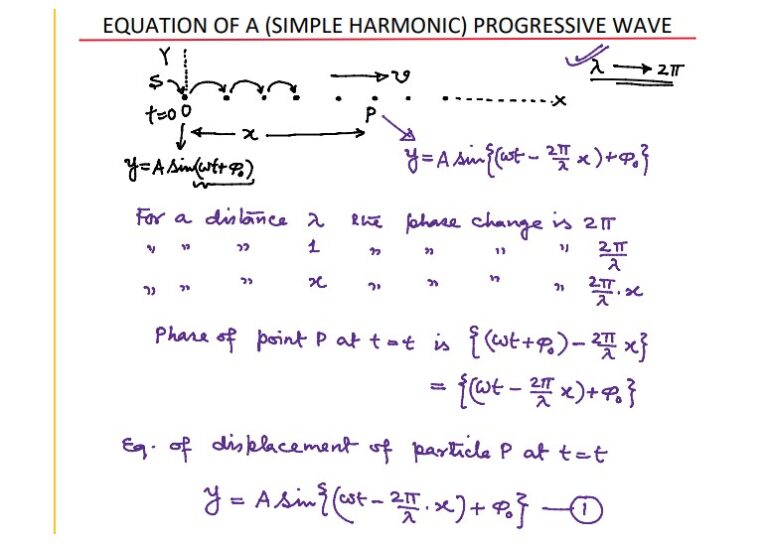
Other Common Forms
All of the following equations describe the same wave. Being able to recognize and convert between them is a key skill for NEET.
Starting from :
-
Substitute and :
-
Factor out and use :
Direction of Propagation
The sign between the time () and position () terms determines the wave's direction.
- Negative sign (
ωt - kxorkx - ωt): The wave travels in the positive x-direction. For a point of constant phase (e.g., a crest), as timetincreases, positionxmust also increase to keep the phase(ωt - kx)constant. - Positive sign (
ωt + kx): The wave travels in the negative x-direction. Astincreases,xmust decrease to keep the phase(ωt + kx)constant.
Finally, we can add an initial phase constant, , to account for the starting condition of the wave at and . The most general form is:
The following resource provides an excellent formal summary of these mathematical relationships.
The OpenStax 'University Physics' textbook offers a clear, structured explanation of the wave function and its different mathematical forms.
Read the section 'Modeling a One-Dimensional Sinusoidal Wave Using a Wave Function'. Focus on the derivation steps leading to the final equation y(x,t) = A sin(kx ∓ ωt). Pay special attention to the definitions of wave number (k) and angular frequency (ω) and the logic for the plus/minus sign.
Test your understanding!
A transverse wave traveling along the x-axis is described by the equation:
where and are in meters and is in seconds.
- What is the amplitude of the wave?
- What is the angular frequency and wave number?
- In which direction is the wave traveling?
Show answer
Comparing the given equation to the general form :
-
Amplitude (A): The amplitude is the maximum displacement, which is the coefficient of the sine function.
-
Angular Frequency () and Wave Number ():
- The term multiplying is . So, rad/s.
- The term multiplying is . So, rad/m.
-
Direction: The sign between the and terms is positive. This indicates that the wave is traveling in the negative x-direction.
3. An Alternative Perspective
There's another intuitive way to build the wave equation, which complements the time-delay method. You can start by taking a "snapshot" of the wave in space at and then make that snapshot move. The Khan Academy video below explains this approach brilliantly.
The equation of a wave | Physics | Khan Academy
This Khan Academy video provides a different but equally powerful way to derive the wave equation. It starts with a spatial picture of the wave (y(x)) and then introduces time dependence to make it move.
Watch the segments from 01:38 to 05:08 and from 07:18 to 11:34. The first part shows how to describe a static wave shape using y(x) = A cos(kx). The second part explains how to add the time-dependent term ωt to make the wave propagate.
Both derivation methods lead to the same result and reinforce your understanding of the relationship between space, time, and phase in a wave. For quick revision of all the forms, the following notes are very helpful.
Revision Notes on Waves for NEET 2026 - Vedantu
These revision notes from Vedantu provide a concise summary of the different forms of the harmonic wave equation, which is ideal for quick review before an exam.
Review the sections 'Equation of a Harmonic Wave' and the 'Formula Chart' at the end. Notice how the various forms of the equation are presented. This is a good way to consolidate what you've learned.
Conclusion
Today we have built the mathematical framework for describing waves. By starting with the simple harmonic motion of a single particle and considering the time it takes for that motion to propagate, we derived the general equation for a one-dimensional progressive wave.
Key Takeaways:
- A wave is a propagating oscillation. The motion of any particle at position is a time-delayed version of the motion at the origin.
- The general equation for a sinusoidal wave can be expressed in several equivalent forms. The most common is:
- Key parameters are Amplitude (), Wave Number (), and Angular Frequency ().
- The sign between the and terms determines the direction of travel: '
+' for the negative direction and '-' for the positive direction.
In our next lesson, we will put this equation to practical use. We will learn how to construct the specific equation of a wave from its physical parameters (amplitude, wavelength, frequency) and how to extract these parameters from a given equation—a crucial skill for solving NEET-style problems.