Hello! Welcome to your second lesson in the "Foundations of Oscillations and Waves" module.
In our previous lesson, we established the mathematical language for describing Simple Harmonic Motion (SHM), deriving equations for displacement, velocity, and acceleration. Today, we'll use that foundation to explore the energy dynamics of an oscillating system. This directly addresses the learning outcome: Calculate kinetic, potential, and total energy in oscillating systems like springs and pendulums.
A key principle in physics is the conservation of energy. In this lesson, we will see how energy transforms between different forms during SHM and how the total energy remains constant, a concept that is not only fundamental but also provides powerful shortcuts for solving NEET-level problems.
Brief Recap:
From the last lesson, we know that for a particle in SHM:
- Displacement:
- Velocity:
- The restoring force is , and the angular frequency is related to mass and the spring constant by .
These equations for displacement and velocity are the starting points for everything we will do today.
1. Kinetic Energy in SHM
Kinetic energy (KE) is the energy of motion. For a particle of mass moving with velocity , the kinetic energy is given by:
We can express this kinetic energy in terms of either displacement () or time ().
Kinetic Energy as a Function of Displacement
To express KE in terms of displacement , we first need an expression for velocity in terms of . We can derive this from our standard SHM equations:
From , we have .
From , we have .
Using the trigonometric identity :
So, the magnitude of the velocity is .
Now, substituting this expression for into our KE formula:
Since , we get the important relation:
From this equation, we can see:
- Maximum KE: Occurs when (the mean position). .
- Minimum KE: Occurs when (the extreme positions). .
The following video provides a clear derivation and explanation of these concepts.
SIMPLE HARMONIC MOTION 03 | Energy in S.H.M | Physics | Class 11th/NEET/JEE
This video from PW English Medium will walk you through the derivation for kinetic energy in SHM and explain where it reaches its maximum and minimum values.
Watch the segment from 00:42:50 to 00:47:15. Focus on how the equation for velocity is used to derive the kinetic energy as a function of displacement, KE = \frac{1}{2}k(A^2 - x^2).
2. Potential Energy in SHM
Potential energy (PE) is the energy stored in a system due to its position or configuration. For a spring-mass system, the restoring force is a conservative force, and the associated elastic potential energy is:
This is the primary formula for potential energy in SHM. From this, we can see:
- Maximum PE: Occurs at the extreme positions, where . .
- Minimum PE: Occurs at the mean position, where . .
The video below explains this concept.
SIMPLE HARMONIC MOTION 03 | Energy in S.H.M | Physics | Class 11th/NEET/JEE
Now, let's look at the potential energy. This part of the same video explains the formula for potential energy and its properties.
Watch from 00:50:16 to 00:52:15. Pay attention to the simple formula for potential energy and where it becomes maximum and minimum.
3. Total Mechanical Energy and Conservation
The total mechanical energy () of the oscillator is the sum of its kinetic and potential energies:
Let's substitute the expressions we found in terms of displacement :
This is a powerful result. It shows that the total mechanical energy of a simple harmonic oscillator is constant. It does not depend on the instantaneous position or time . The energy simply transforms between kinetic and potential forms, but their sum is always conserved.
Notice also that:
Since , we can also write the total energy as:
This confirms that the total energy depends only on the mass, angular frequency, and amplitude of the oscillation.
SIMPLE HARMONIC MOTION 03 | Energy in S.H.M | Physics | Class 11th/NEET/JEE
The following clip demonstrates this crucial derivation and explains the principle of energy conservation in SHM.
Watch from 00:56:25 to 01:00:14. This section proves that the total energy is constant and is equal to the maximum kinetic or potential energy.
4. Graphical Representation of Energy in SHM
Visualizing how these energies change is essential.
Energy vs. Displacement
The formulas and describe parabolas when plotted against .
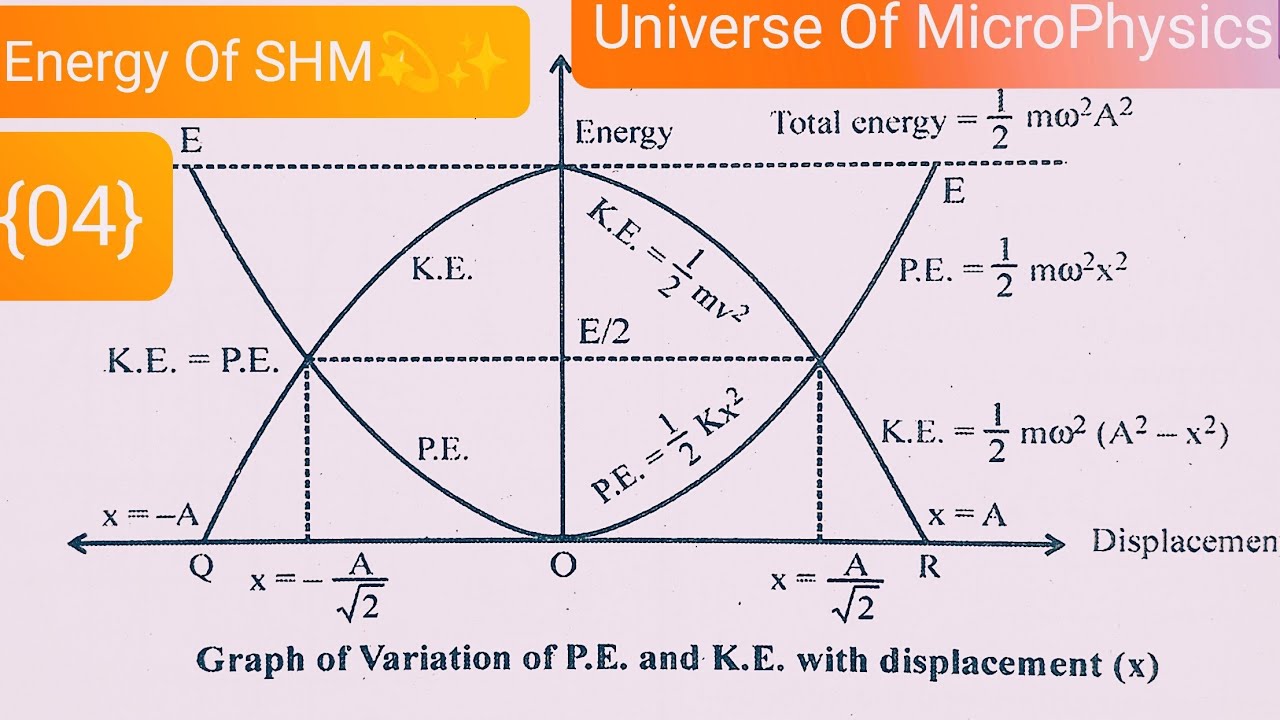
From the graph, you can see that at any displacement , the sum of the PE and KE values always equals the total energy .
Energy vs. Time
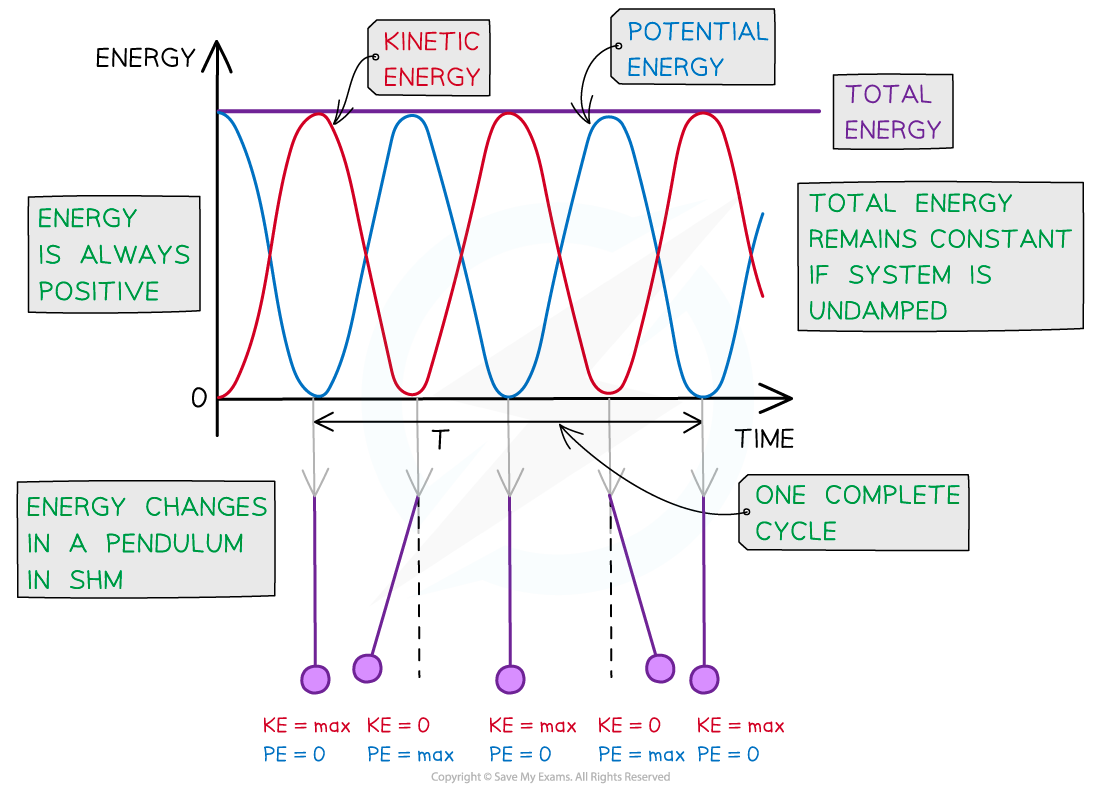
We can also plot these energies as functions of time, using (assuming ):
To tie all these concepts together, let's turn to your NCERT textbook.
NCERT Physics Textbook: Oscillations
The NCERT textbook provides a concise and authoritative summary of all the energy concepts and graphs we've discussed.
Please read Section 13.6, titled 'Energy in Simple Harmonic Motion'. It starts on page 268 of the PDF. Pay close attention to equations 13.15 through 13.18 and the accompanying Figure 13.16, which shows the energy graphs.
5. Problem-Solving: Applying the Energy Concepts
Now, let's put this theory into practice. Your ability to apply these formulas is key for the NEET exam. We'll work through a standard problem from the NCERT textbook.
NCERT Physics Textbook: Oscillations
This example from your textbook is a classic problem that requires you to calculate KE, PE, and total energy at a specific point in the oscillation.
Carefully read through Example 13.7 on page 269 of the PDF. Follow each step of the calculation.
Let's break down the logic of Example 13.7:
Given:
- Mass, kg
- Spring constant, N/m
- Amplitude, cm = m
- We need to find energies at displacement cm = m.
Solution Steps:
-
Calculate Total Energy (E): This is the easiest first step and a good check for your final answer. The total energy is constant throughout the motion.
-
Calculate Potential Energy (U) at x = 0.05 m:
-
Calculate Kinetic Energy (KE) at x = 0.05 m: You could use , or, since you know the total energy, you can simply use the conservation principle:
(Note: The textbook calculates velocity first and gets J due to rounding. Using the energy conservation formula is often more direct and precise).
This problem demonstrates the power of the energy conservation principle.
Test your understanding!
A particle of mass 200 g executes SHM with an amplitude of 20 cm and a time period of 2 s. What is its total mechanical energy? At what displacement from the mean position will its kinetic energy be equal to its potential energy?
Show answer
Part 1: Total Energy
- First, find the angular frequency :
- Convert mass and amplitude to SI units:
- g = kg
- cm = m
- Calculate total energy :
Part 2: Position where KE = PE
- We want to find the position where .
- We know that . If , then .
- Substitute the formulas for and :
- Substitute the value of A:
This is a standard result worth remembering: kinetic and potential energies are equal at .
For more practice with problem-solving techniques, the following video is an excellent resource.
Energy In a Simple Harmonic Oscillator - Maximum Velocity & Acceleration Calculations
This video from The Organic Chemistry Tutor provides another worked example, clearly demonstrating how to use the principle of energy conservation to find the velocity of the oscillating block at any given position.
Watch the segments from 00:06:54 to 00:10:32 and 00:11:56 to 00:14:41. The first part explains the energy distribution, and the second solves for velocity using energy conservation. This is a very common type of question in competitive exams.
Conclusion
Today, we've dissected the energy of an object in Simple Harmonic Motion, a cornerstone of your NEET preparation for this chapter.
Key Takeaways:
- Kinetic Energy: . It is maximum at the center () and zero at the extremes ().
- Potential Energy: . It is zero at the center and maximum at the extremes.
- Total Energy: . It is always conserved in an ideal system.
- The relationship is a powerful tool for solving problems, allowing you to find one quantity if you know the other two.
In our next lesson, we will shift our focus from the oscillation of a single particle to see how these oscillations can travel through a medium. We will derive the general equation for a one-dimensional progressive wave, setting the stage for understanding wave phenomena.