Hello! Welcome back.
In our last lesson, we derived the cornerstone formula for wave superposition: . This equation tells us that the amplitude of the combined wave depends entirely on the phase difference, , between the individual waves.
Today, we will use this formula to answer the central question of interference: what specific conditions lead to the waves reinforcing each other (constructive interference) or cancelling each other out (destructive interference)? Your learning outcome is to solve problems on the conditions for constructive and destructive interference. Mastering these conditions is non-negotiable for your NEET preparation, as they are fundamental to solving a wide range of problems in both mechanical waves and wave optics.
1. Conditions for Constructive Interference
Constructive interference occurs when the resultant amplitude, , is at its maximum possible value. Looking at our main formula, this happens when the term is at its maximum.
The maximum value of is +1. This occurs when the phase difference is an even multiple of .
Phase Condition:
where
This means the waves are "in phase". Their crests align with crests, and troughs align with troughs.
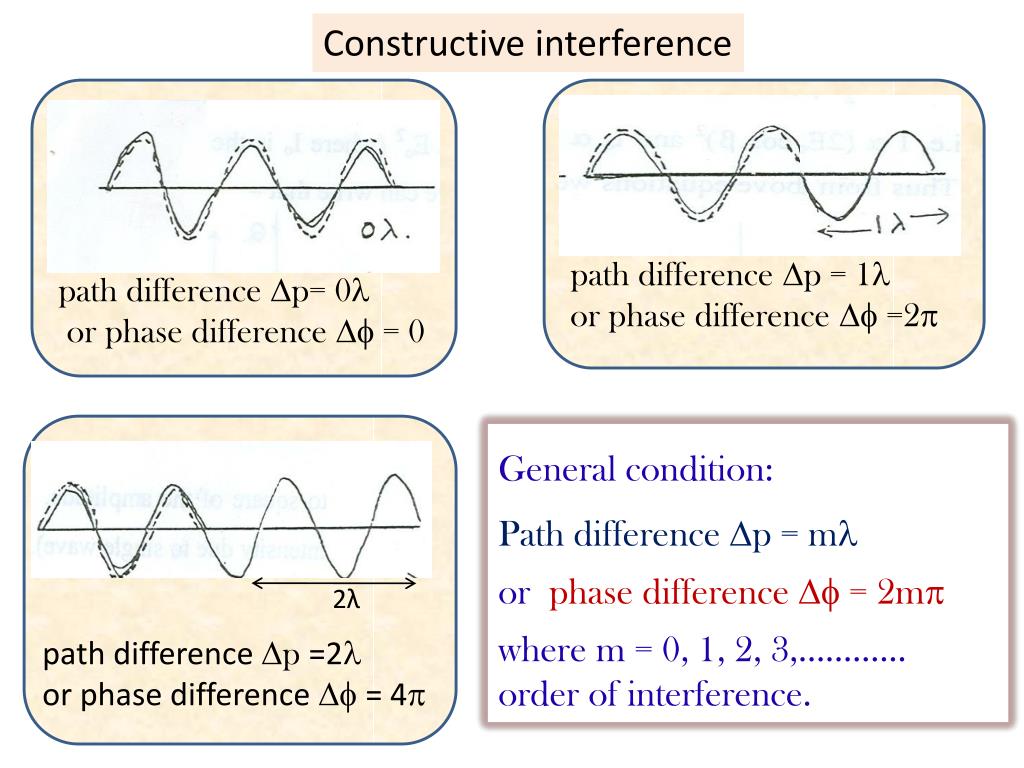
When , the resultant amplitude formula simplifies to:
The amplitudes simply add up.
Path Difference Condition:
We can translate the phase condition into a condition on the path difference, , using the relation we learned previously: .
Substituting the phase condition:
where
So, constructive interference occurs when the path difference is an integer multiple of the wavelength.
2. Conditions for Destructive Interference
Destructive interference occurs when the resultant amplitude, , is at its minimum. This happens when the term is at its minimum value, which is -1.
Phase Condition:
This occurs when the phase difference is an odd multiple of .
where
(Note: This corresponds to . Some books use with , which is equivalent).
This means the waves are "out of phase". The crests of one wave align with the troughs of the other.
When , the resultant amplitude formula becomes:
The resultant amplitude is the difference between the individual amplitudes. If , the resultant amplitude is zero!
Path Difference Condition:
Again, we convert the phase condition to a path difference condition:
where
So, destructive interference occurs when the path difference is a half-integer multiple of the wavelength (e.g., ).
3. Resultant Intensity
For NEET, problems often ask about intensity rather than amplitude. The key relationship is that the intensity of a wave is proportional to the square of its amplitude: .
This allows us to write the formula for resultant intensity:
This formula directly follows from the amplitude equation .
From this, we can find the maximum and minimum possible intensities:
- Maximum Intensity (Constructive): Occurs when .
- Minimum Intensity (Destructive): Occurs when .
The following reading from Aakash, a source dedicated to competitive exam prep, formalizes these conditions.
Interference of waves, intensity, practice problems, FAQs
This article formally lays out the mathematical conditions for constructive and destructive interference, and also derives the important formulas for resultant intensity. Pay close attention to the sections on special cases and intensity.
Please read the sections titled 'Special Cases of Interference' and 'Intensity of Resultant wave'. Focus on the final formulas for phase difference, path difference, and intensity for both constructive and destructive cases.
Test your understanding!
Two waves have intensity in the ratio 9:1. They interfere to produce fringes. What is the ratio of maximum intensity to minimum intensity?
Show answer
Let the intensities be and .
The ratio of their amplitudes is . So, let and .
Maximum intensity occurs when amplitudes add: .
So, .
Minimum intensity occurs when amplitudes subtract: .
So, .
The ratio is .
The ratio is 4:1.
Alternatively, using the intensity formulas:
4. NEET-Style Problem Solving
Let's apply these conditions to problems typical of the NEET exam. This is the "vigorous focus" on mathematical application you asked for.
Guided Example 1: Interference in a Tube
Let's work through a classic problem involving path difference.
Interference of sound waves, practice problems, FAQs
This problem from the Aakash resource on sound wave interference is a perfect example of applying path difference conditions. We will solve it together.
Read the first practice problem ('The figure shows a tube structure...'). We will break down the solution step-by-step.
Problem Breakdown:
- Identify the paths: Sound from the source can reach the receiver via two routes: the straight path and the semicircular path.
- Calculate the path difference ():
- Length of straight path: (the diameter).
- Length of semicircular path: (half the circumference).
- Path difference .
- Substitute values: The radius .
- Apply the condition for constructive interference: For maximum intensity (constructive interference), the path difference must be an integer multiple of the wavelength: , where (n=0 is not possible as is not zero).
- Relate wavelength to frequency: We know , so .
- Find the frequencies: Now we plug in the values and .
We need to find the integer values of that give frequencies between 1000 Hz and 4000 Hz.- For , . (This is in the range).
- For , . (This is also in the range).
- For , . (This is outside the range).
So, the maxima of intensity are detected at approximately 1491 Hz and 2982 Hz.
Guided Example 2: Angle of Interference Minima
Here's another common problem type that involves geometry.
Interference of sound waves, practice problems, FAQs
This second problem from the Aakash resource involves finding an angle for destructive interference from two speakers. This requires combining interference conditions with trigonometry.
Read the problem about the two speakers ('Two speakers, S1 and S2...').
Problem Breakdown:
- Find the wavelength: , .
- Find the path difference: As shown in the resource's diagram, when the observer is far away, the paths from S1 and S2 are nearly parallel. The path difference is given by .
- Here, is the distance between the speakers, which is .
- So, .
- Apply the condition for destructive interference: We want the first minimum. This corresponds to the smallest non-zero path difference for destructive interference. The condition is . The first minimum occurs for .
- Solve for :
For small angles, (in radians), but let's calculate the angle properly. . The solution in the resource calculates it as approximately , which is correct.
5. Conceptual Review
Now that we've covered the math and solved some problems, let's solidify the core concepts with a clear, visual explanation.
Constructive and Destructive interference | Physics | Khan Academy
This Khan Academy video provides an excellent visual and conceptual walkthrough of how path difference leads to constructive and destructive interference.
Watch the segment from 04:04 to 09:22. It visually demonstrates how shifting one wave source by integer or half-integer multiples of the wavelength creates the conditions for constructive and destructive interference that we just derived mathematically.
This video is a great way to reinforce your intuition for why the formulas and work.
Conclusion
Today, we've moved from the general principle of superposition to the specific, testable conditions for interference. These rules are the bedrock of many phenomena you'll study in Wave Optics as well.
Key Takeaways:
- Constructive Interference (Maximum Amplitude/Intensity):
- Phase Difference:
- Path Difference:
- Destructive Interference (Minimum Amplitude/Intensity):
- Phase Difference:
- Path Difference:
- Resultant Intensity: , leading to and .
Preview of the Next Lesson:
We've considered waves traveling in the same direction. What happens if two identical waves travel through each other in opposite directions? This specific case of interference leads to a fascinating phenomenon called a standing wave. In the next lesson, we will describe the formation and properties of these stationary patterns.