Hello! Welcome to your first lesson on refraction.
In the previous module, we concluded our study of light's behavior at reflective surfaces, mastering everything from ray diagrams to solving complex problems with mirror combinations. As promised, we now pivot from reflection to the second major phenomenon of ray optics: refraction.
Today's lesson addresses the learning outcome: Apply Snell's law to solve refraction problems at plane interfaces. This is a fundamental skill for your NEET preparation, forming the basis for understanding lenses, prisms, and many optical phenomena. We'll start with the core concepts of why light bends, introduce the crucial quantity called refractive index, and then dive into applying Snell's Law to solve a variety of problems, just as you requested for your exam practice.
1. The Bending of Light: Refraction and Refractive Index
You've likely observed that a pencil in a glass of water appears bent. This illusion is due to refraction, the bending of light as it passes from one transparent medium to another. But why does it bend?
The bending occurs because the speed of light changes when the medium changes. Every transparent medium has an "optical density," which we quantify using the refractive index (n).
To understand this fundamental concept, let's watch a short video.
Ray optics L3 🔍 Refraction of Light at Plane Surface | Class 12 | JEE 2022 | Shreyas sir | V Enthuse
The video 'Ray optics L3 🔍 Refraction of Light at Plane Surface' from Vedantu JEE English provides a clear explanation of why light bends and introduces the concepts of absolute and relative refractive index. This will build our conceptual foundation.
Watch from 03:57 to 15:20. Focus on: The definition of incident and refracted rays. How the speed of light is related to the absolute refractive index (n = c/v). The distinction between absolute refractive index and relative refractive index (_{1}\mu_{2} or n_{21}).
As the video explained, here are the key takeaways:
-
Absolute Refractive Index (): A property of a single medium, defined as the ratio of the speed of light in vacuum () to the speed of light in the medium ().
Since is always less than or equal to , the refractive index is always greater than or equal to 1. A higher means a more optically dense medium and a slower speed of light. For air, is very close to 1, so we often approximate it as . -
Relative Refractive Index (): Compares two media. The refractive index of medium 2 with respect to medium 1 () is:
Pay close attention to the subscripts: has in the numerator but in the numerator. This is a common point of confusion.
A Note on Wavelength
When light enters a new medium, its speed and wavelength change, but its frequency remains constant. Since , if the speed changes, the wavelength must also change. The relationship is:
2. Snell's Law: The Law of Refraction
Now that we understand refractive index, we can precisely describe how much light bends. This is governed by Snell's Law.
First, let's establish the geometry.
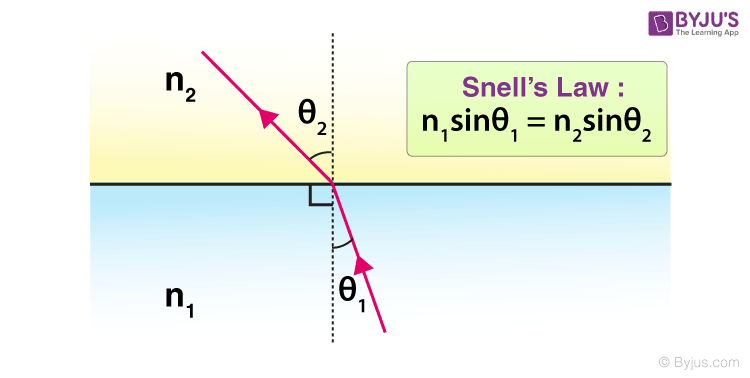
Snell's Law states the mathematical relationship between the angles and refractive indices:
Here, and are the refractive index and angle in the first medium, and and are the values in the second medium.
Let's watch a segment that explains this law and its immediate consequences.
Ray optics L3 🔍 Refraction of Light at Plane Surface | Class 12 | JEE 2022 | Shreyas sir | V Enthuse
We'll return to the Vedantu video to see a detailed explanation of Snell's Law and the qualitative rules for how light bends.
Watch from 23:57 to 30:06. Focus on: The two laws of refraction (coplanarity and Snell's Law). The condition for bending towards the normal (rarer to denser). The condition for bending away from the normal (denser to rarer). The special case of normal incidence (i=0).
Summary of Bending Rules:
- Rarer to Denser (): To maintain the equality in , if is larger, must be smaller. This means . The ray bends towards the normal.
- Denser to Rarer (): If is smaller, must be larger. This means . The ray bends away from the normal.
- Normal Incidence (): If the incident ray is along the normal, . This forces , so . The ray passes without deviation.
3. Applying Snell's Law: Problem-Solving for NEET
Your goal is to become proficient in applying this law. We'll work through problems of increasing complexity, a method well-suited for competitive exam preparation.
Level 1: Direct Application
Let's start with a classic, straightforward problem.
Snell's Law & Index of Refraction Practice Problems - Physics
The video 'Snell's Law & Index of Refraction Practice Problems' from The Organic Chemistry Tutor provides a very clear, step-by-step calculation for a basic refraction scenario.
Watch from 05:03 to 08:08. Follow the calculation for light going from air to water. Notice the clear, methodical process: identify knowns, write the formula, substitute, and solve.
Here is a static image showing a similar calculation, which you can use as a reference.

Test your understanding!
A ray of light traveling in water () strikes a glass plate () at an angle of incidence of 50°. What is the angle of refraction in the glass?
Show answer
We have:
- Medium 1 (water): ,
- Medium 2 (glass): ,
Using Snell's Law:
Since the ray goes from a rarer medium (water, n=1.33) to a denser medium (glass, n=1.50), it bends towards the normal, as expected ().
Level 2: Refraction Through Multiple Parallel Layers
A common NEET problem involves light passing through several parallel slabs, like air -> glass -> water -> air.
Snell's Law & Index of Refraction Practice Problems - Physics
Let's watch another segment from The Organic Chemistry Tutor. It demonstrates how to handle a multi-layer problem and reveals a very useful shortcut.
Watch from 08:08 to 14:23. Pay close attention to two things: The angle of refraction from the first interface becomes the angle of incidence for the second interface. The shortcut that allows you to relate the first and last medium directly, ignoring the intermediate layers: n_1 \sin heta_1 = n_{final} \sin heta_{final}.
The Multi-Layer Shortcut:
For any number of parallel layers, the relationship between the initial angle of incidence () in the first medium () and the final angle of refraction () in the last medium () is simply:
This is incredibly useful because it means the final exit angle of a ray passing through a parallel-sided slab is the same as its initial entry angle if the first and last media are the same (e.g., air).
Level 3: Interfaces with Geometry
Things get more interesting when the interfaces are not parallel, which requires you to combine Snell's law with geometry. This is very typical of higher-level NEET questions.
Snell's Law & Index of Refraction Practice Problems - Physics
This next clip shows how to solve a problem where light passes through a triangular block. This is a precursor to understanding prisms.
Watch from 14:23 to 17:58. The key insight here is how the angle of refraction at the first surface is related to the angle of incidence at the second surface through the triangle's internal angles. Follow the geometric steps carefully.
The strategy here is to break the problem down:
- Apply Snell's law at the first interface to find the first angle of refraction.
- Use the geometry of the block (e.g., sum of angles in a triangle) to find the angle of incidence at the second interface.
- Apply Snell's law again at the second interface to find the final angle of refraction.
Conclusion
In this lesson, you've mastered the foundational law of refraction. We have moved logically from the concept of why light bends to the mathematical tools needed to solve problems, just as you prefer for your NEET preparation.
Key Takeaways:
- Refraction is the bending of light due to a change in its speed as it crosses the boundary between two media.
- Refractive Index quantifies this change: . Higher means a slower speed.
- Snell's Law is the governing equation: . Remember that angles are always measured from the normal.
- Problem-Solving Strategy: For simple cases, apply the formula directly. For multi-layer parallel slabs, you can use the shortcut . For non-parallel surfaces, combine Snell's Law with geometry at each interface.
Preview of the Next Lesson:
Now that we have Snell's Law in our toolkit, we can explore some of its fascinating and practical consequences. In the next lesson, we will use it to analyze the phenomena of apparent depth (why a pool looks shallower than it is) and lateral shift (how a ray is displaced by a glass slab).