Hello! Welcome back to our journey through Ray Optics.
In our last lesson, we established the fundamental principle of refraction: Snell's Law. You learned how to use the formula to predict the path of light across different media, a crucial skill for your NEET preparation.
Today, we will build directly on that foundation to explore two fascinating and very practical consequences of refraction. Our goal is to analyze the phenomena of apparent depth and lateral shift through transparent slabs. You've seen these effects in everyday life—a swimming pool appearing shallower than it is, or the way an image seems to shift when viewed through thick glass. Today, you'll master the physics and mathematics behind these illusions.
1. Apparent Depth: The Pool Illusion
When you look down into a body of water, objects at the bottom appear closer to the surface than they actually are. The depth you perceive is the apparent depth, while the true depth is the real depth. This phenomenon is a direct consequence of refraction.
To understand how this works visually, let's watch a video that sets up the scenario and derives the governing equation. This follows your preferred approach of mastering the visual representation before diving into the formulas.
Refraction : case-1 derivation of Real & Apparent Depth expression | Grade 12 physics
The video 'Refraction : case-1 derivation of Real & Apparent Depth expression' by Make Me Scientific provides an excellent visual and mathematical breakdown of this concept.
Watch the video from the beginning to 08:18. From 00:00 to 03:55, focus on the ray diagram and how the brain perceives a virtual image at a shallower 'apparent depth'. From 03:55 to 08:18, follow the mathematical derivation which uses Snell's Law and the small-angle approximation (\sin heta \approx an heta) for near-normal viewing.
Derivation Summary and Key Formulas
As the video demonstrated, for an observer looking from a rarer medium (e.g., air, refractive index ) at an object in a denser medium (e.g., water, refractive index ), the light rays from the object bend away from the normal as they exit the water. Your brain traces these refracted rays back in a straight line, forming a virtual image above the actual object.
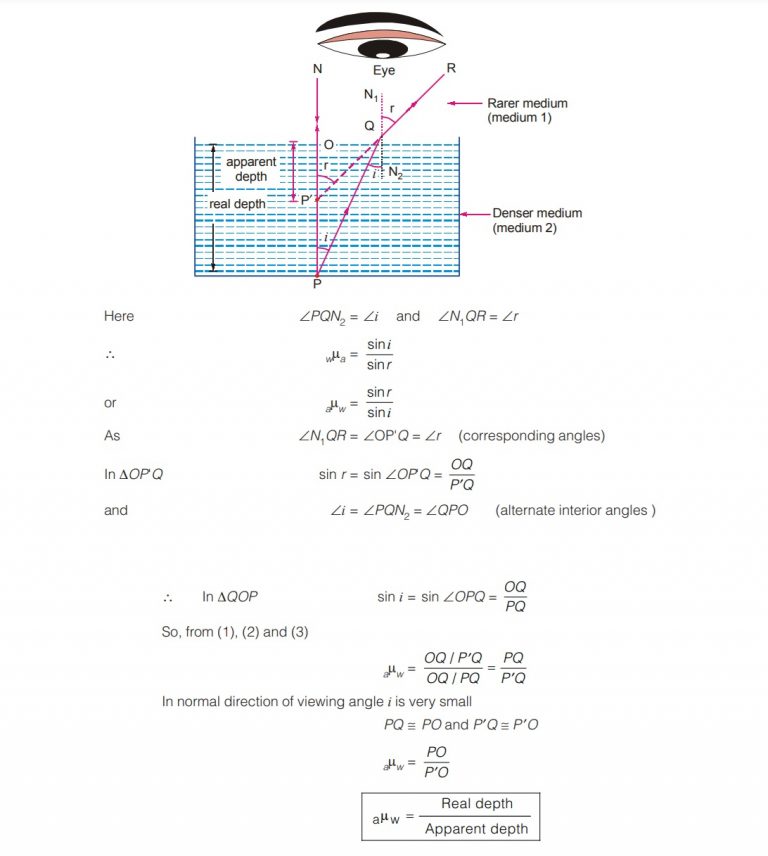
From the derivation using Snell's Law () and the small-angle approximation ( and ), we arrive at the general relationship:
Where:
- is the refractive index of the medium the observer is in.
- is the refractive index of the medium the object is in.
A very common case for NEET problems is observing an object in a medium of refractive index from air (). In this scenario, the formula simplifies to:
The difference between the real and apparent depth is called the apparent shift ():
This shift formula is extremely useful and frequently tested.
Test your understanding!
A small stone is at the bottom of a tank filled with water () to a depth of 80 cm. What is the apparent depth of the stone when viewed from directly above? What is the apparent shift?
Show answer
Here, cm and . The observer is in air ().
Using the simplified formula:
The stone appears to be at a depth of 60 cm.
The apparent shift is:
Alternatively, using the shift formula:
2. Apparent Shift Through Multiple Layers
What happens if you view an object through several stacked, immiscible liquids (like oil on top of water)? The total apparent shift is simply the sum of the individual shifts caused by each layer.
Class 12 Physics | Refraction of Light | #28 Shift of Object due to Multiple Slabs | For JEE & NEET
The video 'Shift of Object due to Multiple Slabs' from Physics Galaxy clearly explains how the final image is formed and how the total shift is calculated.
Watch from the beginning to 03:44. Focus on the core idea that the total shift is the sum of the individual shifts produced by each slab.
For a series of slabs with thicknesses and refractive indices , the total apparent shift () is:
Let's see this applied in a worked example.
Refraction Through Plane Surfaces
The webpage 'Refraction Through Plane Surfaces' provides a concise summary and a worked example for apparent shift through multiple slabs, which will help you solidify your problem-solving approach.
Read the sections titled 'Apparent shift' and 'Example 15.7'. Focus on how the total shift is calculated by summing the individual shifts from each slab.
3. Lateral Shift
Now let's consider a different scenario. When a ray of light passes through a transparent slab with parallel faces, such as a thick pane of glass, it undergoes refraction twice: once on entering and once on exiting.
As we saw in the last lesson, if the medium on both sides is the same (e.g., air), the emergent ray will be parallel to the incident ray. However, it will be displaced sideways. This perpendicular displacement between the incident and emergent rays is called lateral shift.
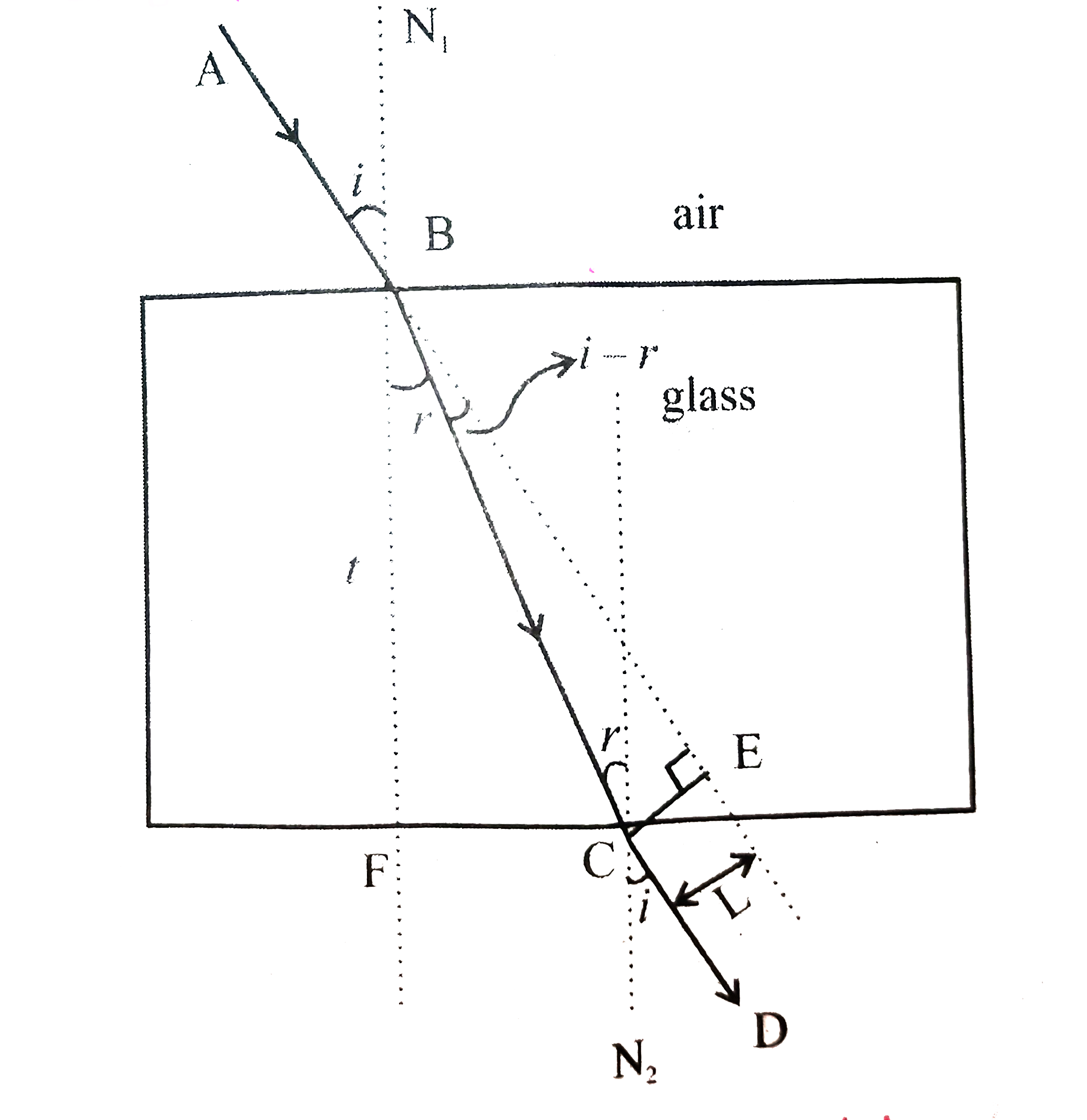
From the geometry of the ray path inside the slab, we can derive the formula for the lateral shift (). Using trigonometry in the diagram, it can be shown that:
Where:
- is the lateral shift.
- is the thickness of the slab.
- is the angle of incidence.
- is the angle of refraction inside the slab (which you can find using Snell's Law: ).
The derivation of this formula comes directly from the right-angled triangle formed by the shifted ray path. You can find this formula and the accompanying diagram in the resource Refraction Through Plane Surfaces under the "Glass Slab" section.
Test your understanding!
A beam of light is incident on a 5 cm thick glass slab () at an angle of 60°. Calculate the lateral shift of the beam as it emerges from the other side. (, , )
Show answer
Step 1: Find the angle of refraction () using Snell's Law.
Assume the light comes from air ().
Step 2: Calculate the lateral shift ().
Given: cm, , .
The lateral shift is approximately 2.56 cm.
Conclusion
Today, we've dissected two key applications of Snell's Law that are staples of competitive exams. By starting with the visual ray diagrams and progressing to the mathematical formulas, you've built a solid, applicable understanding of these phenomena.
Key Takeaways:
- Apparent Depth: An object in a denser medium appears closer. The apparent depth is given by .
- Apparent Shift (): The vertical distance the image is shifted. For a single slab viewed from air, .
- Shift in Multiple Layers: The total apparent shift is the sum of the individual shifts from each layer: .
- Lateral Shift (): The sideways displacement of a ray passing through a parallel-sided slab. The formula is .
Preview of the Next Lesson:
We've seen how light bends when moving from denser to rarer media. What happens if we keep increasing the angle of incidence? At a certain point, the light stops escaping the denser medium altogether and reflects back internally. This powerful phenomenon is called Total Internal Reflection (TIR), and it's the principle behind optical fibers. In our next lesson, we will calculate the critical angle for TIR and solve related problems.