Hello! Welcome back to our study of Ray Optics.
In our last lesson, we explored how Snell's Law explains phenomena like apparent depth and lateral shift. We saw that when light travels from a denser to a rarer medium, it bends away from the normal. This observation leads to a crucial question: what happens if we keep increasing the angle of incidence?
Today, we will answer that question by investigating a fascinating phenomenon called Total Internal Reflection (TIR). Your learning outcome for this lesson is to calculate the critical angle and solve problems involving TIR. This is a high-yield topic for your NEET exam, involving both direct formula application and conceptual questions, so we will focus on building a strong problem-solving foundation.
1. The Phenomenon of Total Internal Reflection
Let's begin, as you prefer, by visualizing what happens. As we increase the angle of incidence () for a light ray traveling from a denser medium (refractive index ) to a rarer medium (refractive index ), the angle of refraction () also increases, and faster than .
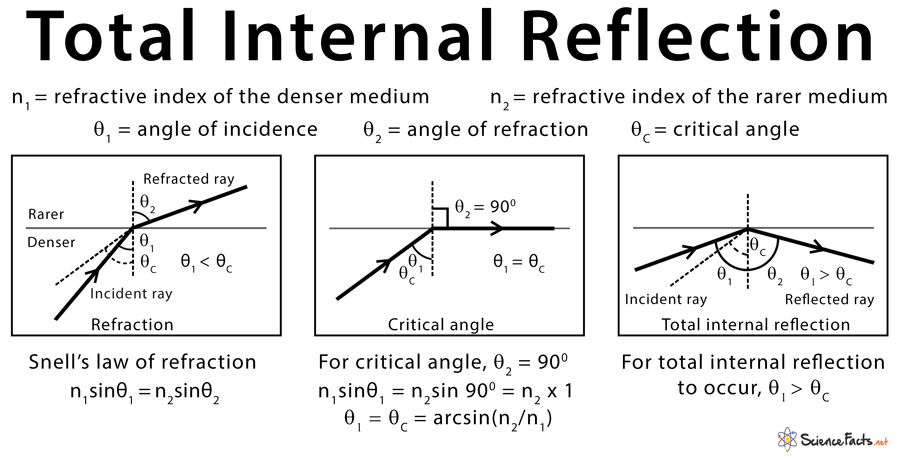
There are three possible outcomes:
- Refraction: For small angles of incidence, the ray refracts into the rarer medium, bending away from the normal.
- Graze the Surface: At a specific angle of incidence, called the critical angle (), the refracted ray skims along the boundary between the two media. The angle of refraction is exactly 90°.
- Total Internal Reflection (TIR): If the angle of incidence is greater than the critical angle, the ray no longer exits the denser medium. Instead, it is completely reflected back into it, obeying the laws of reflection.
The following video demonstrates this transition beautifully.
Total Internal Reflection and Critical Angle - A Level Physics
To see this in action, let's watch 'Total Internal Reflection and Critical Angle - A Level Physics' from the Physics Online channel. It uses a semicircular glass block to provide a clear, practical demonstration of the concept.
Watch the segment from 00:06 to 03:32. Pay close attention to how the refracted ray behaves as the angle of incidence is increased, leading first to the critical angle and then to total internal reflection.
The Two Conditions for TIR
From the video and the underlying physics, we can establish two essential conditions that must be met for TIR to occur:
- The light ray must be traveling from a denser medium to a rarer medium (i.e., ).
- The angle of incidence in the denser medium must be greater than the critical angle ().
The image below provides a perfect summary of these three scenarios.
2. Calculating the Critical Angle
Now that we have the concept down, let's derive the formula to calculate the critical angle. The derivation is a straightforward application of Snell's Law.
We start with Snell's Law:
By definition, at the critical angle of incidence (), the angle of refraction is 90° (). Substituting this into the equation:
Since , the equation simplifies to:
Rearranging for the critical angle, we get the all-important formula:
or
Notice that for the function to be defined, the term must be less than or equal to 1. This mathematically confirms the first condition for TIR: must be greater than .
Let's watch a clear, worked example of how to use this formula.
Total Internal Reflection of Light and Critical Angle of Refraction Physics
The video 'Total Internal Reflection of Light and Critical Angle of Refraction Physics' by The Organic Chemistry Tutor demonstrates how to apply this formula. We'll focus on the calculation for the air-water interface.
Watch from 04:42 to 08:20. The first part (until 06:25) reinforces the definition of the critical angle. The second part (from 06:25) shows a step-by-step calculation using Snell's Law.
Test your understanding!
Calculate the critical angle for light traveling from diamond () to crown glass ().
Show answer
Here, light travels from diamond (denser medium, ) to glass (rarer medium, ).
Using the formula:
The critical angle for the diamond-glass interface is about 38.9°.
3. NEET-Style Problem Solving
Let's apply these concepts to the kind of problems you'll face in the NEET exam.
Problem 1: Calculating Velocity from Critical Angle (NEET 2020)
Question: If the critical angle for total internal reflection from a medium to vacuum is 45°, then the velocity of light in the medium is:
Solution Walkthrough:
- Identify the media: Medium 1 is the unknown medium (). Medium 2 is vacuum (). The critical angle .
- Apply the critical angle formula:
- Solve for the refractive index :
- Relate refractive index to velocity: Recall the definition of refractive index: , where is the speed of light in vacuum ( m/s) and is the speed of light in the medium.
- Solve for velocity :
This is a classic two-step problem combining the critical angle formula with the definition of refractive index. You can find this question and its solution in the resource NEET Previous Year Questions (ID: LINK) under the 2020 section (Q2).
Problem 2: Calculating Critical Angle from Velocities (NEET 2022)
Question: Two transparent media A and B are separated by a plane boundary. The speed of light in those media are m/s and m/s, respectively. The critical angle for a ray of light for these two media is:
Solution Walkthrough:
- Identify the denser and rarer media:
- Speed in A: m/s.
- Speed in B: m/s.
- Since light is slower in medium A, A is the denser medium. So, and .
- Calculate refractive indices:
- Apply the critical angle formula:
- Express the final answer:
This problem tests your ability to first determine which medium is denser based on the speed of light. This problem is available in resource LINK as Q5 from 2022.
Problem 3: TIR in a Prism (NEET 2015)
This is a more advanced problem that combines TIR with dispersion.
Question: A beam of light consisting of red, green, and blue colours is incident on a right-angled prism. The refractive index of the material of the prism for the red, green, and blue wavelengths are 1.39, 1.44, and 1.47, respectively. The light is incident as shown. Which color(s) will be separated from the others?
This is the setup for the problem described, as seen in NEET 2015, Q3 in resource LINK.
Solution Walkthrough:
- Analyze the geometry: The light enters the prism face AC perpendicularly, so it passes undeviated to the face AB. The prism is a right-angled isosceles prism, so the angle of incidence on face AB is 45°.
- State the condition for TIR: The ray will undergo TIR if the angle of incidence (45°) is greater than the critical angle ().
- Calculate the critical angle for each color: The light is trying to exit into air ().
- Red: . .
- Green: . .
- Blue: . .
- Compare and conclude:
- For red: . Red light will refract out of the prism.
- For green: . Green light will undergo TIR.
- For blue: . Blue light will undergo TIR.
- Therefore, the prism separates the red light from the green and blue light.
4. Applications of Total Internal Reflection
Your interest in the sciences goes beyond just exam prep, so it's worth noting that TIR is not just an abstract concept; it's the basis for many technologies.
- Optical Fibers: These thin strands of glass or plastic guide light over long distances with minimal energy loss by ensuring the light always strikes the internal surface at an angle greater than the critical angle. This is the backbone of the internet and modern telecommunications.
- Endoscopy: Medical instruments use bundles of optical fibers to transmit light into the body and carry an image back out, allowing for minimally invasive diagnosis.
- Binoculars and Periscopes: High-quality optical instruments often use prisms instead of mirrors to redirect light. TIR in a prism is more efficient than reflection from a silvered mirror, leading to a brighter and clearer image.
- The Brilliance of Diamonds: A diamond's high refractive index () gives it a very small critical angle (). This means that most light entering the diamond is trapped inside, undergoing multiple internal reflections before exiting, which creates its characteristic sparkle.
Conclusion
Today, you've mastered the concept of Total Internal Reflection, a direct and powerful consequence of Snell's Law. We have followed your preferred learning path, starting with visual intuition, deriving the core mathematics, and then applying it vigorously to exam-style problems.
Key Takeaways:
- TIR occurs when light travels from a denser to a rarer medium and the angle of incidence exceeds the critical angle.
- The critical angle is the angle of incidence that results in a 90° angle of refraction.
- The formula for the critical angle is derived directly from Snell's law: .
- You can solve a variety of problems by combining this formula with the definition of refractive index () and geometrical analysis.
Preview of the Next Lesson:
We have now thoroughly covered refraction at plane surfaces. The next logical step is to see how these rules apply when the boundary is curved. In our next lesson, we will apply the formula for refraction at a single spherical surface, which will lay the groundwork for understanding lenses.