Hello! Welcome to our final lesson on spherical mirrors.
In our previous lessons, we've built a solid foundation. You've mastered ray diagrams, the Cartesian sign convention, the mirror formula, magnification, and the concept of power. You have all the essential tools for analyzing a single mirror system.
Today, we put it all together. As you requested for your NEET preparation, this lesson is all about "vigorous" problem-solving. We will tackle the types of questions that frequently appear in competitive exams: those involving mirror combinations and other complex scenarios. The goal is not to learn new fundamental laws, but to develop a strategy for breaking down complicated problems into manageable steps using the principles you already know.
Strategy 1: Tracing Rays in Mirror Combinations
The simplest combination involves two plane mirrors. The key here is a rigorous application of the law of reflection () and basic geometry.
Let's look at a typical NEET-style problem.
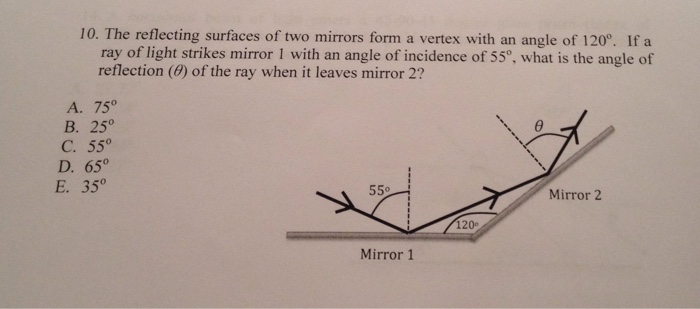
In this problem, a ray strikes Mirror 1. After reflecting, it strikes Mirror 2. We need to find the angle of reflection, , from Mirror 2.
To solve this, we trace the path of the ray and analyze the angles at each step.
- Reflection at Mirror 1: The angle of incidence is given as 55°. By the law of reflection, the angle of reflection is also 55°.
- Geometry: Look at the triangle formed by the point of incidence on Mirror 1, the point of incidence on Mirror 2, and the vertex where the mirrors meet.
- The angle between the reflected ray from Mirror 1 and Mirror 1 itself is .
- The angle between the mirrors is given as 120°.
- The sum of angles in a triangle is 180°. So, the angle 'x' that the ray makes with Mirror 2 is: .
- Reflection at Mirror 2: The angle 'x' is the angle the ray makes with the mirror surface. The angle of incidence on Mirror 2 is the angle between the incoming ray and the normal to Mirror 2.
- Angle of incidence at Mirror 2 = .
- Final Answer: By the law of reflection, the angle of reflection from Mirror 2 is equal to the angle of incidence, which is 65°.
This diagram shows the general geometry for such problems.
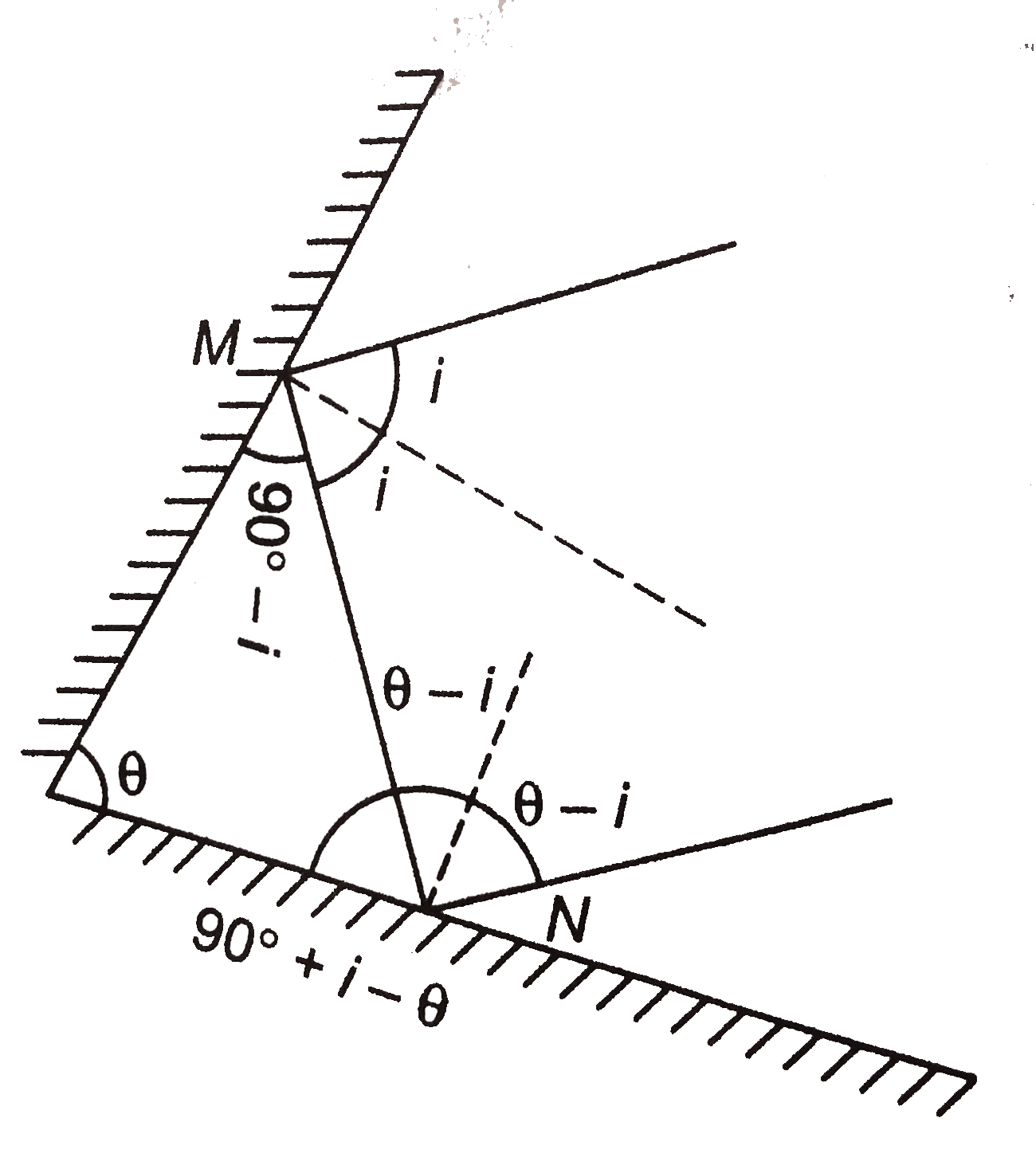
This diagram shows the various angles involved in successive reflections from two inclined mirrors. Mastering this geometry is key.
Shortcut: Number of Images
A common question asks for the total number of images formed by two inclined plane mirrors. While you can find this by tracing images, there's a much faster method for exams.
Tips & Tricks to Solve Ray Optics Quickly | JEE Mains 2023 | #jeephysics | Shreyas Sir
The video 'Tips & Tricks to Solve Ray Optics Quickly' by Shreyas Sir from Vedantu JEE English provides an excellent shortcut for this exact scenario. It's a technique you should definitely have in your NEET toolkit.
Watch the segment from 03:41 to 10:51. The instructor explains a direct formula to calculate the number of images formed by two inclined plane mirrors. Pay close attention to the distinction between when the result of 360/\theta is even versus odd.
Summary of the Trick:
- Calculate , where is the angle between the mirrors.
- If is an even integer: The number of images is .
- If is an odd integer: The number of images is . (This applies when the object is placed symmetrically on the angle bisector, which is the standard case for most problems).
Strategy 2: Tackling Complex Scenarios with a Single Mirror
Even a single mirror can present complex challenges. Let's look at two common types.
A. Longitudinal Magnification: Object Along the Axis
What happens when an object isn't a small point perpendicular to the axis, but a rod lying along the principal axis?
The key is to treat the two ends of the object separately.
- Find the image position () for the closer end (A).
- Find the image position () for the farther end (B).
- The length of the image is the distance between these two image points: .
Let's solve the problem shown: A rod of length 10 cm lies along the principal axis of a concave mirror (f = -10 cm). Its closer end is 20 cm from the mirror.
-
End A (closer end): .
Since this is at the center of curvature (), the image is also formed at C. So, . -
End B (farther end): The rod is 10 cm long, so end B is at from the mirror. .
Using the mirror formula:
So, . -
Length of Image: The image of end A is at -20 cm, and the image of end B is at -15 cm.
.
Notice that the magnification is not uniform along the length of the rod. This is called longitudinal magnification.
B. Moving Objects and Mirrors: Image Velocity
Problems involving moving objects or mirrors can seem daunting, but they become straightforward with the right formula.
Tips & Tricks to Solve Ray Optics Quickly | JEE Mains 2023 | #jeephysics | Shreyas Sir
Let's return to the 'Tips & Tricks' video. The next segment provides a powerful formula to solve image velocity problems, which are a classic complex scenario in competitive exams.
Watch the section from 20:31 to 33:28. The instructor introduces the formula for velocities perpendicular to the mirror and explains how to handle velocities parallel to the mirror. Follow his step-by-step solutions to the example problems, paying close attention to the sign conventions.
Key Formulas for Image Velocity:
-
Motion Perpendicular to the Mirror: The velocities of the image (), object (), and mirror () are related by:
- Crucially, this is a vector equation. You must use sign conventions. A common choice is to take motion to the right as positive and to the left as negative.
-
Motion Parallel to the Mirror:
- The image's parallel velocity component is equal to the object's parallel velocity component.
- The mirror's parallel motion has no effect on the image's position or velocity.
Test your understanding!
An object moves towards a stationary concave mirror with a speed of 5 m/s. In which direction and with what speed does its image move?
Show answer
Let's say the object is moving from left to right, towards the mirror. So, m/s.
The mirror is stationary, so .
Using the formula :
The negative sign means the image moves to the left, away from the mirror, with a speed of 5 m/s. (This makes sense: as the object moves from beyond C towards C, the image moves from between F and C towards C).
Strategy 3: The Universal Principle for Combinations
When you have a system with multiple optical events (e.g., reflection then refraction, or reflection then another reflection), there is one guiding principle:
The image formed by one optical element serves as the object for the next element.
Let's see this in action.
Application 1: Mirror at the Bottom of a Liquid
This common scenario combines refraction (due to apparent depth) and reflection.
Tips & Tricks to Solve Ray Optics Quickly | JEE Mains 2023 | #jeephysics | Shreyas Sir
The 'Tips & Tricks' video has an excellent, detailed walkthrough of a problem where an observer looks at an object inside a liquid with a silvered bottom. This demonstrates the universal principle beautifully.
Watch the segment from 44:40 to 57:38. The instructor analyzes the situation from two perspectives: observer in air looking at the object's reflection, and observer in the liquid looking at an object in the air. Focus on how he first calculates the apparent position due to refraction, and then uses that apparent position as the object for the mirror.
The Logic:
- Direct View (Refraction only): An object at a real depth in a medium with refractive index appears to be at an apparent depth .
- Viewing the Reflection (Refraction -> Reflection -> Refraction):
- Step A: A ray from the object travels to the mirror.
- Step B: The plane mirror forms an image at the same distance behind it as the object is in front of it.
- Step C: This image formed by the mirror now acts as a virtual object for the liquid surface.
- Step D: An observer in the air sees this virtual object at an apparent depth calculated using the refraction formula. The total depth of this virtual object must be used as the "real depth" in the formula.
Application 2: Silvered Lenses
A silvered lens is a lens where one surface is coated to act as a mirror. This system acts as a single, effective mirror.
The Logic: A ray passes through the lens (refraction), reflects off the silvered surface (reflection), and passes back through the lens (refraction).
The effective power of this combination is the sum of the powers of each event:
Since the final system is a mirror, its effective power is .
Remembering that and , we get:
This formula allows you to find the effective focal length of the combination, which then behaves just like a single spherical mirror.
Tips & Tricks to Solve Ray Optics Quickly | JEE Mains 2023 | #jeephysics | Shreyas Sir
Let's watch one more segment from the 'Tips & Tricks' video to see how to apply this concept.
Watch from 33:13 to 44:52. The instructor explains why a silvered lens acts as a mirror and derives the power formula. Follow his worked example to see how to calculate the power of the lens and mirror components and combine them. (Note: The instructor makes a small correction to his calculation later in the video at 51:40, but the method he explains here is the key takeaway).
Conclusion
You have now equipped yourself with the strategies needed to deconstruct and solve the complex mirror problems you'll face in the NEET exam. The physics hasn't changed, but the application is more layered.
Key Takeaways:
- For combinations, the core principle is: the image from one element is the object for the next.
- For inclined plane mirrors, you can use geometry and the law of reflection or a shortcut formula for the number of images.
- For extended objects along the axis, calculate the image for each end point separately.
- For moving objects/mirrors, use the velocity formula , remembering to use sign conventions.
- For silvered lenses, treat the system as a single effective mirror whose power is .
Preview of the Next Lesson:
We are now ready to leave the world of reflection and move on to the next major topic in optics: Refraction. We will begin by exploring what happens when light passes from one medium to another, and we will derive and apply the fundamental law that governs this phenomenon: Snell's Law.