Hello! Let's continue our journey through ray optics.
In our last lesson, you did an excellent job mastering the mirror formula and the magnification equation. You can now take the physical parameters of a mirror setup and calculate the precise location, size, and nature of the image. This mathematical skill is absolutely fundamental for NEET.
Today, we will add the final piece to our theoretical toolkit for single mirrors: the concept of power. We will explore what power means in the context of optics, learn how to calculate it for both concave and convex mirrors, and see how it provides a convenient way to describe a mirror's primary function. This concept is simple but crucial, and often appears in multi-step problems.
What is the Power of a Mirror?
Imagine you have two concave mirrors. One brings parallel light rays to a focus just 10 cm away, while the other focuses them 50 cm away. Intuitively, the first mirror is "stronger" because it bends the light more sharply. This "strength" or "bending ability" is what we quantify as power.
Power (P) is defined as the measure of a mirror's ability to converge or diverge light rays.
- A mirror that causes a high degree of convergence or divergence has high power.
- A mirror that bends light rays only slightly has low power.
Since a mirror with a short focal length (f) bends light more strongly, power is inversely related to focal length.
The Formula and a Crucial Sign Convention
The formula for the power of a lens is P = 1/f. For a mirror, a specific convention is used to keep the signs consistent across all optical devices:
The power of a spherical mirror is given by:
Where:
- is the power in Dioptres (D).
- is the focal length, which must be in meters (m). This is a very common point of error, so always remember to convert
ffrom cm to m!
Why the negative sign? This convention ensures that converging optical devices (like a concave mirror) always have positive power, and diverging devices (like a convex mirror) always have negative power. Let's see how this works.
Calculating Power for Concave and Convex Mirrors
Let's apply this formula using the sign conventions you've already mastered. To understand the relationship between mirror type, focal length, and power, let's turn to a concise resource.
Power of a mirror and lens, physical interpretation
This article from Aakash Institute clearly defines power and provides the specific formulas and sign conventions for concave and convex mirrors. It will serve as our primary reference for this topic.
Please read the following sections: Introduction: Focus on the definition of power and its inverse relationship with focal length. Note the unit, Dioptre. Power of Concave mirror: Pay close attention to how the negative focal length results in a positive power. Power of Convex mirror: Observe how the positive focal length results in a negative power. (You can ignore the parts about lenses for now; we will cover them in a later module.)
After reading, let's consolidate the rules.
1. Concave Mirror (Converging Mirror)
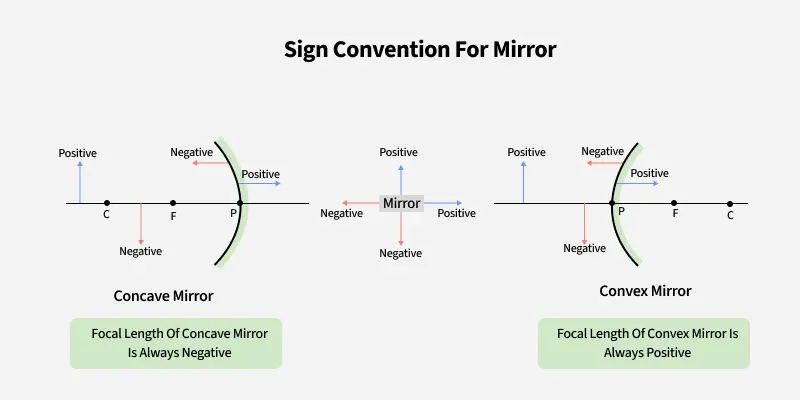
- Sign of Focal Length: As you know, a concave mirror has a real focus. According to the Cartesian sign convention, its focal length () is negative.
- Calculating Power:
- Result: The power () of a concave mirror is positive.
Conclusion: A converging mirror has positive power.
2. Convex Mirror (Diverging Mirror)
- Sign of Focal Length: A convex mirror has a virtual focus behind the mirror. According to the Cartesian sign convention, its focal length () is positive.
- Calculating Power:
- Result: The power () of a convex mirror is negative.
Conclusion: A diverging mirror has negative power.
Here is a visual reminder of the sign convention for focal lengths that we use as the input for our power calculation.
Test your understanding!
A dentist uses a small mirror that gives a magnified image of a tooth.
- What kind of mirror is it?
- Will its power be positive or negative?
Show answer
- To get a magnified image, the dentist must use a concave mirror. (Specifically, they place the tooth within the focal length to get a virtual, erect, and magnified image).
- Since it is a concave (converging) mirror, its power will be positive.
Problem-Solving Practice
Let's work through a few NEET-style problems that integrate today's topic with what you learned in the previous lesson.
Problem 1: Direct Calculation
A concave mirror has a radius of curvature of 40 cm. Find its power.
Solution:
- Find the focal length (f):
. - Apply the sign convention: It's a concave mirror, so the focal length is negative.
. - Convert to meters:
. - Calculate Power (P): The power of the mirror is +5.0 Dioptres.
Problem 2: Working Backwards
The power of a spherical mirror is -2.5 D. Identify the type of mirror and find its focal length.
Solution:
- Identify the mirror type: The power is negative, which corresponds to a diverging mirror. Therefore, it is a convex mirror.
- Calculate Focal Length (f):
- Convert to cm (optional but common):
.
The focal length is +40 cm, and the positive sign confirms it is a convex mirror.
Problem 3: Multi-step Application
An object is placed in front of a spherical mirror, and a real image that is three times the size of the object is formed at a distance of 30 cm from the object. Calculate the power of the mirror.
Solution: This is a great problem because you have to deduce all the parameters first.
- Analyze the given information:
- "real image": Image is in front of the mirror.
- "three times the size": Magnification magnitude is 3. Since the image is real, it must be inverted, so .
- "formed at a distance of 30 cm from the object": This means the separation between and is 30 cm. Since a concave mirror is the only spherical mirror that forms a real, magnified image, the object must be between C and F, and the image is formed beyond C. The image is farther from the mirror than the object. Let the object distance be . Then the image distance is .
- Apply Sign Convention:
- Object distance
- Image distance (real image)
- Use the Magnification Formula to find x:
- Determine u and v:
- Object distance
- Image distance
- Use the Mirror Formula to find f:
- Convert f to meters:
- Calculate Power: The power of the mirror is approximately +8.9 D.
Conclusion
Excellent work today! You have now learned the final theoretical concept for single spherical mirrors. By understanding power, you can quickly classify a mirror and quantify its fundamental optical property.
Key Takeaways:
- The power of a mirror () is a measure of its ability to converge or diverge light.
- The governing formula is , where must be in meters and is in Dioptres (D).
- The negative sign in the formula is a convention to ensure a consistent result:
- Converging mirrors (concave) have a negative and thus positive power.
- Diverging mirrors (convex) have a positive and thus negative power.
Preview of the Next Lesson:
You have now assembled a complete problem-solving toolkit for single mirrors: ray diagrams, sign conventions, the mirror formula, magnification, and power. In our next lesson, we will begin the "vigorous" problem-solving you're looking for. We will tackle a variety of complex, NEET-style questions that might involve finding unknown parameters, dealing with moving objects, or analyzing systems with more than one mirror. The solid foundation you've built will be essential.