Hello! In our previous lesson, we mastered Malus's Law and learned how to calculate the intensity of light passing through man-made polarizers. Now, we turn our attention to how polarization occurs naturally.
Today's lesson focuses on polarization by reflection. We will explore the specific conditions under which reflected light becomes completely polarized. Your learning outcome is to explain polarization by reflection and apply Brewster's Law. This is a fundamental concept in optics and a frequent topic in NEET, involving a simple yet powerful formula that connects reflection, refraction, and polarization.
Let's begin by understanding the phenomenon itself.
1. The Phenomenon: Polarization by Reflection
When unpolarized light strikes a boundary between two different transparent media (like air and water), some of it reflects, and some of it refracts. In general, the reflected light is partially polarized.
However, the Scottish physicist Sir David Brewster discovered that for a particular angle of incidence, the reflected light is completely plane-polarized. This special angle of incidence is called Brewster's angle () or the polarizing angle.
At this angle, a very specific geometric relationship occurs: the reflected ray and the refracted ray are perpendicular (90°) to each other. This is the key physical condition that leads to complete polarization.
The diagram below illustrates this phenomenon perfectly.
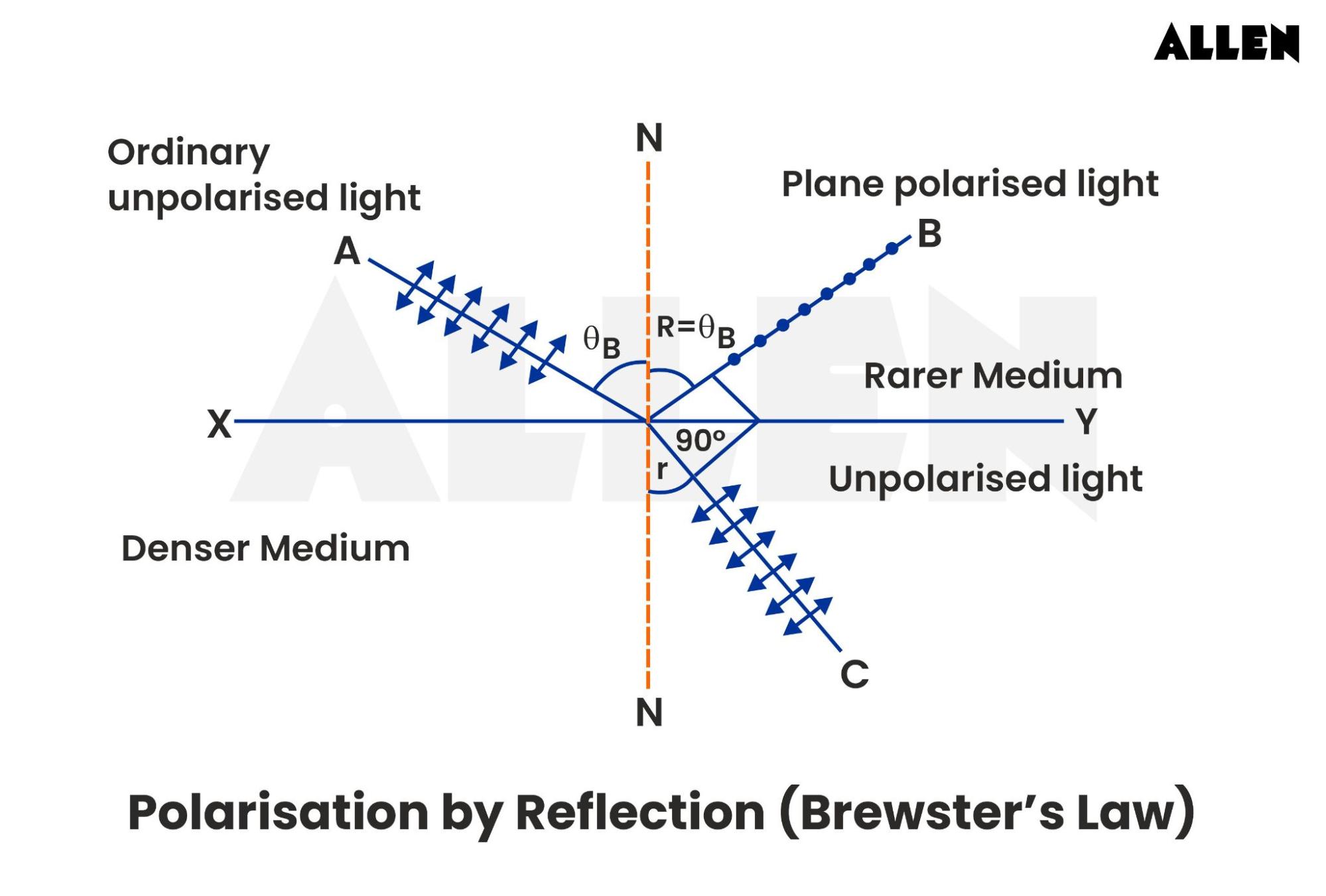
The electric field of the incident unpolarized light can be resolved into two components:
- Components parallel to the plane of incidence (the plane of the diagram, shown as arrows).
- Components perpendicular to the plane of incidence (shown as dots).
At Brewster's angle, all the components parallel to the plane of incidence are transmitted into the second medium. Only the component perpendicular to the plane of incidence is reflected. This is why the reflected light is perfectly plane-polarized.
2. Deriving Brewster's Law
Your preference for understanding the math behind the physics will be very useful here. The derivation of Brewster's Law is a straightforward application of Snell's Law to the unique geometry at Brewster's angle.
Let's break it down:
- From the law of reflection, the angle of incidence equals the angle of reflection. So, the angle of incidence is and the angle of reflection is also .
- Let the angle of refraction be .
- As we saw in the diagram, at Brewster's angle, the reflected and refracted rays are perpendicular. From the straight line along the normal, we can see that: This simplifies to:
- Now, we apply Snell's Law at the interface, where is the refractive index of the first medium and is that of the second:
- Substitute the expression for from step 3 into Snell's Law:
- Using the trigonometric identity , the equation becomes:
- Rearranging the terms to solve for , we get:
This gives us the celebrated Brewster's Law:
This elegant formula tells us that the polarizing angle depends only on the refractive indices of the two media.
To see this derivation and its application in action, the following video is an excellent resource. It walks through the derivation and then immediately applies it to several problems, which aligns perfectly with our goal of preparing for NEET.
Brewster's Angle, Polarization of Light, Polarizing Angle - Physics Problems
This video from The Organic Chemistry Tutor clearly explains and derives Brewster's Law. It then solves multiple problems, which is great practice.
Watch the video from the beginning until 09:12. Pay attention to how the 90-degree condition (01:57) is used with Snell's Law to derive the formula (03:05), and then see how it's applied to calculate the angle for light going from air to water (05:40).
For a quick written reference of the proof, you can consult the Vedantu article.
Brewster Law Explained: Formula, Proof & Exam Questions
The article 'Brewster Law Explained' from Vedantu offers a concise summary. The FAQ section contains a very clear, step-by-step proof of the law.
Refer to Question 3: 'State and prove Brewster’s Law.' in the FAQ section at the end of the article. This provides a compact version of the derivation we just did.
3. Problem Solving with Brewster's Law
For NEET, you'll be expected to apply this law to various scenarios. Let's practice.
Example 1: Basic Application
Light travels from air () to a glass slab (). At what angle of incidence will the reflected light be completely polarized?
- Solution:
We use Brewster's Law directly:
At an incident angle of 56.3°, the reflected light will be perfectly polarized.
Example 2: Going from Denser to Rarer Medium
The video you watched also covers an excellent example of light travelling from diamond () to glass (). This shows that the law applies universally, regardless of which medium is denser.
- Solution (from video):
Test your understanding!
A scuba diver underwater () shines a light up towards the surface. At what angle of incidence (measured from the normal) must the light hit the water-air interface for the reflected light (reflecting back into the water) to be completely polarized?
Show answer
In this case, the light is travelling from water to air.
- First medium (incident): Water, so .
- Second medium (refracted): Air, so .
Using Brewster's Law:
The light must strike the surface at an angle of 36.9° for the reflected light to be completely polarized.
A Classic NEET-Level Combination: Brewster's Angle and Critical Angle
Competitive exams often test your ability to connect different concepts. A common question links Brewster's angle with the critical angle for total internal reflection (TIR).
Let's establish the relationship. Consider light going from a denser medium () to a rarer medium ().
- Brewster's Law (for incidence from medium 1 to 2):
- Critical Angle (for incidence from medium 2 to 1):
Notice that is the reciprocal of . Therefore:
This simple but powerful relation is a favorite for numerical problems. The resource below explains this connection clearly.
Brewster's Law: Definition, Formula, Derivation, Applications
The article from Testbook provides a dedicated section on this important relationship, which is crucial for competitive exams.
Read the section titled 'Relationship between Brewster’s Angle and Critical Angle'. It provides a direct derivation of the formula connecting the two concepts.
Conclusion
Today, we've explored a key natural mechanism of polarization and derived the simple law that governs it. This is a topic where a solid conceptual understanding combined with one key formula can solve many problems.
Key Takeaways:
- Polarization by reflection occurs when unpolarized light strikes a non-metallic surface.
- At a specific angle of incidence, Brewster's angle (), the reflected light is 100% plane-polarized.
- The key physical condition at is that the reflected and refracted rays are perpendicular (90°).
- Brewster's Law is given by .
- Brewster's angle and the critical angle are related by .
Preview of the Next Lesson:
We have now covered all the major theoretical concepts in this module: single-slit diffraction, resolving power, Malus's Law, and Brewster's Law. In our final lesson for this module, we will put it all together by solving a variety of NEET-style problems that combine these topics, honing your problem-solving skills for the exam.