Hello! Welcome to the final lesson in our module on Diffraction and Polarization. So far, we've built a solid conceptual foundation, covering single-slit diffraction, resolving power, Malus's Law, and Brewster's Law.
Today, we shift gears to pure application. This lesson is designed to align with your goal of vigorous preparation for the NEET exam. Your learning outcome is to solve NEET-style problems involving diffraction and polarization. We will tackle a variety of problems, focusing on identifying the correct concepts, applying the right formulas, and developing the problem-solving strategies essential for competitive exams.
Let's begin our practice session.
A Quick Recap of Your Toolkit
Before diving into problems, remember the key formulas from this module. You can find a concise and useful summary in the resource below. I recommend bookmarking this for quick revision.
JEE Diffraction and Polarization - Previous Year Questions ...
The resource 'JEE Diffraction and Polarization - Previous Year Questions' contains an excellent 'Essential Formula Sheet'. It's geared for JEE, but the physics is identical for NEET.
Locate the section titled 'Key Formulas to Remember' which contains the 'Essential Formula Sheet'. Review the formulas for Single Slit Diffraction and Polarization. You don't need to study the Diffraction Grating section for now.
Part 1: Solving Diffraction Problems
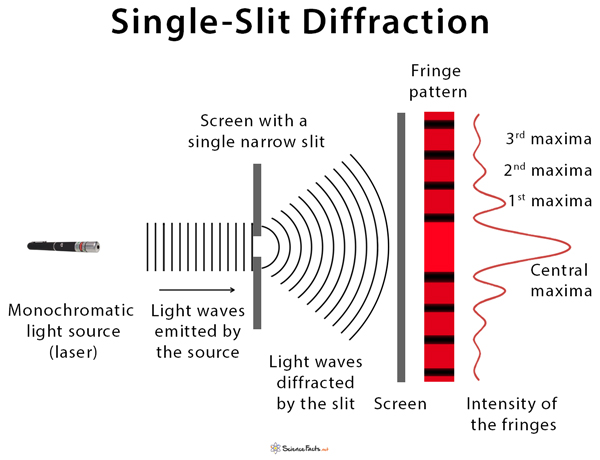
Diffraction problems in NEET often revolve around the single-slit experiment. The most common questions ask for the position of minima or the width of the central maximum.
Problem Type 1: Position of Minima and Maxima
The conditions for minima in single-slit diffraction are straightforward, but questions can add twists. Let's watch a solved NEET problem that tackles finding the position of a dark fringe and then a more complex one involving a secondary maximum.
Diffraction & Polarisation | Final Vijeta (PYQ) Series | NEET 2020 | RS Sir | Career Point Kota
The video 'Diffraction & Polarisation | Final Vijeta (PYQ) Series' by Career Point Kota walks through several previous year NEET questions. We'll watch two segments on diffraction.
First, watch from 15:41 to 18:30 to see the solution for finding the distance of the first dark fringe. Note the formula used: y = Dλ/a for the position of the first minimum. Next, watch from 23:13 to 28:04. This is a more advanced problem about finding the angular position of the second secondary maximum. Pay close attention to the different conditions for minima (a sin(θ) = nλ) and maxima (a sin(θ) = (n + 1/2)λ).
Key Formulas from the video:
- Position of nth minimum: For small angles, the linear distance from the center is .
- Angular position of nth minimum:
- Angular position of nth secondary maximum:
Problem Type 2: Width of the Central Maximum
This is one of the most frequently tested concepts in diffraction. The width of the central maximum is simply the distance between the first minimum on one side and the first minimum on the other.
- Position of first minimum ():
- Width of central maximum:
Let's see this applied to a typical NEET question.
Diffraction & Polarisation | Final Vijeta (PYQ) Series | NEET 2020 | RS Sir | Career Point Kota
We'll return to the 'Final Vijeta' video to see a direct application of the formula for the width of the central maximum.
Watch the segment from 33:42 to 36:30. The problem asks for the distance between the first dark fringes on either side of the central bright fringe, which is exactly the definition of the central maximum's width.
Test your understanding!
A parallel beam of light of wavelength 500 nm falls on a narrow slit and the resulting diffraction pattern is observed on a screen 1 m away. It is observed that the first minimum is at a distance of 2.5 mm from the center of the screen. Find the width of the slit. (This is a practice question from the Vedantu resource LINK).
Show answer
Here, we are given:
- Wavelength,
- Distance to screen,
- Position of the first minimum,
The formula for the position of the first minimum is . We need to find the slit width, .
Rearranging the formula:
The width of the slit is 0.2 mm.
Part 2: Solving Polarization Problems
Polarization questions typically involve Brewster's Law or Malus's Law. Since we just covered Brewster's law in detail, let's start there.
Problem Type 3: Brewster's Law
Recall from our last lesson that when unpolarized light is incident at Brewster's angle (), the reflected light is completely polarized, and the reflected and refracted rays are perpendicular. The governing formula is .
Let's watch a problem that applies this concept in a typical exam scenario.
Diffraction & Polarisation | Final Vijeta (PYQ) Series | NEET 2020 | RS Sir | Career Point Kota
Let's watch the first problem from the 'Final Vijeta' video, which is a NEET 2016 question based on Brewster's Law.
Watch from 05:26 to 10:04. The question states that the reflected and refracted rays are perpendicular. This is the cue that the angle of incidence is Brewster's angle. The problem then asks to identify the correct statement about the polarized reflected light.
This problem highlights an important conceptual point: for polarization by reflection, the reflected light is polarized with its electric field vector perpendicular to the plane of incidence.
Problem Type 4: Malus's Law and Multiple Polarizers
The intensity of light passing through a series of polarizers is a classic problem. Remember the two key rules:
- When unpolarized light of intensity passes through the first polarizer, the transmitted intensity is .
- When already polarized light of intensity passes through a second polarizer (analyzer) whose axis is at an angle to the light's polarization, the final intensity is given by Malus's Law: .
A common trick question involves three polarizers.
Diffraction & Polarisation | Final Vijeta (PYQ) Series | NEET 2020 | RS Sir | Career Point Kota
Let's see how to tackle a multi-polarizer problem. This next segment from the same video solves a question where a third polarizer is inserted between two others.
Watch from 10:04 to 15:23. Follow the step-by-step calculation. Note how the intensity is halved by the first polarizer, and then Malus's law is applied sequentially for each subsequent polarizer.
Test your understanding!
Three polarizers P1, P2, and P3 are placed in series. The transmission axis of P1 is vertical. The axis of P2 is at 30° to P1. The axis of P3 is at 90° to P1 (i.e., horizontal). Unpolarized light of intensity is incident on P1. What is the intensity of light transmitted through P3?
Show answer
Let's track the intensity step-by-step:
-
After P1: The incident light is unpolarized. The intensity after the first polarizer is:
The light is now vertically polarized. -
After P2: The light incident on P2 has intensity and is vertically polarized. The axis of P2 is at to the vertical. Using Malus's Law:
The light is now polarized at 30° to the vertical. -
After P3: The light incident on P3 has intensity . The axis of P3 is horizontal (90° to vertical), and the polarization of light from P2 is at 30° to the vertical. The angle between the light's polarization (30° from vertical) and P3's axis (90° from vertical) is . Using Malus's Law again:
The final transmitted intensity is .
Exam Strategy and Final Tips
Success in NEET requires more than just knowing the formulas; it requires strategy.
JEE Diffraction and Polarization - Previous Year Questions ...
The JEE resource we looked at earlier also has an excellent section on exam strategy that is perfectly applicable to NEET.
Quickly read the sections 'Common Mistakes and Corrections' and 'Exam Strategy'. These contain valuable, practical advice for avoiding simple errors and managing your time during the exam.
Conclusion
You've now tackled a range of NEET-style problems covering the entire module. You have practiced applying the core concepts of diffraction and polarization to quantitative problems, which is exactly the skill needed for the exam.
Key Takeaways:
- Diffraction Problems: Master the formulas for the position of minima () and the width of the central maximum ().
- Polarization Problems: Be ready to apply Brewster's Law () and Malus's Law (), especially in sequential-step problems.
- Strategy: Identify the physical phenomenon first (diffraction, reflection, etc.), then select the correct formula. Always check your units and the angles given. Practice is the key to speed and accuracy.
Preview of the Next Lesson:
We are now concluding our deep dive into Waves and Optics. As per your interest, our next module will be a complete change of pace. We will begin exploring Communication Systems. This topic is less about intensive mathematical problem-solving and more about understanding the fundamental principles that power our modern world of information exchange. We will start with the basic building blocks: the transmitter, channel, and receiver.