Hello! Welcome to our first lesson on Communication Systems.
In the previous modules, we delved deep into the physics of waves and optics, focusing on the mathematical problem-solving skills needed for your NEET preparation. Now, as we shift to Communication Systems, we will also shift our approach. As you wished, our focus here will be on building a strong conceptual understanding of how information is shared in our modern world, rather than on intensive mathematical derivations.
Today’s lesson addresses the learning outcome: Explain the purpose and describe the three essential elements (transmitter, channel, receiver) of a communication system. We will explore what a communication system is at its core and break it down into its fundamental building blocks. This will serve as the foundation for our entire exploration of this fascinating topic.
What is Communication?
At its simplest, communication is the act of conveying information from a source to a destination. In the context of electronics and physics, a communication system is a collection of devices working together to transfer this information over a distance. You interact with these systems every day, from making a phone call and sending an email to watching television or listening to the radio.
To start, let's watch a brief video that introduces the basic idea and the general structure of a communication system.
Introduction to Analog and Digital Communication | The Basic Block Diagram of Communication System
The video 'Introduction to Analog and Digital Communication' provides an excellent overview of what communication means in an electronic context and presents the fundamental block diagram we will be using.
Please watch from the beginning to 02:28. Pay attention to the definition of communication and the examples provided. Also, focus on the initial part of the block diagram, specifically the 'source' and the 'input transducer' (like a microphone).
As the video explains, the process starts with an information source that generates a message. This message (e.g., your voice) is often not in an electrical format, so an input transducer (like a microphone) is needed to convert it into an electrical signal. This electrical representation of the original message is our starting point.
The Fundamental Block Diagram of Communication
Every communication system, no matter how complex, can be broken down into a few fundamental components.

While the diagram shows several stages, the entire system is built around three essential elements that perform the core functions of communication:
- The Transmitter
- The Channel
- The Receiver
Let's explore each of these in more detail.
1. The Transmitter (Tx)
The transmitter's job is to take the initial electrical signal from the input transducer and process it into a form suitable for being sent over a specific physical medium. Think of it as preparing a package for shipping. You can't just put a fragile item in the mail as-is; you need to put it in a sturdy box with packing material.
Similarly, the raw electrical signal from a microphone is weak and has a low frequency, making it unsuitable for long-distance transmission. The transmitter modifies this signal. This processing often includes:
- Modulation: Superimposing the information signal onto a high-frequency carrier wave. We will discuss why this is necessary in our next lesson.
- Amplification: Increasing the power of the signal so it can travel a long distance without fading away completely.
The output of the transmitter is the final signal that is actually sent out, called the transmitted signal.
2. The Channel
The channel is the physical medium that connects the transmitter and the receiver. It's the path through which the signal travels. Channels can be broadly categorized into two types:
- Wired Channels: These use a physical cable to guide the signal. Examples include twisted-pair telephone lines, coaxial cables (used for cable TV), and fiber optic cables.
- Wireless Channels: The signal is radiated through space as an electromagnetic wave. The "channel" is the atmosphere or even the vacuum of space. Examples include radio broadcasting, mobile phone networks, and satellite communication.
The Imperfect Channel
A crucial concept to understand is that the channel is not perfect. As the signal travels, it gets degraded. The video below explains this very well.
Introduction to Analog and Digital Communication | The Basic Block Diagram of Communication System
Let's return to the 'Introduction to Analog and Digital Communication' video. This segment details the role of the channel and the unavoidable problems it introduces.
Watch from 04:41 to 07:46. Focus on the concepts of signal attenuation, distortion, and noise. Try to understand how each of these affects the signal as it passes through the channel.
As the video highlighted, the main problems introduced by the channel are:
- Attenuation: The signal loses strength or power as it travels over a distance. This is like a person's voice becoming fainter the farther away they are.
- Distortion: The shape of the signal changes as it travels. This happens because the channel may affect different frequencies in the signal differently.
- Noise: Random, unwanted electrical signals get added to the original signal. This can come from many sources, like other electronic devices or natural phenomena (e.g., lightning). Noise is a primary challenge in communication.
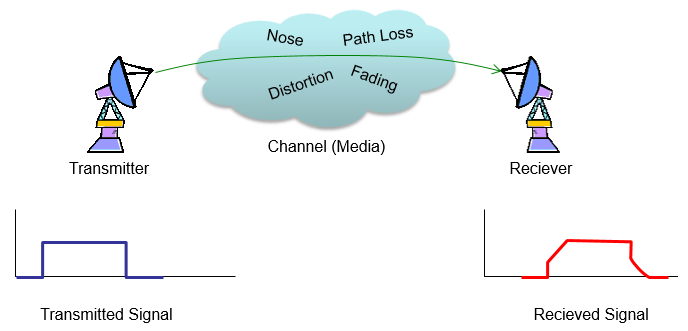
Because of these channel impairments, the signal that arrives at the receiver is a weak, distorted, and noisy version of the one that left the transmitter.
3. The Receiver (Rx)
The receiver's job is to do the difficult work of recovering the original information signal from the degraded signal it collects from the channel. It essentially performs the reverse operations of the transmitter.
The receiver's main tasks include:
- Amplification: The weak incoming signal is first amplified to increase its power to a usable level.
- Demodulation: This is the key process of separating the original low-frequency information signal from the high-frequency carrier wave.
- Filtering: Attempting to remove as much of the noise added by the channel as possible.
Finally, the recovered electrical signal is sent to an output transducer (like a speaker or a display screen), which converts it back into its original form (sound, image, text) for the user at the destination.
Putting It All Together: Real-World Examples
To solidify these concepts, let's analyze two everyday communication systems using this block diagram.
Introduction to Communication Systems
The resource 'Introduction to Communication Systems' from electronx.ca provides two excellent, clear examples that map these abstract blocks to real-world scenarios.
Read the two examples provided under the block diagram: 'Example System #1: FM Radio' and 'Example System #2: Sending a Text Message'. As you read, consciously identify the transmitter, channel, and receiver in each case.
Let's summarize the FM radio example:
- Source/Transducer: A DJ speaks into a microphone, which converts sound to an electrical signal.
- Transmitter: The radio station's equipment modulates and amplifies this signal, sending it out from a large antenna.
- Channel: The air through which the radio waves travel.
- Receiver: Your car radio's antenna picks up the wave. The radio's internal circuits demodulate and amplify the signal.
- Output Transducer: The speakers convert the electrical signal back into sound.
Test your understanding!
Consider watching a live cricket match on your laptop, which is connected to your home Wi-Fi. Identify the transmitter, channel, and receiver for the final leg of this communication journey (from your Wi-Fi router to your laptop).
Show answer
- Transmitter: Your Wi-Fi router. It receives the data from the internet (via a cable) and transmits it as radio waves.
- Channel: The air inside your home between the router and your laptop.
- Receiver: The Wi-Fi card inside your laptop. It receives the radio waves and converts them back into data that can be processed and displayed on the screen.
Conclusion
In this lesson, we've laid the groundwork for understanding all communication systems. We moved away from the intense problem-solving of optics to focus on the core concepts that govern how we share information.
Key Takeaways:
- The fundamental purpose of a communication system is to transfer information from a source to a destination.
- All communication systems are built around three essential elements: a transmitter, a channel, and a receiver.
- The transmitter prepares the information signal for transmission.
- The channel is the physical medium the signal travels through, but it is imperfect and introduces attenuation, distortion, and noise.
- The receiver's task is to extract the original information from the weak and noisy signal it receives.
Preview of the Next Lesson:
We briefly mentioned that the transmitter performs "modulation." But why is this step necessary? Why can't we just amplify the signal from a microphone and send it directly from an antenna? In our next lesson, we will answer this critical question by exploring the need for modulation and why high-frequency carrier waves are essential for practical communication.