Hello! Welcome to the next lesson in our study of wave optics.
In our previous lessons on interference and diffraction, we explored how the wave nature of light leads to fascinating patterns of intensity. We treated light as a simple wave, focusing on its amplitude and phase. However, this doesn't tell the whole story. Light is a transverse electromagnetic wave, and its properties are richer than what we've seen so far.
Today, we delve into a phenomenon that provides definitive proof of light's transverse nature: polarization. Our learning outcome is to describe the phenomenon of light polarization and methods of producing polarized light. We will explore what it means for light to be "polarized" and examine the physical processes that can transform everyday, unpolarized light into this state. This conceptual foundation is essential before we move on to the mathematical calculations you'll need for your NEET preparation.
1. What is Polarization?
Recall that light is an electromagnetic wave, consisting of oscillating electric () and magnetic () fields that are perpendicular to each other and to the direction of wave propagation. By convention, the direction of polarization is defined as the direction of the electric field's oscillation.
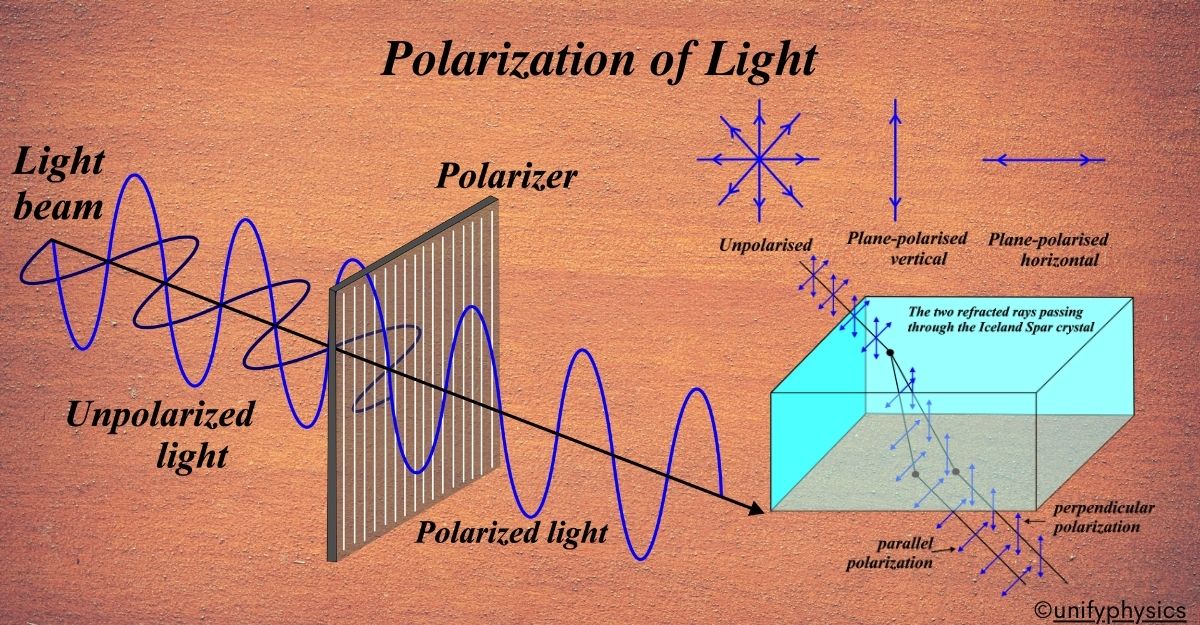
Most natural light sources, like the sun or a light bulb, emit unpolarized light. This means the light consists of a superposition of many waves whose electric fields oscillate in all possible directions perpendicular to the direction of travel.
Polarized light, on the other hand, is light in which the electric field oscillations are confined to a single plane.
The following video provides an excellent introduction to this concept, distinguishing between unpolarized and polarized light.
Introduction to polarization of light, polarizing filters, polarization by reflection and scattering
Watch this short segment from Zak's Lab to visualize the difference between unpolarized and polarized light and understand why polarization refers to the electric field's orientation.
Please watch the video from the beginning to 01:11. Focus on the visual representation of an unpolarized versus a vertically polarized wave.
To summarize the key idea:
- Unpolarized Light: The electric field vectors oscillate in many random planes, all perpendicular to the direction of propagation. We often represent this by showing oscillations in both the vertical and horizontal planes.
- Linearly Polarized Light: The electric field vectors are confined to a single plane along the direction of propagation.
The process of transforming unpolarized light into polarized light is called polarization. Let's explore the common methods to achieve this.
2. Methods of Producing Polarized Light
There are four primary ways to polarize light that you should know for your exams.
A. Polarization by Selective Absorption (Using a Polarizer)
The most common way to create polarized light is by using a special material called a polarizer, like the film used in Polaroid sunglasses. These filters are made of long-chain hydrocarbon molecules that are aligned in a specific direction.
Here's how it works:
- When unpolarized light hits the filter, the electric field component parallel to the long-chain molecules forces electrons in the molecules to oscillate. This energy is absorbed by the molecules and dissipated as heat.
- The electric field component perpendicular to the molecules cannot efficiently move the electrons, so it passes through the filter with very little absorption.
The direction that the filter allows light to pass through is called its transmission axis. Therefore, if the molecules are aligned vertically, the transmission axis is horizontal, and vice-versa.
The following resource provides a great textual explanation and uses the classic "picket-fence" analogy to make the concept intuitive.
Physics Tutorial: Polarization
Please read this section from The Physics Classroom to solidify your understanding of how Polaroid filters work. Pay attention to the picket-fence analogy.
Read the section titled 'Polarization by Use of a Polaroid Filter'. It explains the role of the long-chain molecules and the polarization axis.
B. Polarization by Reflection
Have you ever noticed the intense glare from a wet road or the surface of a lake on a sunny day? This glare is largely due to polarization by reflection.
When unpolarized light strikes a non-metallic surface (like water, glass, or asphalt), the reflected light is partially polarized. The electric field oscillations parallel to the surface are reflected more strongly than the oscillations perpendicular to it.
This means the glare you see is predominantly horizontally polarized light. Polarized sunglasses have their transmission axis aligned vertically to block this horizontal glare, making it easier to see what's beneath the water or on the road.

There is a specific angle of incidence, called Brewster's angle, at which the reflected light is completely polarized. We will explore the mathematics behind this (Brewster's Law) in a future lesson, but for now, it's important to know that reflection is a natural method of polarization.
To see a dynamic explanation of this, please watch the following video clip.
Introduction to polarization of light, polarizing filters, polarization by reflection and scattering
This clip from the Zak's Lab video explains the mechanism of polarization by reflection and conceptually introduces Brewster's angle. It also clearly explains how polarized sunglasses work to reduce glare.
Watch the segment from 01:11 to 05:11. Note how the orientation of oscillating molecules determines which component of light is reflected.
Test your understanding!
Polarized sunglasses with vertical transmission axes are very effective at reducing glare from a horizontal lake surface. Would they be equally effective at reducing glare from the metallic paint of a car? What about from a vertical glass window?
Show answer
- Metallic Paint: No. Metallic surfaces reflect light with all vibrational planes, so the reflected light remains largely unpolarized. The sunglasses would dim the reflection but wouldn't specifically eliminate it as "glare."
- Vertical Glass Window: No. The light reflected from a vertical surface would be partially polarized in the vertical direction (parallel to the reflecting surface). Since the sunglasses' transmission axis is also vertical, they would allow this vertically polarized glare to pass through, making them ineffective.
C. Polarization by Scattering
If you look at a clear blue sky through a pair of polarized sunglasses and rotate them, you'll notice the sky changing in brightness. This indicates that the light from the sky is polarized. This is due to scattering.
When sunlight (which is unpolarized) travels through the atmosphere, it strikes air molecules (like N₂ and O₂). The electrons in these molecules are set into oscillation by the electric field of the light. These oscillating electrons then act like tiny antennas, re-radiating the light in all directions. This is scattering.
Because the oscillations are in a plane perpendicular to the sun's rays, the light scattered at a 90-degree angle from the sun is strongly polarized.
This phenomenon is why photographers often use a polarizing filter to darken the sky in their pictures, which increases the contrast with white clouds (which reflect unpolarized light).
For a concise written summary of polarization by scattering, please review this section from the Lumen Learning resource.
Read the short section titled 'Polarization by Scattering' and look at the accompanying figure, which illustrates how the direction of observation affects the polarization of scattered light.
D. Polarization by Double Refraction (Birefringence)
Certain crystalline materials, such as calcite (also known as Iceland Spar), have a remarkable optical property called birefringence, or double refraction.
When an unpolarized beam of light enters a birefringent crystal, it is split into two separate beams. These two beams are:
- The ordinary ray (o-ray), which obeys Snell's law of refraction.
- The extraordinary ray (e-ray), which does not obey Snell's law and travels at a different speed.
Crucially, these two rays are linearly polarized in directions perpendicular to each other. This property allows these crystals to be used as a way to produce two beams of polarized light from a single unpolarized beam.
Physics Tutorial: Polarization
The Physics Classroom offers a clear, non-mathematical explanation of this effect.
Read the section titled 'Polarization by Refraction'. It describes the phenomenon of double refraction using the example of Iceland Spar.
Conclusion
In this lesson, we established the fundamental concept of polarization and demonstrated that it is a direct consequence of the transverse nature of light waves. You now have a solid conceptual understanding of this property, which is a key topic in wave optics for the NEET exam.
Key Takeaways:
- Polarization refers to the orientation of the electric field oscillations of a light wave.
- Unpolarized light has E-field oscillations in all random directions, while linearly polarized light has oscillations confined to a single plane.
- Polarized light can be produced through four main methods:
- Selective Absorption: Using a polarizing filter (Polaroid) that absorbs one component of the E-field.
- Reflection: Light reflecting from non-metallic surfaces becomes partially polarized parallel to the surface.
- Scattering: Light scattered by molecules in the atmosphere is partially polarized.
- Double Refraction (Birefringence): Certain crystals split unpolarized light into two perpendicularly polarized beams.
Preview of the Next Lesson:
Now that we know how to create polarized light, the next logical step is to learn how to analyze it. What happens when already polarized light passes through a second polarizer? How does the intensity change as we rotate the second polarizer? We will answer these questions by learning and applying Malus's Law, which provides the mathematical relationship between the angle of the polarizers and the transmitted light intensity. This is a favorite topic for numerical problems in competitive exams.