Hello! Welcome back to our journey through wave optics.
In our last lesson, we saw how light passing through a single slit doesn't just go straight through; it spreads out due to diffraction, creating a pattern of bright and dark fringes. A key takeaway was that a point-like source of light, when viewed through an aperture, doesn't create a perfect point image but rather a fuzzy spot called a diffraction pattern.
This has a profound and practical implication. What happens when we try to look at two objects that are very close together, like two distant stars or the two headlights of a faraway car? Each object produces its own diffraction pattern. If they are close enough, these patterns overlap, and our eyes or instruments might see them as a single, blurred object.
Today, we will explore this fundamental limit on our ability to distinguish between closely spaced objects. Our learning outcome is to explain the concept of resolving power and apply the Rayleigh criterion to optical instruments. We will define the physical limit of resolution and learn how to calculate it for telescopes and microscopes—a crucial skill for your NEET preparation.
1. From Point Image to Diffraction Pattern
In ray optics, we assume a point object forms a point image. However, wave optics shows us this is an idealization. When light passes through a circular aperture (like the pupil of your eye, or the objective lens of a telescope or microscope), diffraction occurs. The resulting pattern isn't a simple spot but a bright central circle, known as the Airy disc, surrounded by faint concentric rings.
The size of this Airy disc is critical. For a circular aperture of diameter , the first dark ring (the first minimum) appears at an angle from the center, given by:
Where is the wavelength of the light. Notice the factor of 1.22, which arises from the circular geometry of the aperture, making it different from the formula for a single slit ().
The following video provides an excellent visual introduction to this problem, starting with the car headlight example and explaining how we arrive at a criterion to tell if two objects are distinguishable.
How do telescopes see many stars where our eyes see only one? | Wave optics | Physics | Khan Academy
This video from Khan Academy introduces the concept of resolution and explains why we need a criterion to determine if two light sources can be distinguished. It visualizes how overlapping diffraction patterns can make two sources look like one.
Please watch the video from the beginning up to 10:07. Pay close attention to: The introduction (00:00 - 01:19): How the car headlight problem illustrates the limit of resolution. The Airy Disc (01:42 - 04:22): The diffraction pattern from a circular aperture and the formula for the first minimum. Overlapping Patterns (04:22 - 07:37): The visual difference between resolved, unresolved, and 'just resolved' images. The Rayleigh Criterion (07:37 - 10:07): The formal definition and the resulting formula for the minimum angular separation.
2. The Rayleigh Criterion: Defining the Limit
As you saw in the video, Lord Rayleigh proposed a clear and widely accepted standard to define when two objects are "just resolved."
Rayleigh's Criterion: Two images are just resolvable when the center of the diffraction pattern (central maximum) of one image falls directly on the first minimum of the diffraction pattern of the other.
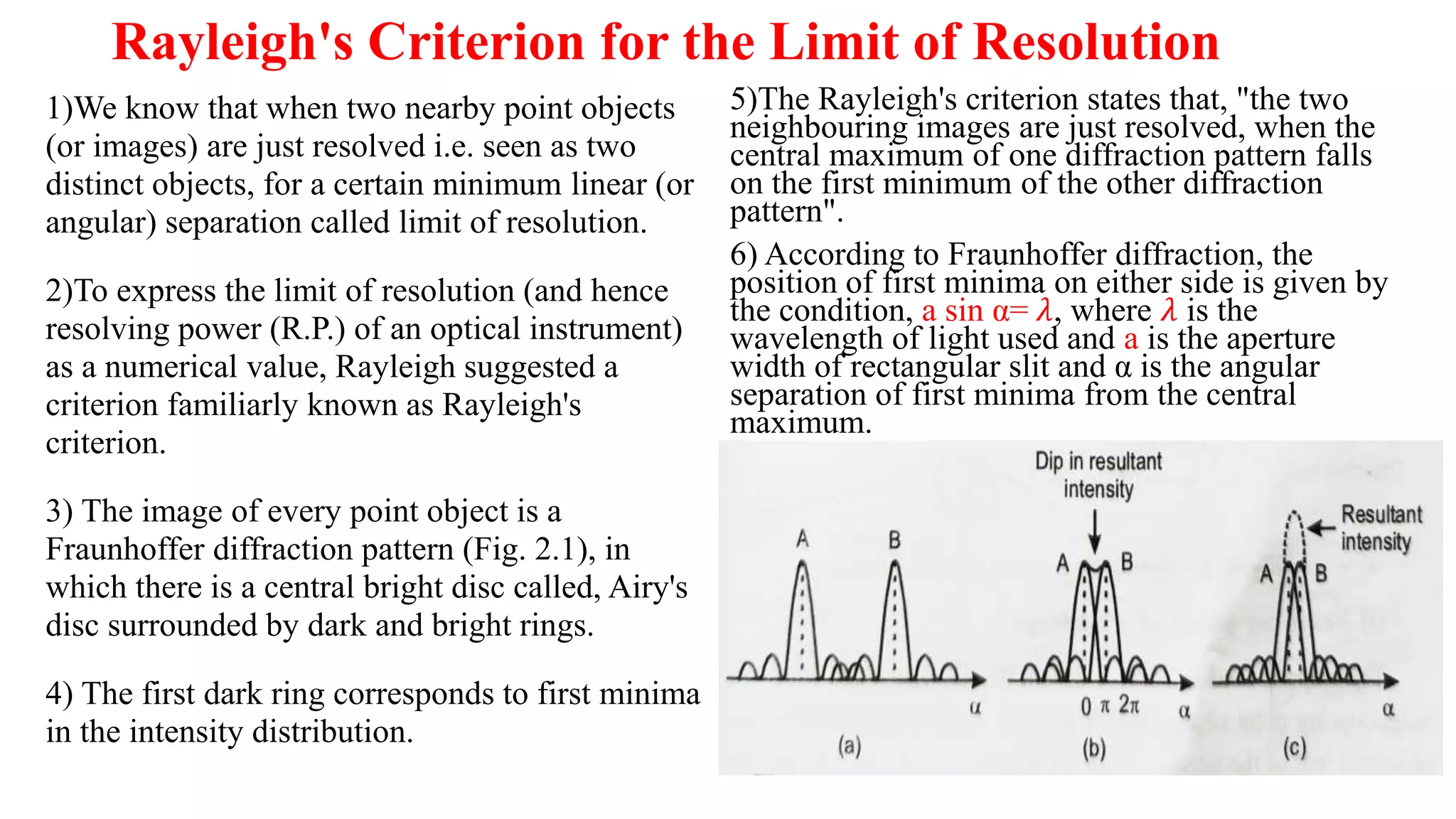
From this criterion, the minimum angular separation, , between two point objects that can just be distinguished is equal to the angle of the first minimum of the Airy pattern.
This angle is known as the limit of resolution. A smaller limit of resolution means the instrument can distinguish between objects that are closer together, which means it has better resolving capabilities.
3. Resolving Power
The term that quantifies this capability is resolving power (RP). It is defined as the reciprocal of the limit of resolution.
- A small limit of resolution means high resolving power.
- A large limit of resolution means low resolving power.
Our goal in designing optical instruments is often to maximize their resolving power. Let's see how this applies to telescopes and microscopes. For a more detailed textual reference on these concepts, you can consult the following resource.
Limits of Resolution: The Rayleigh Criterion
This article from Lumen Learning, titled 'Limits of Resolution: The Rayleigh Criterion', provides a solid written explanation of the concepts we've discussed. It formally defines the criterion and presents the key formulas.
Please read the initial sections of this article, up to the 'Making Connections' box before Example 1. Focus on the formal definition of the Rayleigh criterion and how the formula θ = 1.22λ/D is established.
4. Application to Optical Instruments
For your NEET exam, you need to be proficient in applying these concepts to telescopes and microscopes.
A. Resolving Power of a Telescope
Telescopes are used to view objects that are very far away. Therefore, we are concerned with their ability to resolve two objects with a very small angular separation.
- Limit of Resolution (Angular): This is the minimum angular separation .
- Resolving Power:
Here, is the diameter of the telescope's objective lens or mirror.
Key Implications for Telescopes:
- Larger Aperture is Better: Resolving power is directly proportional to the diameter . This is the primary reason why research telescopes are built with massive mirrors—to collect more light and, crucially, to resolve finer details.
- Shorter Wavelength is Better: Resolving power is inversely proportional to the wavelength . A telescope can resolve objects better when observing in blue or ultraviolet light compared to red or infrared light.
Let's see this in action with a worked example.
Limits of Resolution: The Rayleigh Criterion
Let's revisit the Lumen Learning article to see a practical application of the telescope formula.
Read 'Example 1. Calculating Diffraction Limits of the Hubble Space Telescope'. This is a classic problem that shows how to use the formula to calculate the angular resolution and then find the linear separation of stars at a known distance.
B. Resolving Power of a Microscope
Microscopes are used to view objects that are very close to the lens. Therefore, we are concerned with their ability to resolve two points separated by a small linear distance.
- Limit of Resolution (Linear): This is the minimum distance between two points that can be seen as separate. The formula, derived from the Rayleigh criterion, is:
- Resolving Power:
Let's break down the terms in the denominator:
- : Wavelength of light used.
- : Refractive index of the medium between the objective lens and the object.
- : The half-angle of the cone of light that can enter the lens from the object.
- Numerical Aperture (NA): The term is called the Numerical Aperture. A higher NA means the lens can gather light from a wider angle, leading to better resolution.
So, the formulas can be written as: and (using ).
Key Implications for Microscopes:
- Use Oil Immersion: To increase resolving power, we can increase the refractive index . This is done by placing a drop of special oil () between the objective lens and the slide. This increases the NA.
- Use Shorter Wavelengths: Just like with telescopes, using shorter wavelength light (e.g., blue or UV light) improves resolution. This is the principle behind UV microscopes. Electron microscopes take this to the extreme by using electrons, which have a much smaller effective wavelength than visible light, allowing for vastly superior resolution.
The following video provides a NEET-centric walkthrough of these formulas and solves a typical problem.
Wave Optics - L 10 | | Resolving Power of Microscope | Unacademy NEET | Physics | Mahendra Sir
This video from Unacademy NEET is specifically tailored for exam preparation. It explains the formulas for both microscopes and telescopes and works through some numerical examples.
Please watch the relevant segments of this video: Microscope Formula (19:47 - 23:28): The presenter explains the formula for the resolving power of a microscope and the meaning of the terms involved. NEET Problem - Microscope (23:28 - 25:07): A quick problem is solved showing the inverse relationship between resolving power and wavelength. Telescope Formula (25:07 - 31:03): The video then covers the resolving power of a telescope, explaining the role of angular separation.
Test your understanding!
An optical microscope uses light of wavelength 600 nm. The objective lens has a numerical aperture (NA) of 0.9.
a) What is the minimum distance between two points that can just be resolved?
b) If the space between the objective and the object is filled with oil of refractive index n = 1.5, and this increases the NA to 1.25, what is the new limit of resolution?
Show answer
Part a)
We are given:
The formula for the limit of resolution of a microscope is:
The minimum resolvable distance is approximately 407 nm.
Part b)
Now, the numerical aperture is increased by using oil immersion.
New
The new limit of resolution, , is:
By using oil immersion, the resolving power has increased, allowing the microscope to distinguish between points that are much closer together (from 407 nm down to 293 nm).
Conclusion
Today we confronted a fundamental limit of optics. Because of the wave nature of light, diffraction prevents us from seeing infinitely fine detail. We quantified this limit using the Rayleigh criterion and derived the formulas for the resolving power of telescopes and microscopes, your key tools for solving NEET problems on this topic.
Key Takeaways:
- Diffraction limits resolution: Point objects are imaged as Airy discs, not points.
- Rayleigh Criterion: Two objects are "just resolved" when the central maximum of one pattern lies on the first minimum of the other.
- Limit of Resolution (Telescope): Minimum resolvable angle is . Resolving power increases with a larger objective diameter ().
- Limit of Resolution (Microscope): Minimum resolvable distance is . Resolving power increases with a higher numerical aperture () and by using shorter wavelength light ().
Preview of the Next Lesson:
We have now covered the wave phenomena of interference and diffraction. This concludes our study of how light intensity is redistributed in space. In our next lesson, we will investigate a completely different property of light waves that cannot be explained by treating them as simple scalar waves: polarization. We will learn what it means for light to be polarized and explore the methods used to produce and analyze polarized light.