Introduction
In our previous lesson, we explored how the Nash Bargaining Solution (NBS) identifies a unique outcome by maximizing the product of players' gains, with a particular focus on how outside options define the disagreement point and shape bargaining power. This solution is built on a set of axioms, including the controversial "Independence of Irrelevant Alternatives" (IIA). As we previewed, the NBS is not the only definition of a fair and rational outcome.
This lesson introduces a powerful alternative: the Kalai-Smorodinsky (KS) bargaining solution. We will investigate the critique of the IIA axiom that motivated the development of the KS solution. Your goal is to understand and apply this different model of fairness, which is based on a principle of proportionality rather than product maximization. By the end of this lesson, you will be able to formulate and solve a bargaining problem using the KS solution, appreciating how its different axiomatic foundation can lead to different—and in some contexts, more intuitive—compromises when preferences conflict.
The Problem with Irrelevant Alternatives
The Nash Bargaining Solution's elegance rests on its axioms, but the "Independence of Irrelevant Alternatives" (IIA) has faced significant criticism for being psychologically and strategically counter-intuitive in some scenarios. The IIA axiom states that if a solution is chosen from a large set of options, and then the set of options shrinks—but the original solution is still available—the solution should not change. The new, "irrelevant" alternatives that were removed should not matter.
This sounds reasonable in theory, but it often fails to capture the human element of negotiation, especially the feeling of having made a concession.
[PDF] Lecture 5: Cooperative Bargaining - Northwestern University
These lecture notes from Northwestern University open with a sharp critique of the IIA axiom, providing both an intuitive thought experiment and a mathematical example.
Please read the sections titled "Does the Independence Axiom Make Sense?" and "Kalai and Smorodinsky’s Objection". Pay close attention to the vacation thought experiment. It perfectly captures the psychological argument against IIA. Then, examine the mathematical example that shows how, under the NBS, a player can become worse off even when their set of options improves.
The "Tel Aviv" example you just read highlights a key point: our perception of a fair outcome is often related to the opportunities we've given up. The introduction of a highly desirable but unattainable option changes the psychological landscape of the negotiation. The player who concedes their best option feels they are owed something in return, a dynamic the IIA axiom explicitly ignores.
The mathematical example is even more striking. It shows a situation where expanding the feasible set in a way that should unambiguously benefit Player 2 actually results in the NBS giving Player 2 a worse outcome. This suggests that the NBS can be insensitive to the global structure of the bargaining problem, focusing only on the local properties of the utility frontier.
A New Axiom: Monotonicity
In response to this critique, Ehud Kalai and Meir Smorodinsky proposed replacing the IIA axiom with a different one: Individual Monotonicity.
The intuition is simple and powerful: If the feasible set expands in a way that, for every possible utility for Player 1, Player 2's maximum potential utility increases or stays the same, then Player 2's final negotiated outcome should not get worse. In short, having better options should never hurt you.
This axiom directly addresses the flaw exposed in the previous example and aligns more closely with our intuitive sense of fairness in negotiation.
Defining the Kalai-Smorodinsky Solution
By replacing IIA with Monotonicity, while keeping the other standard axioms (Pareto efficiency, symmetry, and invariance), we arrive at a unique new solution. To define it, we first need to introduce a new concept: the Utopia Point.
The Utopia Point, sometimes called the ideal point, represents the best possible outcome for each player, considered independently. If the feasible set of utility pairs is , the utopia point is defined as:
Note that the utopia point is typically not in the feasible set, as it would require both players to simultaneously achieve their absolute best outcome. It's an aspiration, not a reality.
The Kalai-Smorodinsky solution is the unique, Pareto-efficient point that maintains the same ratio of gains relative to the utopia point. Geometrically, it's found by:
- Identifying the disagreement point, .
- Identifying the utopia point, .
- Drawing a straight line from to .
- The KS solution is the intersection of this line with the Pareto frontier of the feasible set .
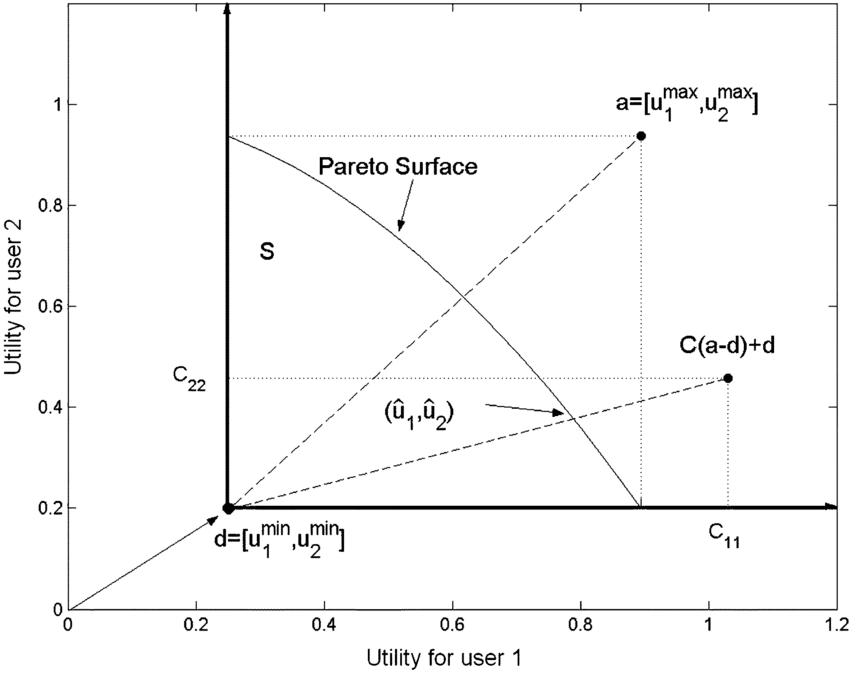
This geometric interpretation gives us a clear computational method.
Kalai–Smorodinsky bargaining solution - Wikipedia
The Wikipedia article on the KS solution provides a concise mathematical definition that complements the geometric intuition.
Read the short section titled "The KS solution". Focus on the final paragraph, which states that the KS solution, \mu, is the point on the Pareto frontier such that the ratio of gains is preserved. This equation is the mathematical equivalent of the geometric line-drawing procedure.
The key insight is that the KS solution ensures that players achieve an equal proportion of their maximum possible gains over the disagreement point. If the final solution is , then:
This concept of proportional fairness stands in stark contrast to the Nash solution's goal of maximizing the product of gains.
Scenario: Negotiating Spontaneity vs. Security
Let's return to Clara and Charles to see how these different fairness models play out. They are negotiating the rules for Clara's date with a new partner, Ben. Their preferences are in direct conflict.
- Charles wants emotional security. His utility comes from rules that reinforce their connection and minimize his anxiety.
- Clara wants spontaneity. Her utility comes from having the freedom to explore the new connection without feeling constrained.
They agree that if they can't find a compromise, the date is off, which is a poor outcome for both. We'll normalize this disagreement point to .
After discussion, they identify two "pure" options that define the extremes of their preferences:
- Option X (High Security): Clara must text Charles on the hour and be home by midnight.
- Charles's Utility: 10
- Clara's Utility: 2
- Option Y (High Spontaneity): No rules on communication; Clara decides when to come home.
- Charles's Utility: 1
- Clara's Utility: 9
Assuming they can mix these strategies (e.g., agree on a level of communication somewhere in between), the Pareto frontier of their feasible set is the line connecting the points (1, 9) and (10, 2). The equation for this line is , which simplifies to .
Let's find the compromise point using both the NBS and the KS solution.
1. The Utopia Point
First, we need the utopia point .
- Charles's maximum possible utility is 10 (from Option X).
- Clara's maximum possible utility is 9 (from Option Y).
- So, the utopia point is .
2. The Nash Bargaining Solution (NBS)
The NBS maximizes the product of gains, , subject to the constraint .
Using substitution, we want to maximize . The first-order condition from setting the derivative to zero gives , which yields:
- NBS Outcome: . Charles gets a significantly better outcome.
3. The Kalai-Smorodinsky (KS) Solution
The KS solution lies on the line from the disagreement point to the utopia point . The equation of this line is .
We find the intersection of this line with the Pareto frontier :
- Substitute into the frontier equation:
- KS Outcome: .
Interpretation
| Solution | Charles's Utility () | Clara's Utility () | Who it Favors | Rationale |
|---|---|---|---|---|
| NBS | 6.29 | 4.89 | Charles | Maximizes the product of utilities. |
| KS | 5.83 | 5.25 | More Egalitarian | Equalizes the proportion of potential gains. |
The KS solution is more balanced. Why? Because it accounts for their aspirations. Charles's potential gain was from 0 to 10 (a range of 10), while Clara's was from 0 to 9 (a range of 9). The NBS doesn't "see" this; it just sees the slope of the frontier. The KS solution, however, aims to give each person the same percentage of their "dream" outcome.
- Under KS, Charles achieves of his maximum possible gain.
- Under KS, Clara achieves of her maximum possible gain.
This principle of proportional achievement makes the KS solution a compelling model for fairness in relationship negotiations, where the feeling of equitable compromise is often paramount. It provides a concrete mathematical foundation for finding a middle ground that respects the scale of each partner's desires.
Conclusion
Today we explored the Kalai-Smorodinsky bargaining solution, a crucial alternative to the Nash framework. We saw how its rejection of the "Independence of Irrelevant Alternatives" in favor of a "Monotonicity" axiom leads to a different, and often more intuitive, standard of fairness.
Key Takeaways:
- The Kalai-Smorodinsky (KS) solution was developed in response to critiques of the Nash solution's IIA axiom.
- It replaces IIA with the Monotonicity axiom: a player's outcome should not get worse if their set of feasible options improves.
- The KS solution is defined by the Utopia Point (the ideal outcome for each player) and the disagreement point. It awards each player an equal proportion of their maximum possible gain.
- Geometrically, it is the intersection of the line connecting the disagreement and utopia points with the Pareto frontier.
- In negotiations involving personal feelings and equity, the KS solution's focus on proportional fairness can make it a more suitable model for finding a mutually acceptable compromise than the product-maximizing NBS.
Preview of the Next Lesson:
Both the Nash and KS solutions are axiomatic—they define what a fair solution should look like but don't describe the process of getting there. In our next lesson, we will shift gears to a strategic model of negotiation: the Rubinstein alternating offers bargaining model. This non-cooperative framework explicitly models the back-and-forth of offers and counter-offers over time, providing a dynamic view of how patience, time preference, and the structure of the bargaining process itself determine the final outcome.