Introduction
In our last lesson, we explored the Rubinstein alternating offers model, a powerful tool for understanding dynamic negotiations. We found that its stark prediction—that the first offer is always accepted without any haggling—hinges on the critical assumption of complete information, where each player knows the other's preferences (specifically, their discount factor) perfectly. We concluded by noting that real-world haggling often serves as a way to probe these very unknown preferences.
Today, we delve directly into that complexity. This lesson addresses how to analyze bargaining scenarios precisely when there is incomplete information about a partner's true hard and soft limits. You will learn to model this uncertainty using the concepts of player "types" and "beliefs." We will move from the Subgame Perfect Equilibrium of our last lesson to the more nuanced Perfect Bayesian Equilibrium, the key solution concept for games where players learn as they go. Our goal is to equip you with a framework to understand how offers and rejections act as signals, revealing private information and shaping the negotiation process in a way that the complete-information model could not capture.
The Nature of the Problem: Incomplete Information
First, it is crucial to be precise about what we mean by incomplete information. It is distinct from imperfect information, which we've seen in simultaneous-move games where you simply don't know what action your opponent has taken at the same time. Incomplete information means you are uncertain about the other player's fundamental characteristics—their payoffs, their preferences, their limits.
Game Theory 101 (#63): Incomplete Information
This video by William Spaniel provides an excellent, clear distinction between these concepts.
Please watch from the beginning up to the introduction of 'types'. Pay close attention to the examples he gives, such as not knowing the intensity of a preference in a Battle of the Sexes game, or the cost for someone in a Volunteer's Dilemma. These are direct analogies for not knowing whether a partner's stated limit is a deeply-held value (high cost to violate) or a mild preference (low cost).
As the video explains, this uncertainty requires us to think about different "types" of players. In our context, a partner might be a "high-compersion" type or a "low-compersion" type; they might have a "high-anxiety" type when it comes to a certain activity, or a "low-anxiety" type. Their type determines their payoff from different outcomes, and it is private information.
Game theorists model this by introducing a fictional player called "Nature" who, at the beginning of the game, chooses a player's type from a known probability distribution. The other players don't know the outcome of Nature's move, but they know the probabilities. This is what the dotted lines in an extensive-form game represent: an information set where a player does not know which specific node they are at, because they do not know the other player's type.
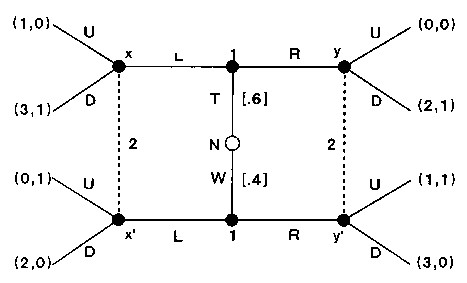
Modeling Unknown Limits: Types, Beliefs, and Equilibrium
Let's ground this in a scenario. Charles wants to negotiate a new boundary with Clara, but he is unsure about her true flexibility. This is a classic case of bargaining under incomplete information. We can model Clara as having two potential types:
- "Flexible" Clara (): She has a soft limit. She might prefer one outcome but is ultimately willing to compromise significantly to maintain harmony and reach an agreement. Her payoff is primarily driven by reaching a deal.
- "Firm" Clara (): She has a hard limit based on a core principle or emotional need. If a proposal crosses this line, she will reject it, even if rejection leads to conflict or continued ambiguity. For her, upholding the principle is more important than the immediate gain from an "unfair" agreement.
Charles doesn't know which type he is facing. However, he has a belief, which we can represent as a probability, , that Clara is the "Firm" type. So, .
This structure is common in bargaining models. The following reading introduces a formal model with an analogous setup, distinguishing between "selfish" and "fair-minded" sellers. This directly maps to our "Flexible" and "Firm" types.
[PDF] Bargaining under Incomplete Information, Fairness, and the Hold-Up ...
This paper by Ferdinand von Siemens models a bargaining situation with two types of sellers. The logic is directly applicable to our scenario.
In the "Summary of the Model" section, please read the description of the two seller types. Focus on the paragraph that begins with this sentence. Note how the "fair-minded" seller has a specific, positive share they must receive (\gamma), while the "selfish" seller will accept any positive offer. This is the formal equivalent of a hard vs. soft limit.
When information is incomplete, players can't just use backward induction as we did before. A player's optimal move depends on their beliefs about the other's type. The solution concept we need is Bayesian Nash Equilibrium (BNE) for simultaneous games, or its sequential counterpart, Perfect Bayesian Equilibrium (PBE).
A PBE has two key components:
- Sequential Rationality: Each player's strategy must be a best response at every stage of the game, given their beliefs about the other players' types.
- Belief Consistency: Players update their beliefs using Bayes' rule whenever they observe an action. An action that is only possible for one type of player can perfectly reveal that player's type.
The next video provides a clear, step-by-step calculation of a Bayesian Nash Equilibrium. It demonstrates how a player combines their beliefs with the other types' strategies to calculate their expected utility and choose their own best action.
Game Theory 101 (#64): Bayesian Nash Equilibrium
This video, also by William Spaniel, walks through the mechanics of finding a BNE.
Please watch from the definition of BNE through the end of the example. Focus on how Player 2 calculates her expected utility for playing "Left" or "Right". She doesn't know if she's facing Type A or Type B, so she weights the outcomes by her belief, p, and chooses the action that is best on average. This is the core logic of decision-making under incomplete information.
A Scenario: Proposing a Rule Under Uncertainty
Let's apply this logic to Charles and Clara. Imagine Charles is making a take-it-or-leave-it offer about a new rule (this simplifies the problem to a single period, like an ultimatum game). The "pie" is a total satisfaction surplus of 1.
-
Clara's Types:
- Flexible Clara (): Accepts any non-negative offer, . (Her hard limit is non-existent).
- Firm Clara (): Rejects any offer she deems "unfair." Let's say her hard limit is that she must receive at least 30% of the surplus, so she only accepts if . We'll call this threshold .
-
Charles's Belief: He believes there is a 50% chance Clara is the "Firm" type, so .
Charles has two main strategies:
-
Aggressive Offer (): He proposes a rule that gives him the entire surplus.
- If Clara is Flexible (prob. ), she accepts. Charles gets .
- If Clara is Firm (prob. ), she rejects. Bargaining breaks down, both get .
- Charles's Expected Payoff: .
-
Conciliatory Offer (): He proposes a rule that just meets the hard limit of the Firm type.
- If Clara is Flexible (prob. ), she accepts. Charles gets .
- If Clara is Firm (prob. ), she also accepts. Charles gets .
- Charles's Expected Payoff: .
Comparing the expected payoffs, , so Charles's optimal strategy is to make the conciliatory offer. The risk of the negotiation failing (a 50% chance) is too high to be worth the potential upside of the aggressive offer.
This strategic calculation is precisely what is described in the Bargaining under Incomplete Information paper. The buyer must decide whether to make a low offer that only the "selfish" type accepts, or a high offer that both types accept.
[PDF] Bargaining under Incomplete Information, Fairness, and the Hold-Up ...
This section formalizes the logic we just worked through.
Please read the short section titled "Equilibrium Play in the Ultimatum Game," focusing on Lemma 3. This lemma summarizes the proposer's choice: If the belief (\mu) of facing a "fair-minded" (Firm) type is greater than the share that type demands (\gamma), the buyer makes the high offer. If it's less, he makes the low offer. This is the formal expression of the calculation we just performed.
The crucial insight here is that the initial offer is entirely shaped by the proposer's beliefs about the other person's hidden limits. An offer isn't just a number; it's a reflection of a strategic calculation about risk and uncertainty.
Haggling, Signaling, and "Splitting the Difference"
The take-it-or-leave-it scenario helps explain the initial move, but it doesn't get us to the back-and-forth of real haggling. This is where we return to the sequential nature of bargaining. A rejected offer is no longer just a failure; it is a powerful signal.
Imagine in our scenario, Charles was more optimistic and believed (only a 20% chance Clara is Firm). His expected payoff for the aggressive offer would be , while the conciliatory offer is still . He would choose the aggressive offer.
Charles: "For this new activity, I think the rule should be that I get to decide all the details." (Aggressive offer, ).
Now, suppose Clara is, in fact, the "Firm" type. She rejects the offer.
Clara: "No. That is not acceptable."
This is a strategically crucial moment. Clara's rejection has sent a signal. Charles, being a rational game theorist, must perform a Bayesian update. He started with a prior belief . The "Flexible" Clara would have accepted his offer. The "Firm" Clara would have rejected it. Since he observed a rejection, he can now be 100% certain he is dealing with "Firm" Clara. His belief updates to 1. Now, in the next round of bargaining, he knows he must offer her at least to get an agreement. The haggling process served to reveal information.
This brings us to a fascinating and common heuristic in real-world bargaining: "splitting the difference." Why is this so prevalent? It doesn't seem to correspond to an equal split of the true surplus. A recent paper offers a compelling explanation rooted in this very process of inference under uncertainty.
[PDF] Fairness in Incomplete Information Bargaining - NBER
This paper provides widespread evidence of "split-the-difference" behavior and offers a novel theoretical justification.
First, read the Introduction (to this point) to understand the phenomenon. Then, jump to Section 4.2, "A Robust Inference Argument." Read this entire subsection (end of the paragraph). The core idea is that rejected offers create robust bounds on what players can believe about each other's values, and splitting this inferred range is perceived as fair.
The "robust inference" argument is powerful. Let's apply it to a negotiation dialogue:
Clara: "I need to feel totally unencumbered on my dates. I propose no-contact as the rule." (This is her 'offer', revealing a position).
Charles: "I can't agree to that, it makes me too anxious. I reject that and propose a text when you get to your date and a call when you're on your way home." (His counter-offer reveals his position).
At this point, the true "surplus" is unknown. But both parties can now see the "potential surplus" as the space between their two stated positions. Clara has robustly signaled she won't accept Charles's proposal, and Charles has signaled he won't accept hers.
Clara: "Okay, a call on the way home is too much. What if I just text you when I'm heading home? That's halfway between your idea and mine."
This is a classic split-the-difference move. It's not an arbitrary gesture; it's a "fair" proposal to divide the newly revealed bargaining range. This reframes haggling not as a battle of wills, but as a collaborative, if strategic, process of defining the boundaries of the problem and then finding a focal point within them.
Conclusion
Today we moved beyond the idealized world of complete information and saw how uncertainty transforms negotiation. By incorporating incomplete information, we can finally account for the strategic complexity of real-world bargaining over limits and boundaries.
Key Takeaways:
- Incomplete information is uncertainty about a player's "type"—their private payoffs, preferences, and limits.
- We analyze these scenarios using Perfect Bayesian Equilibrium (PBE), where players act optimally based on their beliefs and update those beliefs based on observed actions.
- An offer or rejection is a signal that conveys information. Haggling is, in essence, a process of mutual information discovery through a sequence of signals.
- Your initial offer in a negotiation is a strategic choice based on your beliefs about your partner's type and your appetite for risk.
- Common negotiation heuristics like "splitting the difference" can be understood as a rational and fair way to navigate the bargaining space that is revealed by the exchange of offers and rejections.
Preview of the Next Lesson:
This lesson, and the entire module on bargaining, has focused on resolving a specific point of disagreement. But relationships are not one-shot games. In our next lesson, we will begin the module on "Dynamic, Evolutionary, and Behavioral Games" by exploring how the long-term nature of a relationship changes strategic incentives. We will introduce repeated games and see how strategies like "Tit-for-Tat" can sustain cooperation and trust, even when short-term temptations to exploit a partner exist.