Introduction
In our last lesson, we established a powerful framework for finding cooperative solutions to negotiations: the Nash Bargaining Problem. We saw that any two-person bargaining situation can be defined by a feasible set of outcomes and a disagreement point . The Nash solution then identifies the unique, axiomatically "fair" outcome by maximizing the product of the players' gains over this disagreement point.
The conclusion we reached was that the disagreement point is not just a parameter, but the very foundation of bargaining power. This lesson delves into that crucial insight. We will analyze how outside options—such as the availability of an alternative partner or the prospect of a fulfilling life after a separation—act as concrete threat points that define the disagreement outcome. Your goal is to understand and model how these alternatives fundamentally alter the balance of power and shape the final negotiated agreement.
The Disagreement Point as a Best Alternative
In the abstract, the disagreement point represents the utilities players receive if they fail to reach an agreement. But in any real negotiation, this isn't a passive "status quo." It's the outcome of each player actively pursuing their Best Alternative To a Negotiated Agreement (BATNA). The better your BATNA, the more you stand to gain if talks collapse, and consequently, the more leverage you have in the negotiation.
This dynamic can be visualized as a decision tree. Before accepting any deal, a player weighs it against the utility of quitting the negotiation to pursue their outside option.

Let's return to our scenario with Clara (the Hotwife) and Charles (the Cuckold) to see this in action.
Scenario: Clara's New Alternative
In the previous lesson, Clara and Charles were negotiating rules for her dates. Their disagreement point was , representing the utility of their current relationship if they simply decided not to proceed with any hotwife activities. This led them to the Nash Bargaining Solution of Package B: Dinner & Play, No Veto, with utilities .
Now, let's change the situation. Suppose a charismatic former colleague, David, has been pursuing Clara. He is moving to a new city for a fantastic job and has invited Clara to join him, implying the start of a new primary relationship. This is a concrete outside option for Clara. She estimates that this new life with David would give her a utility of 9.
If Clara takes this option, the marriage ends. For Charles, this outcome is devastating, yielding him a utility of only 2.
The disagreement point is no longer the comfortable status quo of . It is now defined by the utilities each person gets if Clara exercises her BATNA. The new disagreement point is .
How does this shift in power affect the negotiation over the original rule packages?
First, any proposed agreement must be individually rational with respect to this new disagreement point. Let's re-examine the options:
| Rule Package | Charles's Utility () | Clara's Utility () | Is it Rational for Clara? () |
|---|---|---|---|
| A: Play Only, No Veto | 6 | 10 | Yes |
| B: Dinner & Play, No Veto | 9 | 8 | No |
| C: Play Only, Veto | 7 | 6 | No |
| D: Dinner & Play, Veto | 8 | 7 | No |
Immediately, Clara's improved outside option renders three of the four potential agreements obsolete. Packages B, C, and D offer her less utility than she would get by leaving with David. She has no rational reason to even consider them. The only viable option left on the table is Package A: Play Only, No Veto.
In this new context, there is nothing left to bargain over. Package A is the only one that satisfies Clara's new minimum requirement. Charles, faced with the alternative of getting a utility of 2 if Clara leaves, will rationally accept Package A, which gives him a utility of 6.
Clara's credible outside option didn't just give her more bargaining power; it completely reshaped the feasible set of rational agreements and determined the outcome.
Formalizing Bargaining with Outside Options
This intuitive result—that your share of a surplus is directly tied to your outside options—is a cornerstone of bargaining theory. Let's look at the formal model.
[PDF] Chapter 12 Bargaining and Power in Networks
This chapter from a book on networks by Jon Kleinberg provides a very clear, accessible model of how outside options influence bargaining.
Please read the subsection titled "The Nash Bargaining Solution" in Section 12.5. Focus on the setup where two players, A and B, have outside options x and y. Pay close attention to the conclusion: the negotiation is really about splitting the surplus s = 1 - x - y, leading to a final allocation where each player gets their outside option value plus half the surplus.
The model you just read presents a beautifully simple idea. If two players are splitting a value of 1, and they have outside options of and respectively (where ), the negotiation isn't about the full dollar. The amounts and are already "off the table"—each player is guaranteed at least that much. The actual bargaining is over the remaining surplus, .
Assuming equal bargaining power, they split this surplus evenly. The final payoffs are:
- Player A gets:
- Player B gets:
This formulation makes it crystal clear: as your outside option increases, so does your final payoff.
The Strategic View: Credibility and Threat Points
The Nash framework is axiomatic, describing what a solution should look like. A different perspective comes from strategic, or non-cooperative, models like the Rubinstein alternating offers game, which models the explicit back-and-forth of offers. In these models, outside options act as a floor for what a player will accept.
However, a crucial subtlety emerges: an outside option only matters if it's actually attractive.
These lecture notes by Asu Ozdaglar add a strategic layer to our understanding by incorporating outside options into the Rubinstein model.
Read the section titled "Outside Options Model" (part of Section "Relation of Axiomatic Model to Extensive Game Model"). The key takeaway is in the intuition: an outside option is only valuable if it's better than the payoff the player would have received anyway. This highlights the importance of the quality of the outside option.
This leads us to the critical concept of credibility. An outside option only functions as a threat point if the threat to use it is credible. In game theory, a threat is credible only if it is a player's rational move to carry it out, should the situation arise. This is the essence of subgame perfection.
Consider a classic example: the entry game.
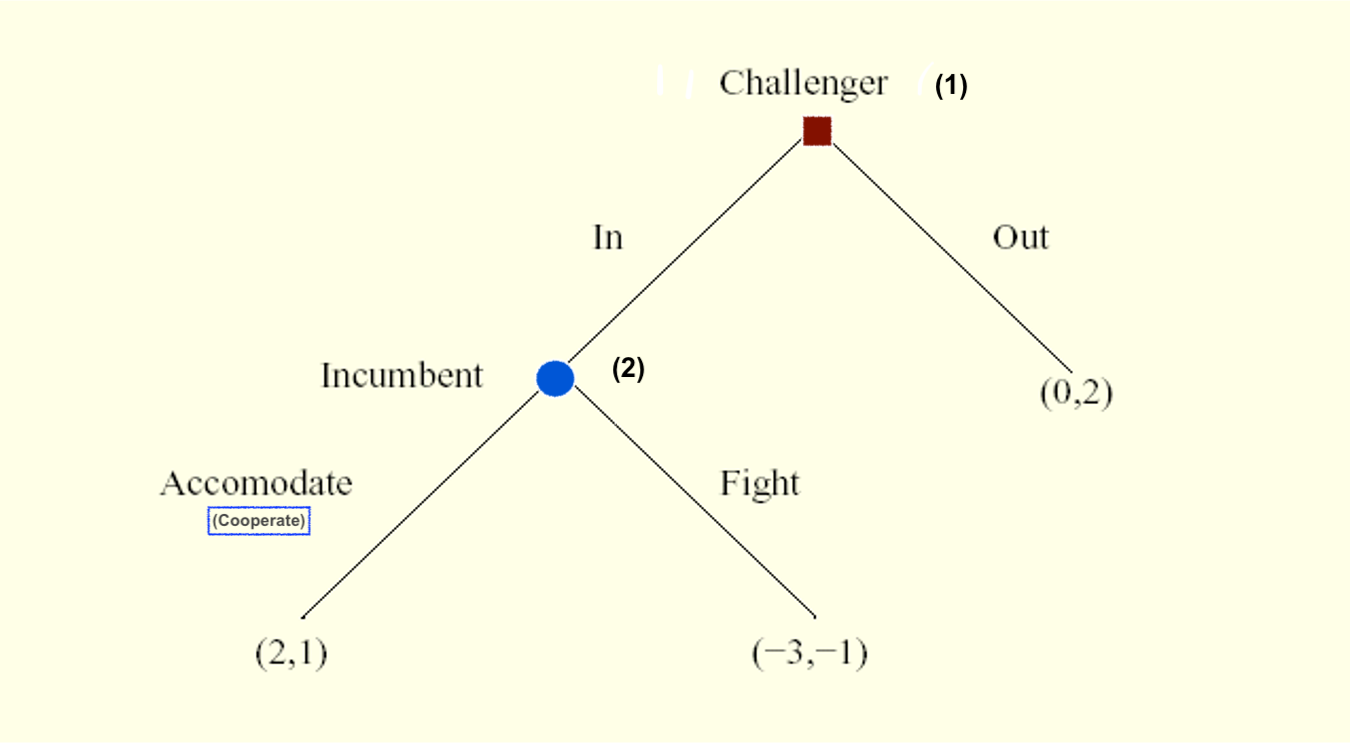
Let's translate this to a relationship negotiation.
- Scenario: Charles is resisting a specific rule change Clara wants. Clara threatens, "If you don't agree, I'll end things and move back in with my parents."
- Analysis: Charles knows that Clara's relationship with her parents is strained and that living with them would give her a very low utility, far lower than even the current, unsatisfactory state of their marriage.
- Conclusion: Clara's threat is not credible. Because carrying out the threat would make her worse off, it has no power as a threat point. Charles can safely ignore it.
Now, compare this to her outside option with David. Because that option gives her a high utility (), her threat to leave is entirely credible. It is her rational move if her demands aren't met. This is what gives her leverage.
An outside option is not merely an alternative; it's a credible alternative that you are willing and rationally motivated to take.
Conclusion
Today, we've dissected the most critical component of bargaining power: the disagreement point. We have moved beyond treating it as a given and have redefined it as the outcome of a player's best alternative to a negotiated agreement (BATNA).
Key Takeaways:
- A player's bargaining power is determined by their outside options. These options establish the disagreement point or threat point of the negotiation.
- In the Nash Bargaining framework, a better outside option increases your share of the final payoff by raising the floor from which you bargain. The negotiation becomes about dividing the surplus that exists above and beyond what each player can secure on their own.
- For an outside option to be an effective threat, it must be credible. A threat is credible if carrying it out is a player's rational, utility-maximizing choice in the event that negotiations actually fail (a subgame perfect action).
Preview of the Next Lesson:
The Nash solution, with its focus on maximizing the product of gains, is just one way to define a "fair" outcome. What if fairness isn't about the product, but about proportionality? In our next lesson, we will explore an alternative but equally powerful model: the Kalai-Smorodinsky bargaining solution. This approach uses a different set of axioms, leading to a solution that ensures players' gains are proportional to their highest possible aspirations. We will compare this to the Nash solution and see how different concepts of fairness can lead to different negotiated outcomes.