Introduction
Welcome back. In our last lesson, you learned to describe the three major families of ethical thought: Utilitarianism (focusing on consequences), Deontology (focusing on duties and rules), and Virtue Ethics (focusing on character). We established that these are not just abstract theories but practical lenses for analyzing the difficult choices you will face as a transformation leader.
This lesson takes the crucial next step from describing to applying. Our learning outcome is to apply ethical decision-making frameworks to transformation choices that affect people's roles. You will move beyond simply identifying the frameworks to using them in a structured way to navigate a realistic and complex ethical dilemma.
We will deepen your understanding of the core frameworks, introduce a few more that are highly relevant for leaders, and then practice using a systematic approach to make a well-reasoned, defensible decision. This skill is paramount when your choices directly impact your colleagues' careers and livelihoods during a large-scale change.
1. Navigating the Tension Between Frameworks
As you saw in the previous lesson's exercise, the three primary frameworks can often point in different directions. A purely utilitarian calculation might favor a decision that a deontological perspective would reject as a violation of individual rights. Virtue ethics, in turn, asks us to find a wise path that balances competing concerns.

To apply these frameworks effectively, you need a deeper appreciation for their strengths and, more importantly, their potential pitfalls in a business context.
Using Ethical Reasoning - Sage Publishing
The following chapter from a textbook on ethical reasoning provides an excellent in-depth analysis of Utilitarianism and Deontology, complete with critiques and classic business case studies.
Please read the following sections: 'Utilitarianism': Pay special attention to the 'Criticisms of Utilitarianism' and the 'Ford Pinto Case' as an example of misapplied cost-benefit analysis. 'Deontology: Rights and Duties': Focus on Kant's Categorical Imperative (especially the second formulation about treating people as ends) and the 'Criticisms of Deontology'. 'Combining Utilitarianism and Deontology': This short section highlights the inherent tensions you will face. 'Virtue Theory': Note how this framework is presented as a means of reconciling the other two by seeking a 'golden mean'. This reading will equip you to see the nuance and potential traps when these frameworks are used in practice.
This reading demonstrates a critical point: simplistic application of these frameworks can be dangerous. The Ford Pinto case shows utilitarian logic gone wrong, where a narrow, flawed cost-benefit analysis ignored fundamental duties to customers. Conversely, a rigid deontological rule can sometimes lead to disastrous outcomes. As a leader, your task is not to pick one framework but to weigh the insights from each.
2. Expanding Your Toolkit: Frameworks for Fairness and Relationships
For a leader managing organizational change, two other ethical perspectives are particularly powerful: Contract Theory and the Ethics of Care. These move beyond individual actions to consider the fairness of systems and the importance of relationships.
Using Ethical Reasoning - Sage Publishing
Let's return to the 'Using Ethical Reasoning' text to briefly introduce these two additional frameworks.
Please read the section 'Other Ethical Perspectives'. Focus on: Contract Theory: Grasp the concept of John Rawls's 'veil of ignorance.' This is a powerful thought experiment for anyone designing new roles, team structures, or compensation systems. The Ethics of Care: Understand how this perspective prioritizes nurturing relationships and gives weight to empathy, which is crucial for maintaining psychological safety during a transformation.
Here's how these new lenses apply directly to your goal:
- Contract Theory asks: "Are the new rules and structures we are creating fair? If I didn't know which role I would have in the new organization, would I still consider this system just?" This is invaluable for your work in organizational design.
- Ethics of Care asks: "How will this decision affect the relationships within our team and the trust people have in leadership?" This aligns with your focus on addressing change fatigue and maintaining morale.
3. From One-Off Decisions to "Ethics by Design"
Making a single ethical choice is good; building an organization where people are systematically prompted to make ethical choices is better. This is the concept of "Ethics by Design." It connects the application of ethical frameworks to your expertise in organizational design and L&D.
One of the core principles of Ethics by Design is Construal: helping people interpret, or construe, a situation in ethical terms rather than purely economic or legal ones. Providing and teaching ethical frameworks is a primary method for improving construal across your organization.
Ethics by Design: An organizational approach to responsible use of technology
This report from the World Economic Forum, Deloitte, and the Markkula Center for Applied Ethics explains how to treat ethics as a design challenge. It provides a strategic view that will resonate with your background.
Please read the following sections: Section 2.2, 'Construal': Understand how this principle helps people see their work through an ethical lens. Within that section, focus on the subsections 'Considering diverse perspectives' and 'Using ethical decision-making frameworks'. Note how these are presented as practical tools. Section 3.4, 'Employees look to senior leadership to provide ethics frameworks': This reinforces your role as a leader in this process. Section 3.9, 'Summary': Review recommendation #6: 'Develop a rubric for ethical decision-making.' This is what we will practice next.
The key insight here is that by teaching and applying these frameworks, you are not just making a single decision. You are building the organization's ethical "muscle" and embedding a new way of thinking into its culture—a critical component of sustaining your transformation.
4. Practical Application Exercise
Now, let's put it all together. We will use a structured matrix to analyze a complex scenario that directly relates to your transformation goals.
The Scenario:
Your B2B software company is in the middle of its strategic shift from a monolithic architecture to microservices. This requires creating a new, highly specialized Platform Engineering team. This team will build and maintain the core infrastructure that all other product development teams (called "Stream-Aligned teams") will use.
The success of the entire transformation hinges on attracting and retaining top-tier talent for this Platform team. However, the market rate for elite platform engineers is 20-30% higher than for the application developers in your existing Stream-Aligned teams.
You and the leadership team are facing a difficult decision with three options:
- Option A: Market-Driven Pay: Create a separate, higher compensation band for the Platform Engineering team to attract the best external talent quickly. Acknowledge the internal pay disparity and justify it based on market dynamics for a specialized skill set.
- Option B: Internal Equity Priority: Maintain a single, unified compensation structure for all engineering roles. This means you can't meet the top market rate for platform engineers. You'll have to rely on upskilling existing developers and hiring less experienced platform engineers, which could slow down the transformation and increase execution risk.
- Option C: Hybrid Model: Create a modest new compensation band that is higher but not at the top of the market. Supplement this with significant non-monetary benefits for the Platform team (e.g., extra training budget, conference travel, R&D time). For existing high-performing developers, create a clear, rapid pathway to get the skills and experience needed to join the Platform team and its higher compensation band.
Your Task (15 minutes):
Your task is to analyze this decision, not just to pick an option. Use the Ethical Decision Making Matrix below as a guide to structure your thinking.
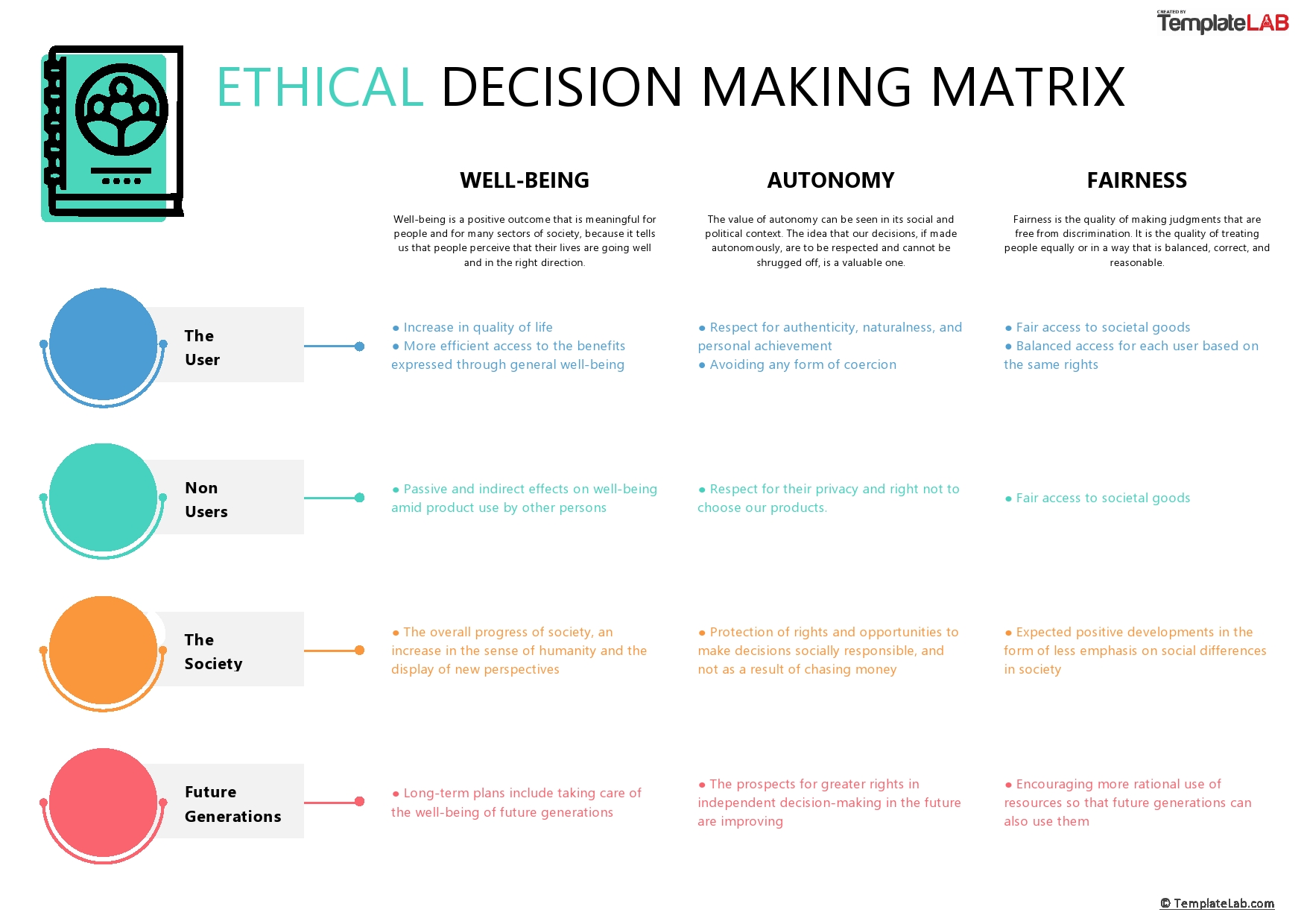
-
Analyze the Dilemma: Using the concepts from the readings, briefly analyze the dilemma through at least three different ethical lenses. For example:
- Utilitarianism: Which option produces the greatest good for the company as a whole (considering shareholders, all employees, and customers)?
- Deontology: Does creating different pay bands for the same "level" of employee violate a duty of fairness or treating people as ends in themselves?
- Contract Theory (Rawls's Veil of Ignorance): If you were an engineer but didn't know if you'd be on the Platform team or a Stream-Aligned team, which pay structure would you agree is most just?
-
Recommend a Path Forward:
- Which option (A, B, or C) do you recommend?
- Write a brief justification for your choice, explicitly explaining how you are balancing the conflicting ethical considerations (e.g., balancing the utilitarian need for business success with the deontological duty of fairness).
This exercise is about the quality of your reasoning. There is no single correct answer, but your justification should demonstrate that you have weighed the different ethical dimensions of the problem.
Conclusion
In this lesson, we moved from knowing what ethical frameworks are to using them as active tools for decision-making. You have seen that making ethical choices as a leader is rarely about finding a simple right or wrong answer. It is about navigating the inherent tensions between valid, competing principles.
Key Takeaways:
- Ethical decisions in business often involve a conflict between Utilitarian goals (the greater good of the organization) and Deontological duties (fairness and respect for individuals).
- Virtue Ethics, Contract Theory, and the Ethics of Care provide additional, powerful lenses to help find a balanced and just path forward.
- Using structured tools like an ethical decision matrix can help ensure you consider multiple stakeholders and principles, leading to more robust and defensible choices.
- By applying these frameworks, you are practicing "Ethics by Design," building your organization's capacity to construe challenges ethically and fostering a culture of integrity.
Preview of the Next Lesson
Making these difficult decisions, especially when they affect people's roles and well-being, takes a personal toll. As a leader at the center of a prolonged transformation, you are subject to immense pressure and the risk of burnout. Having dealt with the ethics of decisions affecting others, our next lesson will turn inward. We will focus on how you can build personal resilience strategies for managing the prolonged demands of leading a transformation program.