Introduction
Welcome to the final lesson in our module on resilience and ethics. In the last session, we navigated the complex world of ethical decision-making, applying frameworks like Utilitarianism and Deontology to a realistic scenario involving pay equity in your transformation. We acknowledged that making such choices, especially when they impact people's careers, places a significant burden on you as a leader.
Today, we shift the focus from the well-being of the organization to your own. The learning outcome for this lesson is to build personal resilience strategies for change leaders managing prolonged transformation programs.
A large-scale transformation is a marathon run at a sprinter's pace. As the leader, you are the focal point for pressure, anxiety, and resistance from all sides. If your own capacity diminishes, the entire program is at risk. This lesson is not about "toughing it out"; it's about treating your resilience as a critical, renewable resource. We will explore the psychological dynamics at play and equip you with a practical toolkit of mindsets and habits to sustain your energy and effectiveness over the long haul.
1. Understanding the Leader's Psychological Load: The Weight of Loss
As a change leader, you become the fulcrum for the entire organization's stress. You absorb the anxiety of your teams, manage the expectations of your sponsors, and navigate resistance from stakeholders. A key source of this pressure, as we'll see, is not the change itself, but what people feel they are losing. Understanding this is the first step to managing your own response.
What leaders need to know about change | Taylor Harrell | TEDxSDSU
This insightful TEDx talk by Taylor Harrell explains that what people truly resist during change is loss. This framework is vital for understanding both your team's reactions and your own.
Please watch the following segments: The Resistance to Loss (04:34 - 05:34): Grasp the core concept that people resist loss more than change. Five Core Types of Loss (05:34 - 11:55): Pay close attention to the five categories: safety, freedom, status, belonging, and fairness. These will sound familiar from our ethics discussion.
As a leader, you are not immune to these feelings of loss. In fact, your position makes you uniquely vulnerable:
- Loss of Status: Your reputation is tied to the success of a high-stakes, high-visibility program.
- Loss of Belonging: Your role may distance you from former peers as you make difficult decisions.
- Loss of Safety: The program's failure could have significant career implications.
Acknowledging these potential losses in yourself is not a weakness; it is a prerequisite for resilience. One of the most powerful strategies to counteract this is to identify what endures.
What leaders need to know about change | Taylor Harrell | TEDxSDSU
Let's watch two more short clips from Taylor Harrell's talk that offer a powerful coping strategy and a personal story.
Please watch these two clips: The Power of What Stays the Same (11:55 - 13:12): Understand how anchoring in enduring aspects of identity provides stability. A Story of Resilience (16:00 - 19:06): Notice how the speaker's mentor helped her reconnect with her core resilient identity, separate from the job she lost.
This idea of anchoring to an enduring identity—your core values, your professional purpose, your commitment to your people—is your first line of defense. It separates your sense of self-worth from the daily volatility of the transformation program.
2. Three Foundational Resilience Mindsets
While understanding the psychology of loss helps you frame the challenge, you also need simple, powerful mental habits to practice daily. Dr. Lucy Hone, a resilience researcher who faced unimaginable personal tragedy, identified three "secrets" of highly resilient people.
The three secrets of resilient people | Lucy Hone | TEDxChristchurch
This moving and practical TEDx talk by Dr. Lucy Hone provides three evidence-based strategies that you can apply immediately in your own thinking.
Please watch the following three segments that explain each of her core strategies: Secret #1: Suffering is Part of Life (06:57 - 08:09): This helps to reframe adversity from a personal attack to a universal human experience. Secret #2: Choose Your Focus (08:09 - 12:14): This explains the concept of attentional bias and the power of 'hunting the good stuff' or benefit-finding. Secret #3: Is It Helping or Harming? (12:14 - 14:27): This is a powerful self-coaching question for regulating your thoughts and actions.
These three mindsets are a powerful toolkit for self-regulation:
- "Adversity is normal" prevents you from getting stuck in a "Why me?" narrative when setbacks occur.
- "Hunt the good stuff" is a deliberate practice to counteract the brain's natural negativity bias, which is often on high alert during a stressful project.
- "Is this helping or harming me?" is perhaps the most practical tool. When you find yourself ruminating on a negative comment or endlessly replaying a failed presentation, asking this question can be the trigger to consciously shift your focus and energy.
3. A Practical Toolkit for Leader Resilience
Building on these mindsets, we can assemble a toolkit of concrete practices and structures to support your resilience. These are drawn from practical guides for leaders in the midst of high-stakes change.
The Resilient Leadership Conundrum
The following article from LifeLabs Learning offers several simple, actionable techniques for building resilience.
Please read section '5 ways to build leadership resilience and adaptability.' Focus specifically on secrets #1, #2, and #4: Strategic Breaks: Note the distinction between micro, meso, and macro breaks. The Two-Hander Technique: This simple physical action is a great way to structure your thinking, especially when you feel overwhelmed. It helps separate what is in your control from what is not. Asking Reset Questions: Learn how to use questions to pull yourself and your team out of a stress response.
Beyond these in-the-moment techniques, it's crucial to build systemic support for yourself. This is where external relationships and deliberate routines become critical.
This excerpt from a Change Management Toolkit reinforces the importance of resilience and borrows from classic leadership literature to provide three key strategies.
Please read the short subsection titled 'A Survival Guide for Leaders.' It outlines three essential strategies for maintaining long-term resilience.
The three strategies from Heifetz and Linsky's work are fundamental:
- Anchor yourself: This isn't just a metaphor. It means having a physical place or a protected routine (like a daily walk) where you can process the day without interruption.
- Seek the support of confidants: This is about creating your personal "board of directors"—trusted advisors outside the immediate chain of command who can offer perspective, not just solutions.
- Manage stress by depersonalizing it: Understand that resistance is often a reaction to the change you represent, not a personal attack on you. This intellectual distance is a powerful shield.
The two diagrams below provide excellent summaries of these resilience practices. The first illustrates the different kinds of relational support you need, while the second provides a holistic model of personal resilience.

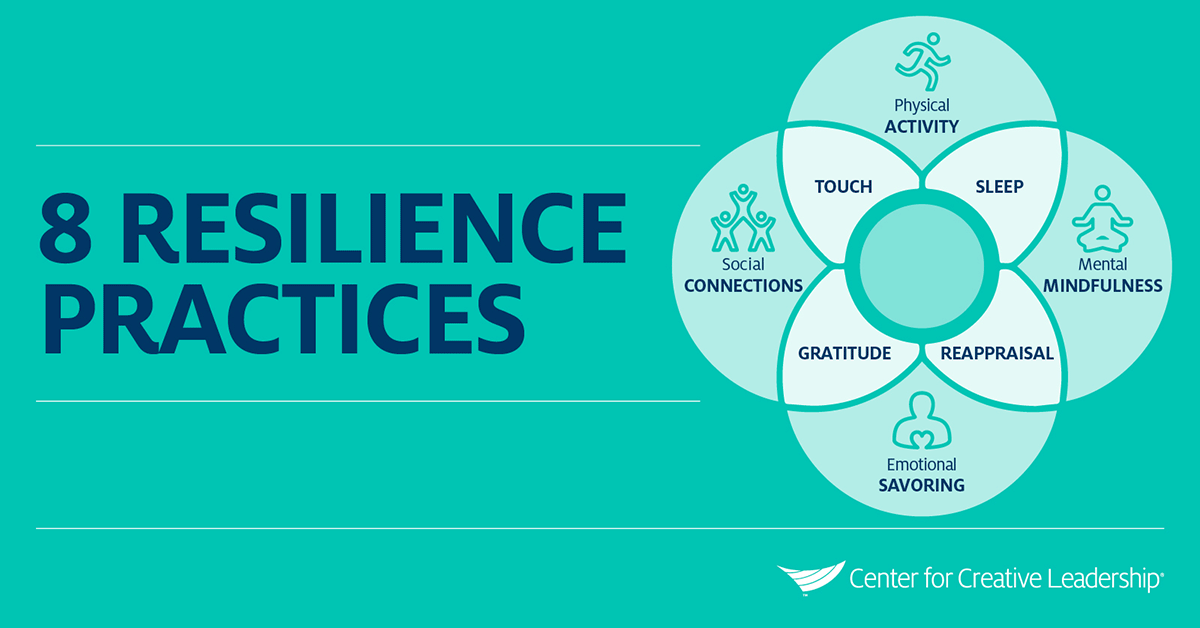
4. Application Exercise: Design Your Personal Resilience Plan
Now it's time to put these strategies into practice. Your task is to create a first draft of your own Personal Resilience Plan. This is a living document you can refine as you move through the transformation.
Your Task (10 minutes):
Answer the following four questions based on the concepts we've covered. Be specific and realistic in your commitments.
- My Core Anchor (Ref: Taylor Harrell): What enduring value, purpose, or part of my professional identity will I consciously connect with when I feel my status or safety is threatened?
- My 'Help or Harm' Filter (Ref: Dr. Lucy Hone): What is one specific recurring thought pattern or behavior (e.g., checking emails late at night, replaying difficult conversations) that I will start applying the "Is this helping or harming me?" question to?
- My Recovery Rhythms (Ref: LifeLabs Learning):
- What micro-break (e.g., 2 minutes of deep breathing) will I schedule into my calendar twice a day?
- What meso-break will I commit to protecting (e.g., a no-meetings lunch break, stopping work at 7 PM)?
- My Support Network (Ref: CGAP Toolkit, HBR): Identify one or two people in your professional or personal life (who are not your direct reports or your immediate boss) that you can enlist as a confidant for neutral perspective.
Conclusion
In this lesson, you have assembled a comprehensive toolkit for your own resilience. We established that as a change leader, you will inevitably experience the psychological weight of loss, and that anchoring to your core identity is a powerful first defense. We then explored practical mindsets and habits to manage your energy and focus for the long term.
Key Takeaways:
- Resilience is a skill, not a trait: It can be learned and developed through conscious practice.
- Acknowledge your own potential for loss: Understanding your own vulnerability to the loss of status, belonging, or safety is the first step to managing it.
- Mindsets are tools: Simple mental cues like "Is this helping or harming me?" and "Hunt the good stuff" can powerfully regulate your emotional state.
- Build a system of support: Your resilience depends on a combination of in-the-moment techniques (breaks, reset questions), protected routines (anchors), and external relationships (confidants).
- Depersonalize resistance: Viewing pushback as a reaction to the change process, rather than a personal assault, preserves your emotional energy.
Preview of the Next Lesson
Having fortified your personal and ethical foundation for leadership, we will now turn to the technology that can support your transformation efforts. The next module, "The Transformation Tech Stack," will explore tools that provide real-time data and insights. We will begin by learning how to evaluate Digital Adoption Platforms (DAPs) for tracking transformation adoption in real-time.