Introduction
Welcome to a new module focused on the technology that underpins and enables successful transformation. In our last lesson, you developed a personal resilience plan, a crucial foundation for sustaining your leadership through the long and demanding process of change. Now, we shift our focus from your internal resources to the external tools that can amplify your effectiveness.
This module, "The Transformation Tech Stack," will equip you with an understanding of modern tools for monitoring and managing change in real-time. Our first lesson addresses the learning outcome: Evaluate Digital Adoption Platforms (DAPs) for tracking transformation adoption in real-time.
A core challenge in any transformation, especially one involving new software and processes like your shift to microservices and AI, is knowing if the change is actually landing. Are people using the new tools? Are they following the new workflows? Or are they reverting to old habits? DAPs provide a direct line of sight into this adoption, offering data to move beyond anecdotes and make evidence-based decisions. This aligns directly with your goal of building an adaptive strategy with real-time feedback loops.
1. What is a Digital Adoption Platform?
At its core, a Digital Adoption Platform (DAP) is a software layer that sits on top of other applications to guide users and accelerate their proficiency. These platforms emerged to solve what the article "Best WalkMe Alternatives" calls the "enterprise software adoption crisis"—where companies invest millions in software, only to see a fraction of its features used.
For your transformation, DAPs serve two primary purposes:
- Driving Adoption: They provide in-app guidance, tutorials, and even automated assistance to help employees and customers navigate new systems and processes.
- Tracking Adoption: They generate real-time data on user behavior, showing which features are being used, where users are getting stuck, and how adoption rates are trending over time.
Initially, DAPs offered simple product tours and tooltips. However, the landscape has evolved significantly. Modern platforms, driven by AI, are moving from simply showing a user where to click to actually doing the task for them, a concept we'll explore further.
To begin, let's look at a high-level summary of the key criteria to consider when you start evaluating these platforms.

2. The DAP Landscape: Key Players and Use Cases
Not all DAPs are created equal. The most critical factor in your evaluation is understanding the platform's primary use case. For your multi-faceted transformation, you'll need to consider tools for both internal and external users.
Let's read a brief overview of the DAP market and its key players.
Best WalkMe Alternatives: Enterprise DAP Options Compared
The following article, 'Best WalkMe Alternatives,' provides an excellent comparison of the leading DAPs. It introduces the crucial distinction between platforms designed for internal employee training versus those focused on external customer activation.
Please read the following sections: Start with the introduction to understand the context of the 'software adoption crisis'. Study the 'Quick comparison' table to get a high-level view of the key players. Read the section 'Critical comparison factors', focusing on the distinction between 'Internal training vs. customer activation' and 'Guidance vs. execution'. Finally, review the 'Key terminology' section to familiarize yourself with terms like DAP, TTV, and Activation Rate.
As the article highlights, the fundamental choice is between platforms optimized for internal employee enablement and those for external customer activation.
-
Internal Employee Enablement (e.g., Whatfix, WalkMe):
- Goal: Drive compliance, enforce standard operating procedures, and reduce internal support tickets.
- Relevance to your transformation: This is critical for rolling out new internal systems related to your delivery process transformation (e.g., new Jira workflows, new DevOps tools) or organizational restructuring (e.g., new HR or finance software). These tools ensure your teams are proficient in the new ways of working.
- Characteristics: Often support a wide range of applications, including legacy desktop software. They excel at creating structured, guided learning paths.
-
External Customer Activation (e.g., Pendo, Tandem):
- Goal: Reduce the time it takes for new customers to find value (Time-to-Value), increase trial-to-paid conversions, and drive the adoption of new features.
- Relevance to your transformation: This is essential for your product and GTM transformation. As you roll out new product modules based on microservices or introduce new AI features, these DAPs can guide customers through the changes, boosting adoption and demonstrating the value of your new architecture.
- Characteristics: These platforms often include strong analytics to understand user behavior (like Pendo) or use AI to automate complex tasks for the user (like Tandem).
The distinction between "guidance" (showing) and "execution" (doing) is also a major shift, particularly relevant given your interest in AI. An AI-driven DAP that can automatically configure a complex feature for a trial user based on a simple prompt drastically accelerates their journey to the "aha!" moment.
3. A Framework for Evaluating DAPs
With this understanding of the landscape, you can now build a structured evaluation framework. This goes beyond a simple feature comparison and forces you to consider how a platform aligns with your strategic goals, technical environment, and organizational needs. A formal Request for Proposal (RFP) process often uses such a framework.
Let's explore the key components of a robust evaluation.
RFP Compass for Knowledge Platforms
The 'RFP Compass for Knowledge Platforms' provides a detailed, strategic guide to selecting a DAP. While you may not run a full RFP, its criteria form an excellent basis for any evaluation.
Please read the following sections to build your evaluation checklist: Section 2 ('Special features to consider...'): Understand the strategic impact of choosing the right (or wrong) DAP. Section 4.1 ('Suitability criteria'): Focus on the checklist items. These questions help you evaluate the provider's credibility, security posture (GDPR, ISO 27001), and their ability to support change management. Section 4.2 ('Performance criteria'): Review this checklist carefully. It covers the technical and functional requirements of the platform itself, such as cross-application support, scalability, robustness to updates, and integration capabilities.
Based on this reading, we can structure your evaluation into two main categories:
A. Provider Suitability (Is the company a reliable partner?)
- Experience & Stability: Do they have a proven track record with comparable projects and clients? Are they financially stable?
- Security & Compliance: Do they hold key certifications like ISO 27001? Can they demonstrate GDPR compliance? This is non-negotiable for enterprise software.
- Change Management Support: Do they offer consulting and content creation services, or are they just a software vendor? A partner who understands change can be invaluable.
B. Product Performance (Does the tool do what we need?)
- Functional Capabilities:
- Can it work across all your target applications (web, desktop, etc.)?
- Can it deliver not just IT guidance, but also context about your specific business processes?
- How easy is it for your team to create and maintain content?
- Technical Capabilities:
- Robustness: How does it handle updates to the underlying software? Platforms with "self-healing" architecture are far less brittle than those relying on static CSS selectors.
- Integration: Does it have open APIs to connect with your existing systems (e.g., your LMS, SharePoint, or a future transformation dashboard)?
- Scalability: Can it grow with you as you expand the rollout to more users and applications?
- Analytics & Reporting:
- What kind of data does it provide? Can you track adoption by user segment, feature, or business unit?
- Can this data be exported or integrated into a central dashboard? The goal is to get a unified view of transformation progress.
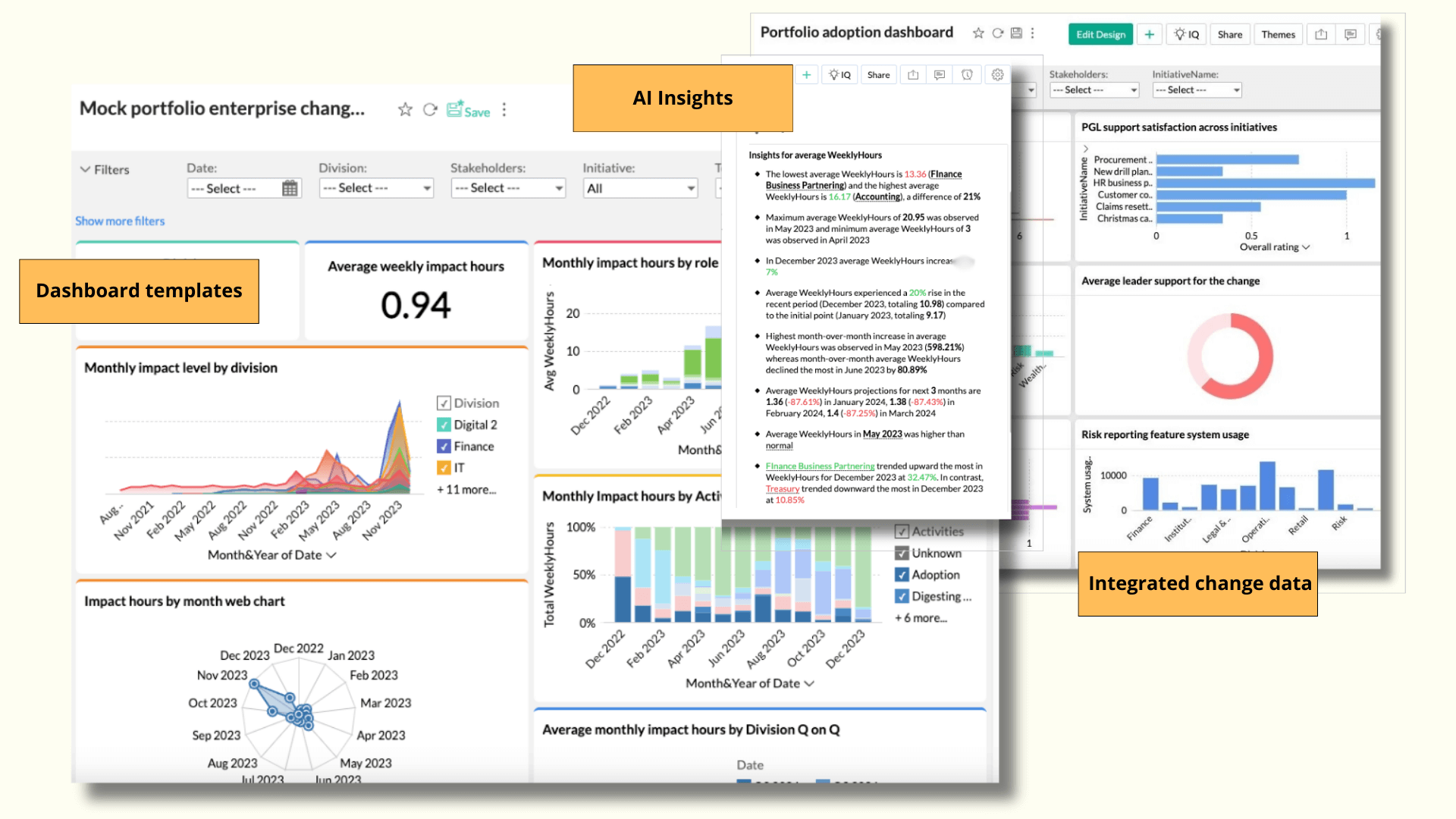
The ultimate output of a DAP's tracking capabilities should feed into a broader transformation monitoring system, giving you and your leadership team real-time insights.
4. Application Exercise: Draft Your DAP Evaluation Scorecard
Now, let's apply this framework to your specific context. Your task is to identify the most critical evaluation criteria for selecting a DAP to support your company's transformation.
Your Task (10 minutes):
- Review the criteria discussed in Section 3 (both Provider Suitability and Product Performance).
- Select the top 5 most critical criteria for your transformation initiative.
- For each criterion, write a one-sentence justification explaining why it is critical for you. Be specific. Consider the different facets of your transformation (e.g., internal process changes for the delivery team vs. external product feature adoption by customers).
For example:
- Criterion: Robustness during updates (Self-healing architecture).
- Justification: Because our product teams ship UI updates every two weeks, a DAP that breaks with each release would create an unsustainable maintenance burden for our L&D team.
Think about what truly matters for a successful rollout at your company.
Conclusion
In this lesson, you've taken the first step into the transformation tech stack by learning how to evaluate Digital Adoption Platforms. We've seen that these tools are not just for training; they are strategic instruments for driving and measuring change in real-time.
Key Takeaways:
- DAPs help solve the "software adoption crisis" by guiding users and providing data on their behavior.
- The primary evaluation filter is Internal Training vs. External Customer Activation. Your transformation likely requires a strategy for both.
- Modern DAPs are evolving from passive "guidance" to active, AI-driven "execution."
- A robust evaluation framework assesses both the provider's suitability (security, experience, support) and the product's performance (functionality, technical robustness, analytics).
- The data from a DAP is a critical input for a real-time transformation monitoring dashboard, enabling an adaptive approach to change management.
Preview of the Next Lesson
While DAPs help us track user behavior, they don't always tell us how users are feeling. Is the resistance to a new process due to a lack of understanding, or is it rooted in anxiety and frustration? To answer that, we need to measure sentiment. In our next lesson, we will learn how to apply sentiment analysis tools to measure workforce sentiment during transformation.