Introduction
Welcome to the next lesson in our module on Change Agent Resilience and Ethics. In our previous session, we confronted one of the most immediate ethical challenges of an AI transformation: the fear of job displacement. We developed a playbook for addressing this fear with transparency and empathy, moving the narrative from automation to augmentation.
However, as a leader, you will face situations where empathy and transparent communication alone are not enough. You'll need to make hard choices with significant consequences for individuals, teams, and the business. For instance, how do you balance the financial health of the company (which benefits all employees long-term) with the job security of a few in the short term? When does a business necessity, like restructuring a team, cross an ethical line?
To navigate these high-stakes decisions with integrity, you need a set of mental models. This lesson provides that toolkit. Our learning outcome is to describe common ethical decision-making frameworks relevant to business transformation (e.g., Utilitarian, Deontological, Virtue Ethics). We will unpack these formal theories and, most importantly, connect them to the real-world dilemmas you'll encounter as a change leader.
1. Why Study Ethical Frameworks?
Before diving into the theories, it's worth asking: why bother with 2,500 years of philosophy when you have a transformation to run? The simple answer is that these frameworks are not abstract academic exercises; they are practical tools for improving the quality of your decisions under pressure.
To set the stage, let's watch a brief, engaging introduction to how ethical theories can help us navigate complex moral situations in everyday life.
How Ethics Can Help You Make Better Decisions | Michael Schur | TED
In this TED talk, 'How Ethics Can Help You Make Better Decisions,' Michael Schur (creator of the show 'The Good Place') provides an accessible and humorous look at three major ethical theories. He demonstrates how they offer different lenses through which to view a problem.
Please watch the segment from 04:38 to 05:02, and then from 09:42 to 11:16. Focus on the core idea: studying ethics increases your chances of success when facing a complex dilemma with no easy answers.
As Schur points out, you are guaranteed to face "complicated, confusing, ugly, gut-wrenching moral dilemmas." Your transformation, which involves shifting technology, restructuring teams, and redefining roles, will be full of them. These frameworks won't give you a single "right" answer, but they will equip you to analyze the problem from multiple valid perspectives, leading to a more considered and defensible decision.
2. The Three Main Families of Ethical Thought
Most Western ethical theories can be grouped into three main categories, each focusing on a different aspect of a moral problem: the consequences of the action, the action itself (our duties and rules), or the character of the person acting.
This short video provides a clear and structured overview of these three families.
Three Moral Theories | Normative Ethics
The video 'Three Moral Theories' from Philosopher Games breaks down normative ethics into its three main camps: consequentialism (which includes utilitarianism), deontology, and virtue ethics.
Watch the introduction from 00:00 to 01:38. This will give you a mental map of how the three frameworks relate to each other by focusing on different parts of any human action: what comes before (character/intent), the action itself (rules), and what comes after (consequences).
Now, let's look at each of these three frameworks in more detail.
a) Utilitarianism: The Focus on Consequences
Utilitarianism is a form of consequentialism. It argues that the most ethical choice is the one that produces the greatest good for the greatest number of people.
- Core Question: "Which option will maximize overall happiness and well-being and minimize suffering?"
- In a Business Context: This framework is often implicitly used in business decisions. A cost-benefit analysis is a form of utilitarian thinking. When deciding on a policy, a utilitarian approach would weigh the total benefits to all stakeholders (shareholders, customers, all employees) against the total costs or harms.
Three Moral Theories | Normative Ethics
Let's return to the 'Three Moral Theories' video for a concise explanation of Utilitarianism.
Watch the segment on consequentialism from 01:38 to 03:04. Note the 'principle of utility': maximizing favorable consequences for everyone involved.
b) Deontology: The Focus on Duty and Rules
Deontology proposes that some actions are inherently right or wrong, regardless of their consequences. The morality of an action is based on whether it adheres to a set of rules or duties.
- Core Question: "What is my duty? Are there rules I must follow? Am I treating people with the respect they deserve?"
- Key Concept: Immanuel Kant's Categorical Imperative has two famous formulations relevant to business:
- Universality: Act only according to a principle that you could will to become a universal law. (e.g., "Would I want all companies to lay people off without notice? If not, then I shouldn't do it.")
- Humanity: Never treat people merely as a means to an end, but always as ends in themselves. (i.e., Don't use people as mere tools to achieve a business objective. Respect their inherent dignity.)
Three Moral Theories | Normative Ethics
Next, the video explains Deontology.
Watch from 03:04 to 05:34. Pay close attention to the explanation of Kant's Categorical Imperative, especially the 'principle of humanity'.
c) Virtue Ethics: The Focus on Character
Virtue ethics shifts the focus from actions or consequences to the character of the moral agent. It asks what a virtuous person would do in a given situation.
- Core Question: "What action would a person of integrity, compassion, and courage take? What will this decision say about my character and the character of our organization?"
- In a Business Context: This framework encourages leaders to cultivate virtues like honesty, fairness, justice, and courage. A decision is evaluated based on whether it reflects these virtues. Your extensive experience in Learning & Development has likely involved designing programs to cultivate such leadership characteristics.
Three Moral Theories | Normative Ethics
Finally, let's look at the oldest of the three frameworks, Virtue Ethics.
Watch the final segment from 05:34 to 06:34. The key takeaway is the focus on character and asking, 'What kind of person should I be?'
3. A Comparative Summary
These three frameworks provide different, and sometimes conflicting, advice. To help consolidate your understanding, let's turn to a resource that applies these theories directly to the world of AI.
Ethical theories, governance models, and strategic frameworks for ...
This academic article, 'Ethical theories, governance models, and strategic frameworks for ... responsible AI adoption,' offers clear definitions and an excellent comparative table.
First, please read the section 'Ethical theories and frameworks' (Section 2.1). This will reinforce the definitions you just learned. Then, carefully study 'Table 1. Comparative overview of ethical theories applied to AI contexts.' This table is the key takeaway, providing a side-by-side comparison.
The table you just reviewed is a powerful summary. Here are the crucial distinctions for a transformation leader:
| Feature | Utilitarianism | Deontology | Virtue Ethics |
|---|---|---|---|
| Focus | Outcomes (The greatest good) | Duties & Rules (The action itself) | Character (The agent performing the action) |
| Strength | Practical, aligns with business cost-benefit logic | Provides clear moral guardrails, protects rights | Focuses on long-term moral development, culture building |
| Weakness | Can justify harming a minority for the majority's benefit | Rigid, can lead to bad outcomes if rules are absolute | Can be seen as vague, lacks clear rules for specific actions |
4. Applying the Frameworks to Change Management
Knowing the theories is one thing; applying them is another. Let's examine a resource that directly connects these ethical principles to the practice of change management.
[PDF] Guiding Principles for Ethical Change Management
The paper 'Guiding Principles for Ethical Change Management' is highly relevant to your work. It specifically applies Aristotelian (Virtue Ethics) and Kantian (Deontology) analysis to change leadership.
Please read the section titled 'The Ethical Model' (starts on page 33). Pay close attention to how it defines virtues relevant to change management (like courage, justice, sociability) and how it applies Kant's Categorical Imperatives. Finally, carefully study 'Table 4. Code of Ethical Change Management' on page 38. This table is a practical bridge from theory to action.
Table 4 is particularly valuable because it operationalizes these abstract concepts. It shows, for example, that the ethical principles of Utility and Competence (Virtue Ethics) translate into the change management practice of inclusive Planning. The principles of Consistency, Respect, and Integrity (Deontology and Virtue Ethics) translate into building Honest, credible, good faith trust.
This gives you a direct line of sight from a philosophical principle to a concrete leadership behavior.
Practical Application Exercise
Let's use a scenario to practice thinking through these lenses.
Scenario: Your company is undergoing the planned AI and microservices transformation. One department, focused on manual software testing and quality assurance for the old monolithic product, is significantly impacted. An analysis shows that AI-driven automated testing tools can handle about 70% of their current workload with higher accuracy. This would result in significant cost savings and faster release cycles, benefiting the entire company and its customers.
You have three options on the table:
- Option A (Pure Utilitarian): Lay off the 20 most impacted employees. This delivers the maximum cost savings fastest, allowing for reinvestment in new product development that secures the company's future and the jobs of the other 300 employees.
- Option B (Pure Deontological): Commit to no layoffs. Find or create new roles for all 20 employees, even if some roles are suboptimal or the retraining is extremely costly and has an uncertain ROI. The guiding rule is "we do not treat our people as disposable."
- Option C (Hybrid/Virtue Ethics): Announce a 12-month transition plan. Offer a comprehensive, voluntary retraining program for new roles (e.g., AI test designers, complex user-experience testers). For those who choose not to participate or for whom a new role isn't a fit, offer a generous severance package and outplacement services. This is costly but balances business needs with employee dignity.
Your Task (10 minutes):
For each of the three main ethical frameworks, briefly explain how a leader would justify or critique Option A (the layoff option).
- From a Utilitarian perspective: What is the argument for Option A? What does it maximize?
- From a Deontological perspective: What is the argument against Option A? Which rule or duty does it potentially violate?
- From a Virtue Ethics perspective: What virtues might a leader who chooses Option A be seen as lacking?
This exercise is not about finding the "right" answer, but about practicing the articulation of different ethical viewpoints.
Conclusion
Today, we've unpacked three foundational ethical frameworks that can guide you through the complex decisions inherent in large-scale transformation. You don't need to be a philosopher to use them; you simply need to ask the right questions.
Key Takeaways:
- Utilitarianism asks: "What will produce the best overall result for everyone?" It focuses on consequences.
- Deontology asks: "What are my duties and rules? Am I treating people with dignity?" It focuses on the action itself.
- Virtue Ethics asks: "What would a person of integrity and compassion do?" It focuses on the character of the leader and the organization.
- These frameworks are not mutually exclusive. Often, the most robust ethical decisions come from analyzing a problem through all three lenses.
Preview of the Next Lesson
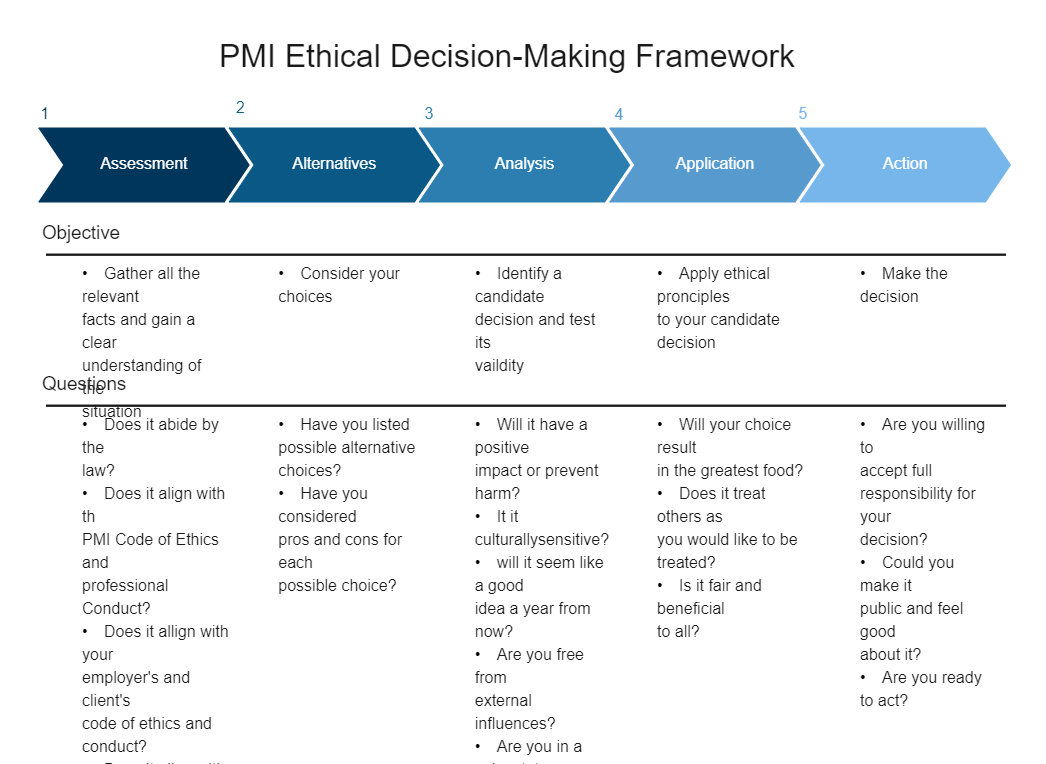
We have now described the frameworks. The next logical step is to apply them to make a decision. In our next lesson, we will work through a complex transformation scenario from start to finish. We will use a structured process, like the PMI Ethical Decision-Making Framework, to move from assessing a situation to taking concrete action, using the theories we learned today as our analytical tools.