Introduction
Welcome back. In our last lesson, we designed a formal escalation path and saw how the Transformation Management Office (TMO) often serves as the central hub for resolving cross-stream conflicts. This naturally leads to a critical question: what exactly is this TMO, and what does it do?
Answering this question is the focus of today's lesson. Our learning outcome is to define the mandate and operating model of a Transformation Management Office (TMO). We will distinguish it from a traditional Project Management Office (PMO), detail its core responsibilities (its mandate), and explore how it is structured and runs day-to-day (its operating model).
For a large-scale transformation like the one you are planning, a dedicated TMO is not a luxury; it's the engine room. It provides the coordination, discipline, and strategic oversight needed to keep multiple complex workstreams—like product architecture, delivery processes, and go-to-market strategy—moving in the same direction.
1. The Mandate: What is a TMO and What Does It Do?
Your background in project and product management likely makes you very familiar with the concept of a Project Management Office (PMO). It's crucial to understand that a TMO is a fundamentally different entity with a more strategic scope.
The Ultimate Blueprint to Setting Up a Transformation Management Office
To start, let's clarify this distinction. The article 'The Ultimate Blueprint to Setting Up a Transformation Management Office' by Forrest Advisors provides a clear definition of a TMO and contrasts it with a traditional PMO.
Please read the sections 'What is a Transformation Management Office?' and 'Transformation Management Office vs. Project Management Office'. As you read, focus on the differences in scope, focus, and objectives between the two.
To summarize the key difference visually:
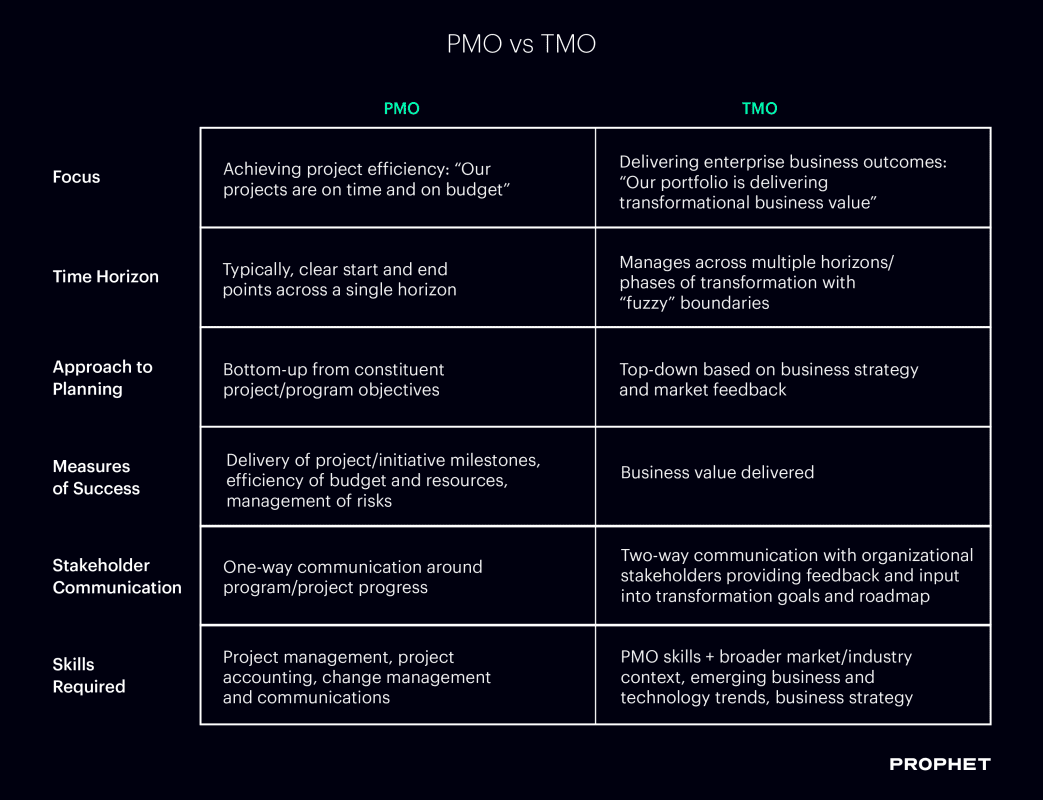
With this distinction in mind, let's define the TMO's mandate—its core purpose and set of responsibilities.
The Many Roles of a Transformation Office
This short video from Bain & Company provides a concise and powerful framework, outlining five key roles that a Chief Transformation Officer and their TMO typically play. This gives us a high-level view of the mandate.
Please watch the first part of the video (00:00 - 01:25). As you watch, note down the five key roles described: Strategic Architect, Integrator, Dashboard Holder/Controller, Operator, and Coach.
These five roles—Strategic Architect, Integrator, Controller, Operator, and Coach—form the heart of the TMO's mandate. Let's expand on them with more detail from our resources. The Forrest Advisors article you read earlier contains an excellent list of 'Key Responsibilities of a Transformation Management Office' that map well to these roles.
A comprehensive TMO mandate includes:
- Strategic Alignment (Architect & Coach): The TMO doesn't just execute; it ensures the entire program, from the microservices migration to the GTM shift, is aligned with the company's North Star. It helps leaders connect the dots between actions and strategic goals.
- Cross-Functional Integration (Integrator): This is perhaps the TMO's most visible role. It acts as the "air traffic controller," managing dependencies between the Product, Delivery, and GTM workstreams. As we saw in the previous lesson, it's the central point for resolving cross-stream conflicts.
- Governance and Performance Management (Controller): The TMO establishes the "rules of the road"—the reporting cadence, risk management processes, and decision-making frameworks (like the escalation path we designed). It holds a single source of truth, tracking progress against milestones and value realization (ROI).
- Centralized Operations & Support (Operator): The TMO runs initiatives that don't belong to any single workstream, such as enterprise-wide change management campaigns or setting up transformation-wide tools.
- Resource and Portfolio Management (Integrator & Controller): This is a critical but often overlooked function. A transformation introduces a massive amount of new work. The TMO must provide a holistic view of all projects (both BAU and transformation) to make strategic trade-offs and ensure the right people are working on the right things.
How to set up and manage a digital transformation office - the role of the 'transformation war room'
This next video emphasizes the critical importance of resource and portfolio management. It provides a very practical perspective on why the TMO must get an overview of all ongoing projects to free up key personnel for the transformation.
Watch the section from 01:25 to 03:47. Pay close attention to the argument that you can't just 'add more tasks to existing people' and why the TMO's first job is often to create a complete project portfolio overview.
2. The Operating Model: How Does a TMO Function?
Having defined what the TMO does, we now turn to how it operates. This involves its structure, its daily and weekly routines, and how it evolves over time.
Structure and Governance
A TMO is not a large, permanent bureaucracy. It's a small, agile team of high-impact individuals. Its structure is designed to connect leadership strategy to on-the-ground execution.
How to Create a Transformation That Lasts
The article 'How to Create a Transformation That Lasts' from Boston Consulting Group (BCG) offers deep insights into setting up a TMO. We'll use it to understand the structure and key processes.
Please read the section 'Getting the Transformation Office Off the Ground'. Focus on the five dimensions, particularly 'Strategy and Scope', 'Governance and Organization', and 'Roles Within the Transformation Office'. Note the typical roles mentioned (CTO, workstream liaisons, finance, HR, etc.).
Based on this, a typical TMO operating model includes:
- Leadership: A Chief Transformation Officer (CTO) or Head of Transformation who reports directly to a C-level sponsor (often the CEO or CFO). This person must have the authority to hold other leaders accountable.
- Core Team: A small group handling central functions like overall program management, financial tracking, risk management, and communications.
- Workstream Liaisons: Dedicated members who are embedded with or act as the primary contact for each major workstream (e.g., Product/Tech, Delivery, GTM). They serve as the connective tissue between the central TMO and the delivery teams.
- Steering Committee: The TMO is accountable to and facilitates the key decision-making body, the Steering Committee, which we've discussed in previous lessons.
This diagram illustrates how these pieces fit together, showing the TMO as the hub connecting leadership with the various change streams.

Routines, Processes, and Behaviors
The TMO drives the transformation's pulse through a rigorous set of routines and processes. The goal is to create what the BCG article calls "executional certainty."
Key processes run by the TMO include:
- The Meeting Cadence: The TMO establishes and runs a series of interlocking meetings (e.g., weekly workstream check-ins, bi-weekly TMO-wide reviews, weekly Steering Committee meetings). This rhythm creates transparency and accountability. The focus is on problem-solving and decision-making, not just status reporting.
- Stage-Gate Methodology: The TMO ensures that initiatives pass through formal gates (e.g., from idea to business case to execution), ensuring rigor and that resources are spent on validated priorities.
- Tracking and Reporting: The TMO owns the central tracking system and dashboards that provide real-time visibility into milestones, risks, and value capture. This is the foundation for the "Dashboard Holder/Controller" role.
Most importantly, the TMO is the primary agent for driving the behavioral changes needed for the transformation to stick. The BCG article introduces a powerful framework for this: ATAC (Anchoring, Transparency, Accountability, Consequences). By constantly anchoring discussions in the transformation's goals, creating transparency through its dashboards, assigning clear accountability for results, and ensuring there are consequences (both positive and corrective), the TMO actively shapes the organization's culture.
The Evolution of the TMO
A successful TMO ultimately works to make itself obsolete. Its role is not permanent; it evolves with the transformation's maturity.
The Many Roles of a Transformation Office
Let's return to the Bain & Company video, which beautifully illustrates the lifecycle of a TMO.
Please watch the remainder of the video (01:25 to the end). Notice how the TMO's focus shifts from strategic architecture in the early days to integration and coaching later on. The ultimate goal is to dissolve the TMO as the 'new way of working' becomes business as usual.
This evolution is key. The TMO begins as a highly centralized function to kickstart and align the change. Over time, it systematically transfers capabilities and ownership to the business units, until the transformed operating model can sustain itself.
3. Application Exercise: Drafting a TMO Mandate
Now, let's make this concrete. Imagine you have been tasked by your CEO to formally establish the TMO for your company's transformation (migrating from a monolith to a microservices/AI platform).
Your Task (15 minutes):
Draft a one-page charter to define the TMO's mandate and operating model. Use the concepts from this lesson to fill out the following sections. Be concise and use bullet points.
- TMO Mission Statement: A one-sentence summary of the TMO's purpose.
- Key Responsibilities (Mandate): List 5-7 key responsibilities tailored to your software company's transformation. (e.g., instead of generic "integration," specify what you're integrating).
- Proposed Operating Structure: Briefly describe the key roles in your proposed TMO.
- Key Interactions & Routines: Identify 3 key stakeholder groups and the primary routine you will use to interact with them.
Click here for a sample answer and analysis.
1. TMO Mission Statement:
To orchestrate the successful transformation of our product platform and business operations, ensuring strategic alignment, executional certainty, and sustainable value creation.
2. Key Responsibilities (Mandate):
- Strategic Alignment: Ensure all transformation initiatives directly support the business goals of increasing customer value, improving scalability, and enabling AI-driven features.
- Cross-Workstream Integration: Act as the central integration point between the Product Architecture (Microservices), Agile Delivery Transformation, and Go-to-Market (GTM) workstreams.
- Value & Performance Management: Track and report on key transformation KPIs, including migration progress, adoption of new delivery metrics (e.g., cycle time), and ROI of new product modules.
- Resource Prioritization: Maintain a holistic portfolio view of all major engineering and GTM initiatives to resolve resource conflicts between transformation and ongoing business needs.
- Change & Communications Hub: Drive the enterprise-wide change narrative, translating technical shifts into business value for sales, marketing, and support teams.
- Governance & Risk Oversight: Manage the central risk register and facilitate the escalation and decision-making process for the entire program.
3. Proposed Operating Structure:
- TMO Lead (CTO): Reports to the CEO, with ultimate accountability for program success.
- Workstream Liaisons (3): One dedicated liaison for each of the Product Architecture, Agile Delivery, and GTM workstreams.
- Transformation Analyst (1): Manages the central dashboard, financial tracking, and risk register.
4. Key Interactions & Routines:
- Stakeholder: Steering Committee (CEO, CTO, CFO, Heads of Product, Eng, Sales)
- Interaction/Routine: Weekly 60-minute Steering Committee meeting focused on decisions, risk mitigation, and roadblock removal.
- Stakeholder: Workstream Leads
- Interaction/Routine: Bi-weekly 90-minute "Integrator" meeting to review cross-stream dependencies, surface risks, and share learnings.
- Stakeholder: All Employees
- Interaction/Routine: Monthly all-hands "Transformation Update" and a bi-weekly newsletter showcasing progress, celebrating wins, and reinforcing the "why" of the change.
Conclusion
In this lesson, we have formally defined the crucial role of the Transformation Management Office. We've established it as a strategic entity, distinct from a PMO, that is essential for orchestrating complex organizational change.
Key Takeaways:
- A TMO is a strategic function focused on value realization and business outcomes, while a PMO focuses on project delivery efficiency (time, scope, budget).
- The TMO's mandate is multi-faceted, encompassing roles as a Strategic Architect, Integrator, Controller, Operator, and Coach.
- The TMO's operating model relies on a lean structure, a rigorous meeting cadence to drive accountability (ATAC), and strong governance links to senior leadership.
- A successful TMO is not permanent; it evolves and eventually dissolves as it embeds new capabilities and ways of working into the organization's DNA.
Preview of the Next Lesson
We've established the TMO as the "air traffic controller" responsible for integration. In our next lesson, we will equip the TMO with one of its most critical tools. We will learn how to "Map interdependencies and critical path elements across product, delivery, and GTM transformation workstreams." This is the practical work of integration that allows the TMO to anticipate bottlenecks, manage risk, and keep the entire program on track.