Introduction
Welcome back. In our previous lesson, we established the Transformation Management Office (TMO) as the strategic "air traffic controller" for your company's large-scale change. We defined its mandate to integrate, govern, and drive the transformation forward.
Today, we equip the TMO with one of its most essential navigation tools. Our learning outcome is to map interdependencies and critical path elements across product, delivery, and GTM transformation workstreams.
In a complex transformation like shifting from a monolithic product to a microservices and AI architecture, the greatest risk often lies not within a single workstream but at the seams between them. A delay in developing a new microservice (Product) can derail the sales team's enablement on a new pricing model (GTM), which in turn depends on new CI/CD pipelines being ready (Delivery). This lesson is about making those connections visible so you can manage them proactively. This is the core of the TMO's integrator role.
1. Defining Workstreams and Their Interdependencies
A large transformation is broken down into manageable parts called workstreams. These are essentially dedicated project streams, each focused on a specific domain of change. For your goal, the most critical workstreams are:
- Product & Technology Transformation: Migrating the monolith, building new microservices, and integrating the AI layer.
- Delivery Process Transformation: Shifting teams to an Agile/DevOps model, implementing new tools, and creating new team structures (topologies).
- Go-to-Market (GTM) Transformation: Redefining pricing, training sales and support, migrating customers, and updating marketing messages.
The challenge is that these workstreams are not independent. They are a network of commitments and dependencies.
Why IMO Charters & Workstreams are Critical to Integration
To see a practical example of how workstreams are structured, we can look at how they are used in a similarly complex scenario: a post-merger integration. The article 'Why IMO Charters & Workstreams are Critical to Integration' provides an excellent breakdown.
Please read the section 'Value and Benefits of IMO Workstreams' to understand their purpose. Then, review the 'Key Workstreams' examples in 'Step 2: Structuring the Workstreams'. Notice how the 'Technology Integration' and 'Sales and Marketing' workstreams have clear objectives, tasks, and interdependencies, much like your Product and GTM workstreams.
Types of Interdependencies
As the article hints, dependencies aren't just about one task finishing before another can start. In a strategic transformation, they are more nuanced. Thinking in categories helps the TMO identify a wider range of potential risks.

Here are the key types of interdependencies to look for:
- Deliverable Dependency: The most common type. The GTM workstream cannot train the sales team on a new feature until the Product workstream delivers it.
- Resource Dependency: Two workstreams require the same scarce resource. Your top solutions architect may be needed to design a new microservice (Product) and simultaneously help a pilot team troubleshoot their new deployment pipeline (Delivery).
- Knowledge Dependency: One workstream's success depends on information from another. The GTM team needs to understand the technical limitations of the new AI module (from Product) to set correct customer expectations.
- Synchronization Dependency: Key events must happen at the same time. The launch of a new marketing campaign (GTM) must be synchronized with the deployment of the new feature to production (Product/Delivery).
Identifying these connections early is a core responsibility of the TMO. As the BCG article "How to Create a Transformation That Lasts" from our previous lesson noted, a key role of the TO is to "join forces across silos and functions, especially in highly interdependent areas" and "deal with interdependency failure points."
2. The Critical Path Method: A Tool for Mapping and Analysis
Once you start listing dependencies, the network can quickly become complex. The Critical Path Method (CPM) is a classic project management technique that provides a structured way to visualize this network, identify the most critical sequence of tasks, and understand where you have flexibility.
Given your project management background, you've likely encountered CPM before. Here, we'll apply it specifically as a strategic tool for the TMO to manage the entire transformation portfolio.
Critical Path Method (CPM) Made Simple: A Complete Guide
This video provides a clear and comprehensive refresher on the fundamentals of the Critical Path Method. We will focus on the core concepts and a straightforward calculation method.
Please watch the following segments: Terminologies (00:34 - 03:00): Focus on the four types of dependencies (FS, SS, FF, SF) and the definition of the critical path and float (slack). Creating a Network Diagram (06:19 - 07:32): This shows how to visually map tasks and their predecessors. The 'Zero-Day' Method (17:34 - 22:30): This is a simple and intuitive way to calculate the critical path, early/late start dates, and float. Pay close attention to how tasks with zero float form the critical path.
Key Concepts from CPM for the TMO
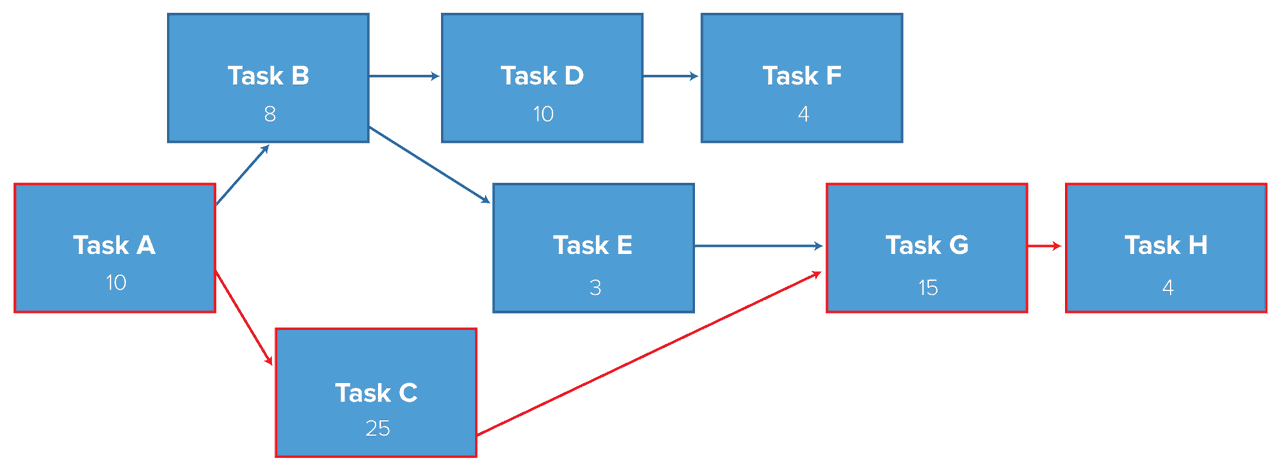
- Network Diagram: This is your visual map of the transformation. Each box is a major milestone or deliverable, and the arrows show the dependencies between them. Creating this map with the workstream leads is a critical alignment activity for the TMO.
- Critical Path: This is the longest sequence of dependent tasks through the network diagram. The length of this path determines the shortest possible duration for the entire transformation. Any delay in a task on the critical path will delay the final completion date. This is where the TMO must focus its attention and risk mitigation efforts.
- Float (or Slack): This is the amount of time a task can be delayed without affecting subsequent tasks (free float) or the overall project end date (total float). Tasks not on the critical path have float, which gives you scheduling flexibility.
3. Application Exercise: Mapping Your Transformation
Let's apply this thinking to your scenario. Imagine you're three months into the transformation program. The TMO brings the workstream leads together to map out the next major phase.
Scenario: The goal for the next six months is to release the first new microservice ("Billing") and have the first pilot customer using it.
Here are some high-level milestones identified by the workstream leads:
- Product & Tech Workstream:
- P1: Finalize the "Billing" microservice architecture & API contract. (Est. duration: 3 weeks)
- P2: Develop and test the "Billing" microservice. (Est. duration: 8 weeks)
- P3: Develop the "Strangler Fig" facade to safely route traffic from the monolith to the new service. (Est. duration: 6 weeks)
- Delivery Process Workstream:
- D1: Complete advanced Agile & DevOps training for the pilot "Billing" team. (Est. duration: 2 weeks)
- D2: Build and validate the automated CI/CD pipeline for microservices. (Est. duration: 4 weeks)
- GTM Workstream:
- G1: Define the new modular pricing for the "Billing" service. (Est. duration: 4 weeks)
- G2: Create training materials and enable the Sales & Support teams. (Est. duration: 3 weeks)
- G3: Onboard the pilot customer and manage their migration to the new billing service. (Est. duration: 4 weeks)
Your Task (15 minutes):
- Identify Dependencies: List the key dependencies between these milestones. Think about all four types (Deliverable, Resource, Knowledge, Synchronization). For example,
P2depends onP1. What else doesP2depend on? - Draw a Network Diagram: On paper or using a simple tool, draw a network diagram connecting the milestones based on the dependencies you identified.
- Hypothesize the Critical Path: Looking at your diagram, which sequence of milestones do you think forms the critical path? You don't need to do the full float calculation; reason it out based on the logical flow and estimated durations. Explain why a delay in this path would be critical.
Click here for a sample analysis.
1. Identified Dependencies:
- P2 (Develop Service) depends on P1 (Finalize Architecture). (Deliverable)
- P2 (Develop Service) also depends on D2 (Build CI/CD Pipeline). You can't effectively develop and deploy a microservice without the pipeline. (Deliverable/Resource)
- P3 (Develop Facade) depends on P1 (Finalize Architecture) to know how to route traffic.
- G1 (Define Pricing) likely depends on P1 (Finalize Architecture) to understand the scope and value of the new service. (Knowledge)
- G2 (Enable Sales) depends on G1 (Define Pricing) and P2 (Develop Service) being largely complete to have a stable product to train on. (Deliverable/Knowledge)
- G3 (Onboard Customer) is the final step and depends on everything being ready: P2 (Service Ready), P3 (Facade Ready), and G2 (Teams Enabled). (Synchronization)
- The D1 (Team Training) milestone can likely happen in parallel with other early activities like P1.
2. Sample Network Diagram:
A possible diagram would show:
Startsplits intoP1andD1.D2starts afterD1.P2starts after bothP1andD2are complete.P3starts afterP1.G1starts afterP1.G2starts afterG1andP2are complete.G3starts afterG2andP3are complete.G3leads toEnd.
3. Hypothesized Critical Path:
Based on this flow and durations, a likely critical path is:
Start -> P1 (3w) -> D2 (4w) -> P2 (8w) -> G2 (3w) -> G3 (4w) -> End
-
Total Duration: 3 + 4 + 8 + 3 + 4 = 22 weeks.
-
Reasoning: This path represents the core "build and release" sequence. The development of the service itself (
P2) is a long pole, and it depends on the CI/CD pipeline (D2) being ready. The final GTM activities (G2,G3) are dependent on the product being finished. The development of the facade (P3- 6 weeks) can happen in parallel with a large part of the service development (P2- 8 weeks), so it may have some float and might not be on the critical path initially. A delay in building the pipeline, developing the service, or enabling the teams would directly push out the pilot customer launch. This is the sequence the TMO must watch like a hawk.
Conclusion
In this lesson, we moved from the abstract concept of the TMO as an integrator to the concrete practice of mapping the transformation. You now have a framework for identifying and managing the complex web of connections between your Product, Delivery, and GTM workstreams.
Key Takeaways:
- Large transformations are executed via interdependent workstreams (e.g., Product, Delivery, GTM).
- Dependencies are multifaceted, including deliverables, resources, knowledge, and synchronization points.
- The Critical Path Method (CPM) is a vital tool for the TMO to visualize dependencies, calculate the project's minimum duration, and identify the sequence of activities with zero float.
- Managing the critical path is the TMO's primary mechanism for mitigating risk and ensuring the entire transformation program stays on track.
Preview of the Next Lesson
We have successfully created a map of our transformation, highlighting the most critical route. But a map is only useful if you know where you are on it and can see the roadblocks ahead.
In our next lesson, we will build the systems to do just that. We will learn how to "Design integrated reporting and risk management processes for cross-stream coordination." This will involve creating dashboards and routines that provide real-time visibility into progress along the critical path and a structured way to manage the risks we've just identified.