Introduction
Welcome back. In our previous lesson, we established a clear framework for decision rights using DACI and RAPID, defining who gets to make which decisions within your transformation program. This is a critical step in preventing ambiguity. However, even with the best-laid plans, situations will arise where a decision is blocked, teams are deadlocked in conflict, or a roadblock appears that is beyond the authority of the assigned owner to remove.
This lesson addresses that "what if" scenario directly. Our learning outcome is to: Design an escalation path for resolving conflicts and removing roadblocks. We will move from defining static decision rights to designing a dynamic process that keeps the transformation moving when friction inevitably occurs. A well-designed escalation path is not a sign of failure; it is a feature of robust governance, ensuring that issues are surfaced and resolved quickly, maintaining momentum and trust across the organization.
1. The Psychology of Escalation: Feature, Not Bug
In many organizations, "escalation" has a negative connotation. It can be perceived as an admission of failure, an act of aggression, or "tattling" on a colleague. This cultural barrier often causes teams to delay raising critical issues, letting them fester until they become genuine crises. For your transformation to succeed, it's vital to reframe escalation as a healthy, necessary tool for collaborative problem-solving.
To understand this better, let's explore the cultural and practical aspects of escalation management.
Escalation management: Tips for making faster, better decisions
The article 'Escalation management: Tips for making faster, better decisions' from CIO offers excellent insights into the cultural dynamics of escalation and provides practical advice for both those escalating and those receiving escalations.
Please read the introduction and the sections 'Why are escalations ignored/delayed in common workplace settings?', 'When to escalate?', and 'To whom and how to escalate?'. As you read, focus on: The reasons escalations are often perceived negatively. The importance of reframing escalation as 'leadership hygiene, not a fire alarm.' The principles of doing due diligence and time-boxing discussions before escalating.
The key shift in mindset is to view an escalation path as a pre-agreed process for seeking help, not assigning blame. It provides a safety valve that empowers individuals at all levels. When someone knows there is a clear, blameless path to get a decision un-stuck, they are more likely to raise issues early, which is crucial for the adaptive strategy you want to build.
2. Diagnosing Conflict: When to Escalate
Not all disagreements require formal escalation. Part of designing an effective path is understanding the nature of conflict itself, so you can recognize when informal resolution is failing and a structured intervention is needed.
A useful tool for this is Glasl's Model of Conflict Escalation. It shows how conflicts, if left unchecked, tend to intensify through predictable stages, moving from a collaborative "win-win" mindset to a destructive "lose-lose" reality.

Let's break down the phases:
- Phase 1: Win-Win. Here, the conflict is about the issue itself. Parties are still focused on finding a mutually beneficial solution. Interventions like facilitated discussion are usually enough.
- Phase 2: Win-Lose. The focus shifts from the issue to the relationship. It becomes about winning and losing, personal attacks, and forming coalitions. At this point, mediation by a neutral third party (like a TMO lead or manager) is often required.
- Phase 3: Lose-Lose. The goal is no longer to win, but to ensure the other side loses, even at one's own expense. This is where threats, sabotage, and total confrontation occur. Intervention here must be authoritative and decisive, which is precisely what a formal escalation to senior leadership provides.
Your escalation process is a formal mechanism to trigger intervention, ideally while the conflict is still in late Phase 1 or early Phase 2, before significant damage is done to relationships and project goals.
3. Designing a Formal Escalation Path
A robust escalation path is not just a line on an org chart; it's a well-defined process. Let's build one using a structured, four-step approach.
Escalation Process In 4 Steps With Escalation Template
The article 'Escalation Process In 4 Steps' by TCGen provides a practical, step-by-step guide for creating a formal escalation workflow. We will use this as our core framework.
Please read the numbered list of 4 steps (starting with 'Define decision categories'), the section 'What Else You Should Know about the Escalation Process', and the 'Case Study' about NetCo. Focus on the core components of a documented escalation process.
Based on these readings, here is a consolidated framework for designing your path:
Step 1: Define Escalation Categories
First, define the types of issues that can be escalated. This provides clarity and helps route the issue to the right people. These categories should align with the decision types you defined in the last lesson.
- Resource Contention: e.g., two workstreams needing the same key engineer.
- Budget Overruns: e.g., a workstream needing more funds than allocated.
- Scope Disagreements: e.g., conflict over whether a feature is in or out of scope for a release.
- Technical Roadblocks: e.g., a critical architectural decision that impacts multiple teams.
- Timeline/Dependency Conflicts: e.g., one team's delay blocking another team's start.
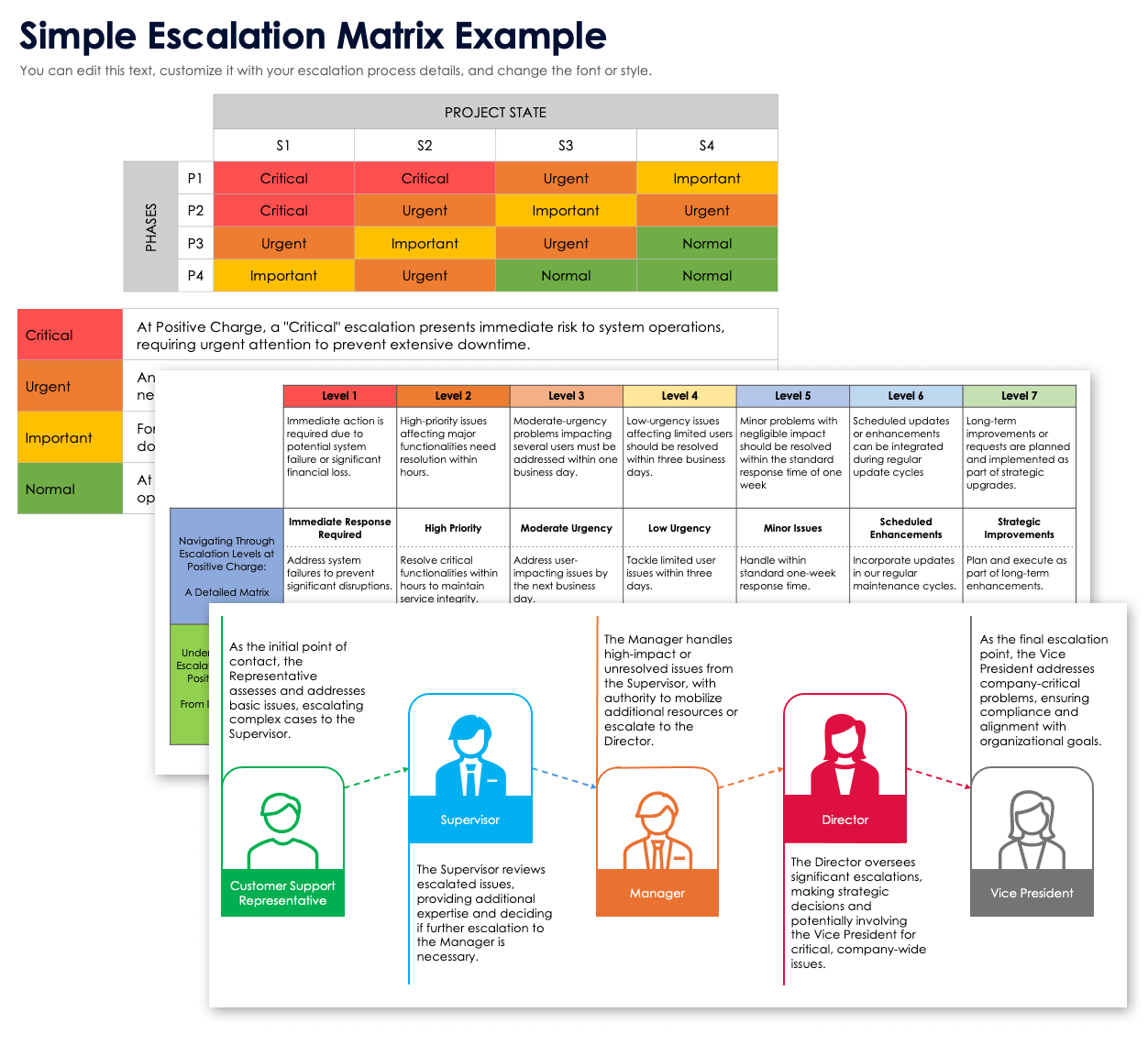
Step 2: Define Escalation Levels and Service Level Agreements (SLAs)
This is the core of the path. You must define the hierarchy and the expected response time at each level. For your transformation, this might look like:
- Level 1: Between individuals within a workstream -> Workstream Lead
- Level 2: Between workstreams -> Transformation Management Office (TMO)
- Level 3: Major strategic, budget, or cross-program issues -> Steering Committee (SteerCo)
For each level, you must define an SLA. For example:
- Acknowledgement SLA: The recipient of the escalation must acknowledge receipt within 4 business hours.
- Resolution SLA: The issue must be resolved or a clear action plan communicated within 3 business days.
This matrix makes the path tangible and sets expectations for urgency.
Step 3: Define the Escalation Procedure ("How to Escalate")
An escalation should not be a frantic email or a hallway complaint. It should be a structured request for a decision. As recommended in the CIO article, the person escalating must first do their due diligence. The procedure should require the submission of a concise brief (e.g., a 1-pager) containing:
- Problem Statement: A clear, neutral summary of the issue or conflict.
- Business/Customer Impact: Why does this matter? Quantify if possible (e.g., "This will delay the Q3 launch and affect our top 5 customers.").
- Options Explored: What solutions were considered by the parties involved? What were the pros and cons of each?
- Point of Disagreement: A specific summary of where the parties are deadlocked.
- Specific Request: What decision is needed from this level of leadership?
This discipline ensures that by the time an issue reaches a leader, it has been properly framed, saving time and focusing the discussion on resolution, not discovery.
Step 4: Secure Leadership Buy-in and Communicate
An escalation path is useless if leadership doesn't respect it. The final step is to review the documented path with the Steering Committee and other leaders. They must publicly commit to:
- Being responsive and honoring the SLAs.
- Following the process and not encouraging "back-channel" escalations that undermine the structure.
- Focusing on solving the problem, not on blaming the individuals or teams who escalated it.
Once approved, this document should be shared widely and become part of the transformation program's operating charter.
4. Application Exercise: Navigating a Conflict
Let's apply this to a realistic scenario from your transformation.
Scenario:
The Product Workstream wants to delay the next major release by one month. They have discovered that a core part of the legacy monolith is more complex than anticipated, and they want to refactor it properly to align with the new microservices architecture. They argue this is crucial for long-term stability.
The GTM Workstream is strongly opposed. They have a major marketing campaign planned, and the sales team has already committed to the original release date with several key customers. They argue that a delay will damage credibility and potentially lose deals.
The two workstream leads have met twice but are deadlocked. The TMO Lead has now been brought in.
Your Task (15 minutes):
- Diagnose the Conflict: Based on Glasl's model, what stage would you say this conflict is in? Justify your answer.
- Draft an Escalation Brief: Imagine you are the TMO Lead. The decision is too significant for you to make alone, so you must escalate to the Steering Committee. Draft a 1-page escalation brief following the structure from Step 3 above. Be concise and use bullet points.
- Outline the Path: In this scenario, what was the correct escalation path the issue followed?
Click here for a sample answer and analysis.
1. Conflict Diagnosis:
This conflict is likely in late Stage 3 (Action, not words) or early Stage 4 (Images/Coalitions) of the Win-Win/Win-Lose transition. The discussion has moved beyond a simple factual debate (Stage 2). The fact that the leads are deadlocked and bringing in others suggests they are beginning to solidify their positions and may start building coalitions (e.g., GTM talking to Sales, Product talking to Engineering VPs) to strengthen their case. The goal is shifting from "our best solution" to "my solution must win."
2. Sample Escalation Brief:
To: Steering Committee
From: TMO Lead
Date: [Date]
Subject: Escalation: Decision Required on Q3 Release Date
-
Problem Statement: Product and GTM workstreams are deadlocked on the Q3 release date. Product requests a 1-month delay to refactor a legacy component for technical stability. GTM insists on meeting the original date due to customer and market commitments.
-
Business Impact:
- Option A (Delay Release): Pros: Improves long-term platform health, reduces future technical debt. Cons: Breaks public commitments, risks losing 2 major deals in the pipeline, requires re-planning a $200k marketing campaign.
- Option B (Meet Date): Pros: Meets customer expectations, supports Q3 sales targets. Cons: Introduces significant technical debt, high risk of post-launch performance/stability issues that could require an emergency patch.
-
Options Explored:
- Partial Launch: GTM rejected this as it doesn't include the key features promised.
- Staggered Rollout: Product rejected this as it adds technical complexity without solving the core refactoring need.
-
Point of Disagreement: The core conflict is prioritizing long-term architectural health vs. short-term commercial commitments.
-
Specific Request: A final decision from the Steering Committee on whether to (A) delay the release by one month or (B) accept the technical risk and hold the original date.
3. Escalation Path Followed:
The correct path was: Workstream Leads (Level 1) -> TMO (Level 2) -> Steering Committee (Level 3). The workstream leads attempted to resolve it themselves. When they failed, they correctly escalated to the TMO, whose role is to facilitate cross-stream issues. Recognizing the strategic impact, the TMO correctly escalated to the SteerCo for a final decision.
Conclusion
Today, we've designed the critical mechanism for handling friction in your transformation. A clear and trusted escalation path is what allows a complex program to absorb shocks and keep moving forward.
Key Takeaways:
- Escalation is a healthy governance process, not a sign of failure. It requires a culture of trust, which leaders must actively build.
- Understanding conflict dynamics (Glasl's Model) helps you know when to intervene. An escalation path is your formal tool for intervening before a conflict becomes destructive.
- A well-designed escalation path is a documented process with clear categories, hierarchical levels, response time SLAs, and a defined procedure for making the request.
- Leadership commitment is non-negotiable. The entire process relies on leaders agreeing to the system and being responsive when issues are raised.
Preview of the Next Lesson
We've repeatedly mentioned the Transformation Management Office (TMO) as a central hub for integration, decision-driving, and escalation management. In our next lesson, we will do a deep dive into this critical function. We will "Define the mandate and operating model of a Transformation Management Office (TMO)," exploring its structure, responsibilities, and how it acts as the engine room of the entire transformation program.