Introduction
Welcome back. In our previous lesson, we identified the key governance bodies for a large-scale transformation: the strategic Steering Committee, the coordinating Transformation Management Office (TMO), and the execution-focused Workstream Leads. We established who the main players are.
However, simply having roles isn't enough. A common failure point in transformations is ambiguity over who has the final say. This leads to decision paralysis, endless meetings, and frustration. This lesson directly addresses that challenge.
Today, we will focus on the learning outcome: Define decision rights for key transformation choices using a RACI or similar framework. We will explore how to move from a list of roles to a clear, actionable "operating constitution" that specifies who is empowered to make which decisions. We'll start with the widely known RACI framework, critically assess its suitability for complex transformations, and then explore more robust alternatives that are better equipped for the dynamic environment you're planning to navigate.
1. The Classic Model: Understanding RACI
The most common tool for clarifying roles and responsibilities is the RACI matrix. RACI is an acronym that stands for Responsible, Accountable, Consulted, and Informed. Before we critique it, it's essential to understand its mechanics.
RACI explained its simple yet powerful - The most watched RACI matrix video on YouTube
This short video, 'RACI explained,' provides a clear and concise introduction to the four roles within the framework and how to construct a basic RACI chart.
Please watch the video from the beginning to 05:20. As you watch, focus on: The specific distinction between Responsible (the doer) and Accountable (the owner where 'the buck stops'). The definitions of Consulted (two-way communication) and Informed (one-way communication). The basic rules for analyzing a RACI chart, such as having only one 'A' per task.
To summarize the key roles:
- Responsible (R): The person or people who do the work. They are responsible for action and implementation.
- Accountable (A): The one individual who is ultimately answerable for the correct and thorough completion of the task. There must be only one 'A' for each task.
- Consulted (C): People who are asked for their input or expertise before a decision is made or action is taken. This implies a two-way conversation.
- Informed (I): People who are kept up-to-date on progress or decisions. This is a one-way communication.
While RACI can bring clarity to simple, single-team projects, its effectiveness diminishes rapidly in the face of the complexity inherent in a large-scale transformation.
2. RACI Under Stress: Why It Fails in Transformations
Your goal involves a multi-dimensional transformation with multiple vendors, cross-functional dependencies (product, delivery, GTM), and a shift to new technologies like microservices and AI. In such an environment, RACI's limitations become critical liabilities.
Let's examine why RACI is often insufficient for this kind of work.
RACI Tells You Who Does the Work. It Doesn't Tell You Who Drives It.
The article 'RACI Tells You Who Does the Work. It Doesn't Tell You Who Drives It.' provides an excellent, in-depth critique of RACI within the context of complex transformation programs.
Please read the sections 'What RACI Gets Wrong' and 'The Three Gaps That Kill Transformation Governance'. Focus on how the article connects RACI's design assumptions (single organization, line management authority) to the specific gaps that emerge in a multi-partner program.
As the article argues, RACI was designed for a simpler world. In a complex transformation, it creates three critical gaps:
- The "No Driver" Gap: RACI assigns who is Responsible for doing a task and who is Accountable for the outcome, but it fails to name who is responsible for driving the process forward—chasing down inputs, scheduling meetings, and removing blockers. The 'A' is often a senior sponsor who lacks the bandwidth for this day-to-day management, and the 'R' may be a vendor who lacks the authority to compel action from the client.
- The "No Decision Authority" Gap: RACI assumes the 'A' is also the decider. In your transformation, a decision might require input from multiple workstreams, legal, finance, and the SteerCo. The 'A' may be accountable for the outcome, but they may not have the final authority to approve a budget increase or a major scope change. This leads to decisions getting stuck in limbo.
- The "Accountability Without Authority" Gap: The framework can lead to situations where a role is 'Accountable' for an outcome they cannot control. For example, a business unit leader might be accountable for adopting a new CRM, but has no authority over the IT team responsible for implementing it. This creates pressure without power, leading to frustration and blame.
The McKinsey article, "The limits of RACI," reinforces these points, highlighting how RACI can lead to having too many "voters" and poor orchestration of stakeholders.
3. Better Frameworks for Transformation: DACI and RAPID
Given RACI's shortcomings, we need more robust frameworks that are explicitly designed for decision-making in complex environments. The article you just read introduces two powerful alternatives: DACI and RAPID.
RACI Tells You Who Does the Work. It Doesn't Tell You Who Drives It.
Let's return to the same article to explore the solutions it proposes. This section provides a comprehensive review of several governance frameworks and makes a strong case for using DACI and RAPID in a transformation context.
Please read the sections 'The Five Governance Frameworks: A Complete Review,' 'Why DACI Wins for Transformation Execution,' 'When to Add RAPID...,' and 'The Recommendation: What to Implement.' As you read, focus on: How DACI directly solves the 'No Driver' gap. How RAPID solves the 'No Decision Authority' gap for high-stakes decisions. The practical recommendation to use DACI for execution and RAPID for governance forums.
Let's break down these superior alternatives.
DACI: For Program Execution
DACI is a simple but powerful shift in focus from task completion to forward momentum.
- Driver (D): The person responsible for corralling stakeholders, gathering input, and driving the work to a decision. This is the project manager or workstream lead who ensures progress. This role directly fills RACI's biggest gap.
- Approver (A): The single person who makes the final decision. Their 'yes' means go.
- Contributors (C): The experts who have knowledge and a voice, but not a vote. This combines RACI's 'Responsible' and 'Consulted' roles.
- Informed (I): People who are notified of the decision once it's made.
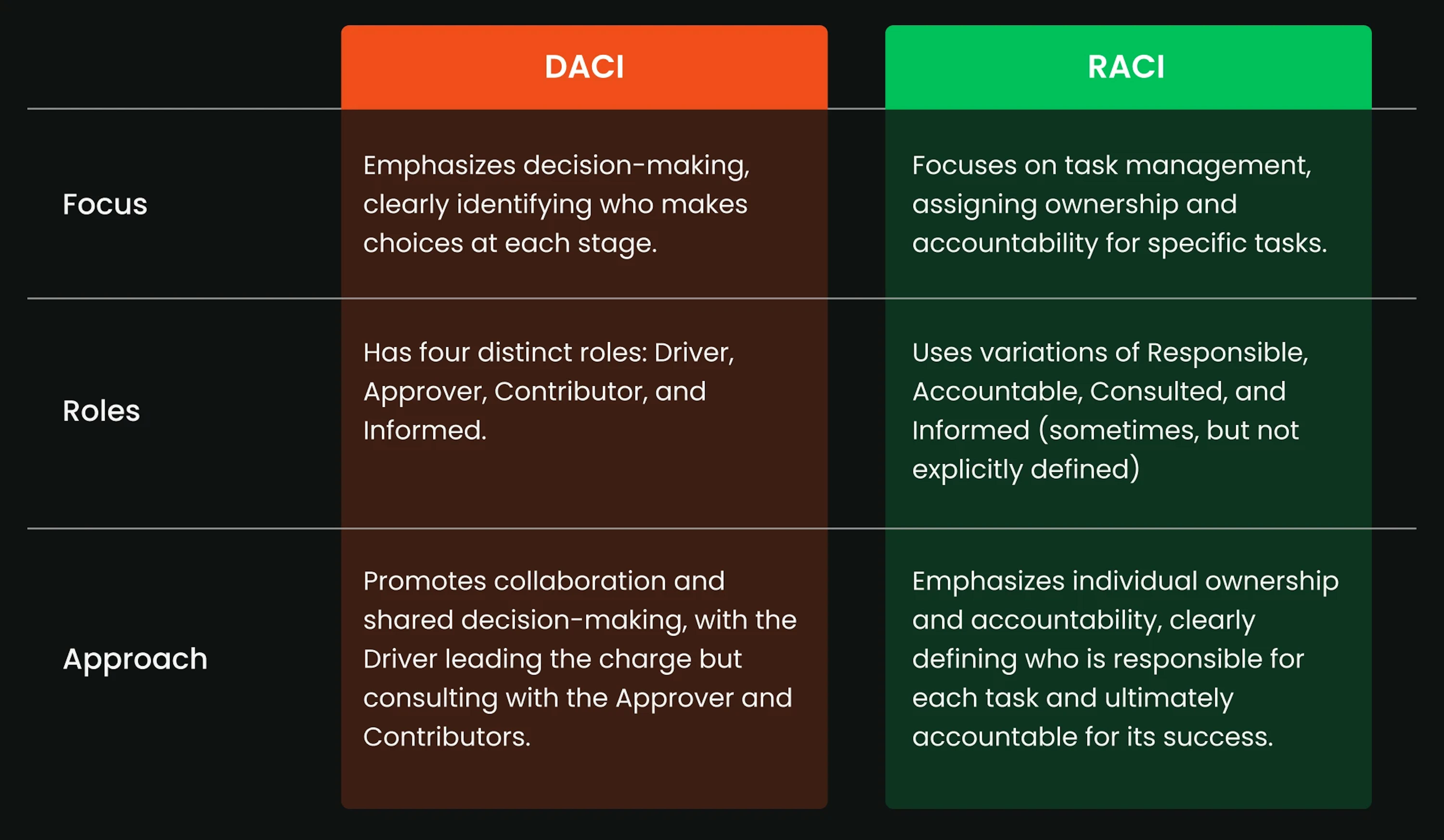
By explicitly naming a Driver, DACI ensures that someone is tasked with pushing work forward, which is critical in a multi-vendor environment where responsibilities are distributed.
RAPID: For High-Stakes Decisions
For major decisions made in your Steering Committee or other governance forums, RAPID provides even greater clarity.
- Recommend (R): Makes a proposal.
- Agree (A): People who must agree to the recommendation (e.g., legal, compliance). They have a veto right.
- Perform (P): Executes the decision.
- Input (I): Provides input to the recommendation, but has no veto.
- Decide (D): The single person who makes the final call and commits the organization to action.
The power of RAPID is that it forces you to name a single Decider and clearly distinguishes between those who provide input and those who have a formal veto. This prevents "death by committee" where everyone has an opinion but no one can make a final call.
4. Application Exercise: Creating a Decision Rights Matrix
Now, let's make this practical. The output of this thinking is not just an abstract chart, but a concrete Decision Rights Matrix that becomes a reference for your entire transformation program. This matrix lists key decision types and assigns a decision-making framework (like DACI or RAPID) to each.
Here is an example of what a simple decision rights matrix can look like:

Your Task (10 minutes):
Your transformation involves shifting from a monolithic product to a microservices architecture. Consider the governance roles from our last lesson: Steering Committee (SteerCo), TMO, Product Workstream Lead, and GTM Workstream Lead.
For the key decisions listed below, create a simple matrix in your notes. Use the DACI framework. For each decision, identify who you believe should be the Driver (D) and who should be the Approver (A).
Key Decisions:
- Prioritizing the next 3 product components for migration from the monolith to microservices.
- Approving a 10% budget increase for the Product Workstream to hire specialized cloud engineers.
- Changing the customer communication plan for the next phase of the migration.
- Finalizing the Q3 integrated roadmap across the Product and GTM workstreams.
Click here for a sample answer and analysis.
Here is one possible way to structure the decision rights. The most important part is the reasoning behind the choices.
| Decision | Driver (D) | Approver (A) | Rationale |
|---|---|---|---|
| 1. Prioritize next 3 components for migration. | Product Workstream Lead | Product Workstream Lead | The Product lead has the context and authority for this tactical execution decision. The TMO and GTM lead would be Contributors (C) to ensure alignment. |
| 2. Approve 10% budget increase for Product Workstream. | TMO | SteerCo | The TMO drives the process by validating the business case and its impact. The SteerCo has the ultimate authority to approve significant, unbudgeted expenses. |
| 3. Change the customer communication plan. | GTM Workstream Lead | GTM Workstream Lead | Similar to #1, this is a tactical decision within the GTM lead's authority. The Product lead would be a key Contributor to ensure technical accuracy in the messaging. |
| 4. Finalize the Q3 integrated roadmap across Product and GTM workstreams. | TMO | SteerCo | The TMO is the natural Driver for this cross-functional planning, as its role is to integrate. The Approver is the SteerCo, as the integrated roadmap represents a major strategic commitment. |
Conclusion
In this lesson, we have moved from identifying roles to defining their power. Clear decision rights are the antidote to the confusion and delays that plague complex programs.
Key Takeaways:
- RACI is a starting point, not the destination. While common, its assumptions don't hold up in complex, multi-partner transformations.
- The "Driver" and "Decider" roles are critical. Frameworks like DACI and RAPID succeed because they explicitly name who is responsible for moving work forward and who has the final say.
- Use the right tool for the job. DACI is excellent for day-to-day program execution, while RAPID brings crucial clarity to high-stakes decisions at the governance level.
- Documenting decision rights is essential. A Decision Rights Matrix makes governance tangible and provides a "source of truth" for the entire program team.
Preview of the Next Lesson
We have now established who the key players are and what they are empowered to decide. But what happens when a decision is blocked, or a conflict arises that cannot be resolved at the assigned level? In our next lesson, we will build on this foundation to "Design an escalation path for resolving conflicts and removing roadblocks," ensuring that momentum is never lost for long.