Introduction
Welcome to the first lesson of Module 5: Transformation Governance and Program Management. In our last lesson, we focused on the adaptive nature of transformation, specifically how to communicate strategic pivots without losing stakeholder trust. A key question that emerged was, "Who has the authority to approve a pivot?" Answering this requires a clear and robust governance structure.
This lesson directly addresses that need by focusing on the learning outcome: Identify key roles and bodies for a transformation governance structure (e.g., Steering Committee, TMO, Workstream Leads). We will move from the 'what' and 'why' of your transformation strategy to the 'who' of its execution. Establishing this "operating constitution" is the foundational step in ensuring your large-scale transformation is managed with discipline, clarity, and accountability.
1. What is Transformation Governance?
Think of a transformation without a governance structure like a major construction project without blueprints. You might have skilled teams working hard, but they may not be building the same structure. Governance provides the blueprints, defining who decides what, when, and based on what information. It replaces ambiguity and politics with a clear process for decision-making, oversight, and accountability.
A well-designed governance structure typically has several layers of oversight and execution. This image provides a high-level conceptual view of how these layers connect.

As the diagram shows, a dedicated governance structure for the transformation sits within the broader enterprise context. It ensures the transformation program receives strategic guidance from the top, while effectively managing the work on the ground. The two most critical components of this structure are typically the Transformation Steering Committee and the Transformation Management Office (TMO).
Let's explore these key bodies and roles in more detail.
2. The Steering Committee: The Decision-Makers
The Transformation Steering Committee (often called a "SteerCo") is the primary decision-making body for the transformation. It is comprised of senior leaders who have the authority to approve major strategic shifts, allocate resources, and remove significant roadblocks. This is the group that would ultimately approve the kind of strategic "pivot" we discussed in the last module.
To understand the role of a SteerCo, please watch the following video.
Successful Project Steering Committee Meetings
This video, 'Successful Project Steering Committee Meetings' by Stuart Taylor, clearly explains the fundamental purpose and authority of a Steering Committee.
Watch the video from the beginning to 04:42. As you watch, focus on: How the SteerCo's authority extends beyond that of the project/program manager. Its role as the key forum for decisions regarding budget, scope, and timelines. Its function as the ultimate escalation point for issues the team cannot resolve.
The key takeaway is that the SteerCo is not involved in day-to-day management. Its purpose is strategic oversight, governance, and high-stakes decision-making. Given your interest in practical templates, the following resource provides a concrete example of how a SteerCo's mandate is formalized.
Transformation Charter & Governance Templates
The document 'Transformation Charter & Governance Templates' from Umbrex offers a powerful, real-world example of a board charter, which defines the mandate for the highest-level steering committee.
Please read section 14.1, 'Sample Board Charter'. Don't worry about memorizing every clause. Instead, focus on understanding the key components that give the committee its power and clarity: Purpose: What is its primary objective? Scope and Authority: What decisions is it empowered to make? Composition: Who are the members? Note the seniority and cross-functional representation.
From this template, you can see the critical elements that define the SteerCo's role:
- Composition: It must include members with real organizational power—the CEO, CFO, and other C-suite leaders—who can make and enforce decisions on budget, resources, and strategic direction.
- Authority: It has the power to approve funding, reallocate capital, and even terminate initiatives that are not delivering value. This is the "teeth" of governance.
- Accountability: It is accountable to the board and shareholders for the overall success and value delivery of the transformation program.
3. The Transformation Management Office (TMO): The Engine Room
If the Steering Committee is the strategic brain, the Transformation Management Office (TMO) is the central nervous system and engine room. The TMO is a dedicated team responsible for coordinating, managing, and accelerating the day-to-day activities of the transformation. It acts as the central hub for tracking progress, managing dependencies, resolving issues, and ensuring alignment across all the different parts of your complex program.
This short video from Bain & Company provides an excellent overview of the TMO's multifaceted role.
The Many Roles of a Transformation Office
In 'The Many Roles of a Transformation Office,' Bain & Company breaks down the core functions that make a TMO effective.
Please watch the entire video (4 minutes). Pay close attention to the five primary roles the TMO plays and how its function evolves over time.
As the video explains, the TMO is not just an administrative function. It plays several critical roles:
- Strategic Architect: Helps design the transformation roadmap and business case.
- Integrator: Manages interdependencies between workstreams (e.g., ensuring the GTM plan aligns with the product migration roadmap).
- Dashboard Holder/Controller: Tracks progress against KPIs and provides a single source of truth to the Steering Committee.
- Operator: Runs central initiatives that are cross-functional in nature.
- Coach: Builds change management capabilities throughout the organization.
The following image provides another useful way to visualize the TMO's responsibilities, grouping them into three pillars.
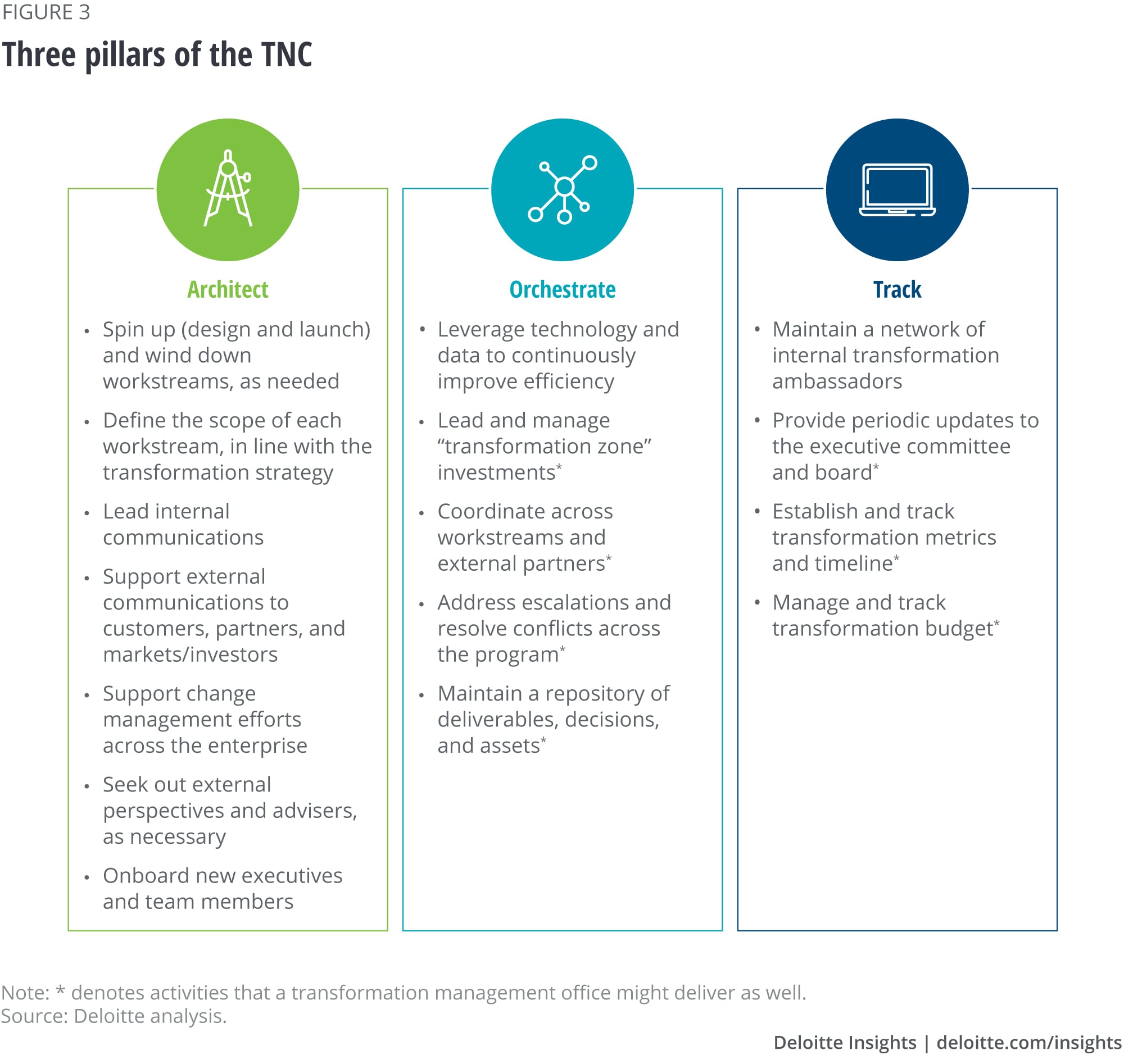
Notice the note at the bottom: "Activities with * may also be delivered by TMO." This highlights that the TMO's scope can be flexible. A key point from the Bain video is that the TMO is often a temporary "bridge" organization. It provides stability and focus while the main "line" organization is itself being transformed. Once the new ways of working are embedded, the TMO's functions can be distributed and the central office dissolved.
4. Workstream Leads & Other Key Roles
A large-scale transformation like yours—spanning product, delivery, and GTM—is too big to manage as a single project. It must be broken down into distinct but interconnected workstreams. Each workstream requires a leader.
The key roles at this level are:
- Workstream Lead: This person is the accountable owner for a major component of the transformation (e.g., Head of Engineering for the Microservices Migration, Head of Sales for the GTM Transformation). They are responsible for planning, executing, and reporting on the progress of their specific stream. The Forrest Advisors article below refers to these as "Project Managers and Teams" or leaders of "Functional or Departmental Committees."
- Sponsor: A senior executive (usually on the Steering Committee) who champions a particular workstream or the program as a whole. They use their influence to secure resources and remove high-level obstacles.
- Business Owner: A leader from a functional area who is ultimately accountable for adopting the changes and realizing the business value within their department.
The following resource provides a concise summary of these roles.
Effective Transformation Management: Governance Best Practices
This article, 'Effective Transformation Management: Governance Best Practices' from Forrest Advisors, includes a helpful FAQ that lists and defines the key roles in a governance structure.
Please scroll to the 'Frequently Asked Questions (FAQs)' section and read the answer to the first question: 'What are the key roles and responsibilities in transformation strategy governance?'. This will reinforce your understanding of how the roles we've discussed fit together.
Putting it all together, you have a hierarchy:
- Steering Committee: Provides oversight and makes major decisions.
- TMO: Drives and coordinates the program.
- Workstream Leads: Own and deliver specific parts of the program.
Application Exercise
Let's apply this to a realistic scenario based on your transformation goal.
Scenario: The GTM Transformation workstream is forecasting a 3-month delay. The Workstream Lead (Head of Sales) has identified that her team cannot create the necessary sales enablement materials for the new microservices-based product without hiring two dedicated technical writers. This requires an unbudgeted expense of $150,000.
Your Task (5 minutes):
Based on the governance structure we've discussed, answer the following questions:
- The request for additional budget is a decision that needs to be made. Which body is the ultimate authority for approving this request?
- Which body/role would be responsible for helping the Workstream Lead prepare the business case, analyze the impact of the delay on other workstreams, and package the information for the decision-makers?
- Which role is primarily responsible for escalating this issue and presenting the case for the additional budget?
Click here to see a sample answer after you've completed the exercise.
Sample Answer:
- The Transformation Steering Committee is the ultimate authority for approving an unbudgeted expense of this size that impacts the program's timeline and finances.
- The Transformation Management Office (TMO) would be responsible for this. Its "integrator" and "controller" functions involve analyzing cross-stream dependencies and ensuring that decisions presented to the SteerCo are supported by robust data and a clear business case.
- The Workstream Lead (Head of Sales) is responsible for escalating the issue and championing the need for the additional resources, working in partnership with the TMO to present the case to the Steering Committee.
Conclusion
In this lesson, we have laid the foundation for effective transformation management by identifying the key governance bodies and roles. A clear structure is not about bureaucracy; it’s about enabling speed and clarity by making it obvious who has the authority to decide, who is responsible for execution, and where to go for support.
Key Takeaways:
- Governance provides clarity: It defines the "who" behind decision-making, accountability, and execution.
- The Steering Committee provides strategic oversight: This senior body makes the big decisions on budget, scope, and strategic direction.
- The TMO is the engine room: This central team drives coordination, tracks progress, manages risks, and supports workstreams.
- Workstream Leads own delivery: They are accountable for executing their specific portion of the transformation plan.
Preview of the Next Lesson
We have now identified the key players in our governance structure. However, simply having roles is not enough. We need to precisely define what each role is responsible for in any given situation to avoid confusion and delays.
In our next lesson, we will address the learning outcome: "Define decision rights for key transformation choices using a RACI or similar framework." We will move from identifying the cast of characters to scripting their interactions, ensuring everyone knows their part in driving the transformation forward.