Introduction
Hello and welcome back. In our last lesson, you drafted a high-level roadmap for migrating a monolithic application to a microservices architecture. You learned that such a transformation is not just a technical exercise; it's a strategic move that provides the foundation for future agility and innovation.
Today, we will explore one of the most significant opportunities unlocked by that new, modular architecture: Artificial Intelligence. This lesson directly addresses the learning outcome: Describe common AI capabilities relevant to B2B software products and identify strategic use cases aligned with business objectives.
Your goal is to lead a major transformation, and a key part of that is articulating why the company is undertaking this effort. By understanding how to strategically apply AI, you can build a powerful narrative that connects the architectural changes we've discussed to tangible business growth and competitive advantage. We will focus on AI from a product leader's perspective—less on the algorithms and more on the business value they can create.
1. The Right Mindset: AI as a Business Tool
Before we dive into specific AI capabilities, it's crucial to establish the correct strategic frame. Technology itself provides no value; its value comes from how it's applied to solve a business problem or enhance a product.
Integrating Generative AI Into Business Strategy: Dr. George Westerman
Dr. George Westerman from MIT provides an excellent framing for how leaders should think about technology-driven transformation. His insights will help us ground our discussion of AI in business reality.
Please watch the following two segments from 'Integrating Generative AI Into Business Strategy': Westerman's Law (04:57 - 06:58): Pay close attention to the core message that the hard part isn't adopting the technology, but changing the business. Note the examples from Airbus and Home Depot, emphasizing that investment should be in solving a business problem, not in AI for its own sake. Four Areas for Opportunity (09:09 - 10:12): Listen for the four domains where you can look for digital transformation and AI opportunities. This provides a high-level map for identifying potential use cases.
Dr. Westerman's four areas—customer experience, operations, business models, and employee experience—provide an excellent high-level framework. As you think about your B2B software company, you can use these as buckets to brainstorm where AI could have the most impact.
2. A Manager's Guide to AI Capabilities
To identify use cases, you don't need to be a data scientist, but you do need a mental model for the different types of AI and what they're good at. The field is complex, but we can simplify it into a few key categories that are relevant for a business leader.
Integrating Generative AI Into Business Strategy: Dr. George Westerman
Dr. Westerman provides a very accessible, non-technical overview of four major categories of AI. This will give you a practical way to think about which type of AI might be suited to a particular business problem.
Watch the segment from 14:49 to 26:17. Focus on understanding the core characteristics, strengths, and limitations of these four types of AI: Rule-based systems (Expert Systems): Good for simple, bounded problems where you can define the logic. Econometrics (Statistics/Traditional ML): Excellent for predictions and classifications with structured, numeric data. Deep Learning: Powerful for pattern recognition in unstructured data (images, sound, complex relationships) but often a 'black box'. Generative AI: Creates new content (text, images, code) based on prompts and massive training data.
This taxonomy helps you move from a vague idea of "using AI" to a more concrete discussion. For example, if your goal is to predict customer churn, you're likely in the realm of econometrics/ML. If you want to help users write marketing copy within your app, you're looking at generative AI.
3. Strategic AI Use Cases in B2B Software
Now, let's connect these capabilities to concrete applications within a B2B SaaS context. We can organize these use cases into three strategic areas that directly align with business objectives.
AI in B2B SaaS: The 2025 Product Leadership Transformation Guide
The article 'AI in B2B SaaS: The 2025 Product Leadership Transformation Guide' provides an excellent structure for categorizing AI use cases. It's written for product leaders and aligns perfectly with your goals.
Please read the first three major sections of the article: 'AI's Disruptive Impact', 'Key Areas of AI Transformation', and the subsections 'Product Experience', 'Operations and Efficiency', and 'Revenue Models'. Focus on the specific company examples provided for each use case.
As the article details, AI can be a powerful lever in:
- Enhancing the Product Experience: Creating more personalized, predictive, and intuitive products.
- Improving Operations and Efficiency: Automating internal processes, optimizing resource usage, and improving customer support.
- Creating New Revenue Models: Moving beyond simple subscriptions to consumption-based or value-aligned pricing.
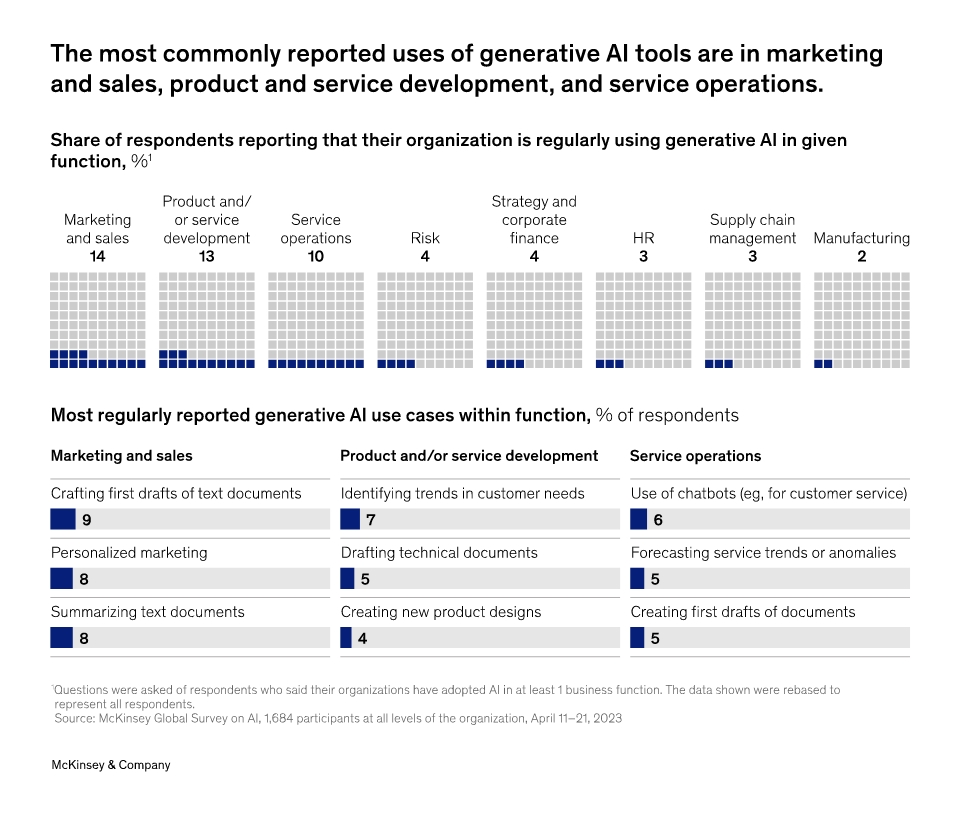
The following chart from a McKinsey global survey shows where companies are currently focusing their generative AI efforts. This gives you a sense of where the most common, near-term value is being found.
For B2B companies, the impact on the sales and marketing cycle is particularly important. The Gartner prism below provides a useful framework for evaluating potential use cases based on their business value and feasibility.

Finally, while many use cases are about adding features, a more advanced application involves creating AI Agents—autonomous systems that can reason, plan, and act to achieve a goal. This is particularly relevant for automating complex B2B operational workflows.
10 Use Cases for AI Agents: IoT, RAG, & Disaster Response Explained
This video from IBM Technology explains the concept of AI agents and provides several powerful use cases, many of which are highly relevant in a B2B context.
Watch the 'rapid fire' segment from 07:29 to 09:01. Pay attention to the breadth of applications across different business functions, such as banking (fraud detection), IT operations (automated remediation), and supply chain (predictive analytics).
4. A Framework for Identifying Your Opportunities
You now have a list of potential capabilities and use cases. The next step is to develop a systematic way to identify and prioritize the opportunities that are right for your business.
First, you need to ask the right questions to determine if a problem is a good fit for a particular AI approach.
Integrating Generative AI Into Business Strategy: Dr. George Westerman
Let's return to Dr. Westerman's talk. He provides a superb set of questions that a leader should ask their technical team (or themselves) when evaluating an AI initiative.
Watch the segment from 26:17 to 28:05. Focus on these critical questions: On the Problem: How accurate do I have to be? What's the cost of being wrong? Do I need explainability? Do I need consistency? On the Data: Do you have a source of truth? Is the data generalizable and free of bias?
These questions are your first-pass filter. For example, in a Loan Origination System, the "cost of being wrong" for a credit decision is very high, and you likely need high explainability for regulatory reasons. This might make a "black box" deep learning model less suitable than a more transparent statistical or rule-based model.
Once you have potential candidates, you can follow a more structured process for strategic planning.
AI in B2B SaaS: The 2025 Product Leadership Transformation Guide
The Scenicwest article we reviewed earlier also provides a high-level framework for this process.
Please read the section 'Strategic Framework for AI Integration'. Focus on the three phases: Assessment, Opportunity Identification, and Implementation Roadmap. This provides a logical sequence for your strategic planning.
5. Practical Application: Identify AI Use Cases
Let's apply these frameworks to the Loan Origination System scenario from our previous lessons. Your task is to identify strategic AI opportunities that your new microservices architecture could enable.
Exercise (Approx. 15 minutes):
Identify three potential AI use cases for your Loan Origination System, one from each of the strategic areas we've discussed. For each use case, fill out the template below.
Use Case 1: Enhancing the Product Experience
- Use Case Description: (e.g., "AI-powered document classification to automatically categorize and validate uploaded borrower documents like pay stubs, tax returns, etc.")
- Business Objective: (e.g., "Reduce manual processing time for loan officers by 30% and decrease document error rates.")
- Likely AI Type (from Westerman's categories): (e.g., "Deep Learning for image/document recognition.")
- Key Question (from Westerman's list): What is the cost of being wrong? (Answer briefly: e.g., "Medium. Misclassifying a document delays the loan but doesn't cause a wrong credit decision. A human-in-the-loop review for exceptions is necessary.")
Use Case 2: Improving Operations & Efficiency
- Use Case Description:
- Business Objective:
- Likely AI Type:
- Key Question: Do you need the answer to be explainable? (Answer briefly)
Use Case 3: Creating a New Revenue Model/Opportunity
- Use Case Description:
- Business Objective:
- Likely AI Type:
- Key Question: Do you have a source of truth (good data) for this? (Answer briefly)
Take a few minutes to think through each of these. The goal is not to find the "perfect" answer but to practice the thinking process of linking a technical capability to a business outcome.
Conclusion
In this lesson, you have learned how to think about AI from a strategic, business-first perspective. You've gone from understanding high-level opportunities to categorizing specific AI capabilities and seeing how they apply to real-world B2B software products.
Key Takeaways:
- Start with the Business Problem: AI is a tool to achieve business goals like improving customer experience, operational efficiency, or revenue—it's not the goal itself.
- Use a Simple Taxonomy: Grouping AI into categories like Rule-based, Traditional ML, Deep Learning, and Generative AI helps you match the right tool to the job.
- Identify Use Cases Systematically: Look for opportunities to enhance the product experience, improve internal operations, and create new revenue streams.
- Prioritize with a Framework: Use guiding questions about accuracy, explainability, and data quality to filter potential projects before committing to a full strategic assessment.
Preview of the Next Lesson
Identifying potential use cases is the first critical step. The next is to plan how you will actually deliver them. In our next lesson, we will focus on how to outline the key elements of an AI adoption roadmap including data strategy, integration patterns, and phasing. This will bridge the gap between your strategic ideas and a concrete, actionable plan.