Introduction
Welcome back! In our previous lesson, you did an excellent job identifying strategic AI use cases by linking them to specific business objectives. You learned to categorize different AI capabilities and ask the critical questions needed to filter potential projects. This answered the what and why of using AI.
Today, we transition from ideation to execution. A great idea is only as good as the plan to make it a reality. This lesson will equip you to build that plan by focusing on the learning outcome: Outline the key elements of an AI adoption roadmap including data strategy, integration patterns, and phasing.
For your goal of leading a large-scale transformation, the AI adoption roadmap is a cornerstone artifact. It's the document that aligns your executive team, engineers, and go-to-market functions on a single, coherent plan. We will break this down into manageable, actionable components that you can adapt for your company.
1. The Anatomy of an AI Roadmap
First, let's establish what a robust AI roadmap contains. It's much more than a timeline of features; it's a strategic document that aligns technology with business readiness and outcomes.
Enterprise AI Roadmap: The Complete 2026 Guide
The article 'Enterprise AI Roadmap: The Complete 2026 Guide' from RTS Labs provides a clear and comprehensive breakdown of the essential pillars of an AI roadmap. This will serve as our high-level structure.
Please read the section titled 'Core Components of an Enterprise AI Roadmap'. As you read, focus on how each of the five components addresses a different dimension of organizational readiness.
As the article outlines, a mature AI roadmap is built on five core components. Think of these as the essential chapters of your strategic plan:
- Business Objectives & Use-Case Prioritization: This connects directly to our last lesson. It ensures every AI initiative is tied to a measurable business outcome (e.g., reduce costs, increase revenue, mitigate risk).
- Data Readiness & Infrastructure Assessment: AI is powered by data. This component evaluates if your data is ready for AI and if the underlying infrastructure can support it.
- Technology & Architecture Blueprint: This defines the "how." It details the specific tools, platforms, and architectural patterns you will use to build, deploy, and manage your AI models.
- People, Skills & Operating Model: AI is not just a technical change; it's an organizational one. This component addresses the human side: what skills do you need, how do teams need to be structured, and who owns what?
- Governance, Risk & Compliance (GRC): This establishes the guardrails. It addresses critical issues like data privacy, model bias, security, and ethical considerations, ensuring you adopt AI responsibly.
For the rest of this lesson, we will do a deep dive into three of the most crucial technical aspects of the roadmap: Data Strategy, Integration Patterns, and Phasing.
2. Deep Dive: The Data Strategy
Data is the lifeblood of any AI system. A common reason AI projects fail is poor data quality or a flawed data strategy. Given your experience with large systems in the BFSI sector, you'll know that data governance and quality are paramount.
This video from IBM Technology, 'Develop your Data Strategy,' outlines a practical, six-step framework that is perfect for building the data strategy component of your roadmap.
Please watch the segment from 00:50 to 04:36, which details the six steps. Pay close attention to how the process moves from business alignment to technical execution. Listen (00:50): Aligning with C-suite objectives. Assess (01:23): Understanding the current state of your data, culture, and workflows. Apply (02:27): Documenting the strategy (people, process, tech). Test (02:51): Refining for quality, privacy, and security. Execute (03:34): Starting with small, focused Minimum Viable Products (MVPs). Scale (04:11): Expanding successful solutions across the business.
This framework gives you a repeatable process for each AI initiative on your roadmap. When you plan to build an AI feature, your data strategy for that feature should address these key questions, which are also highlighted in the "AI in B2B SaaS" article (LINK):
- Collection & Quality: Where will we get the data? Is it clean, complete, and accurate?
- Privacy & Security: How will we protect sensitive customer and internal data?
- Integration: How will we combine data from different systems (e.g., your CRM, ERP, and product databases)?
- Scalability: Can our data infrastructure handle the volume and speed required as the AI feature is adopted?
A failure to address these points early is a primary source of risk in any AI project.
3. Deep Dive: Integration Patterns & Technology
With a data strategy in place, you need to decide how to build and integrate AI into your product. This involves making critical "build vs. buy" decisions and choosing the right architectural patterns.
The Strategic Choice: APIs vs. Custom Models
Your first major decision is whether to use a pre-built AI service via an API or build a custom model in-house. This choice has significant implications for cost, speed, and control.
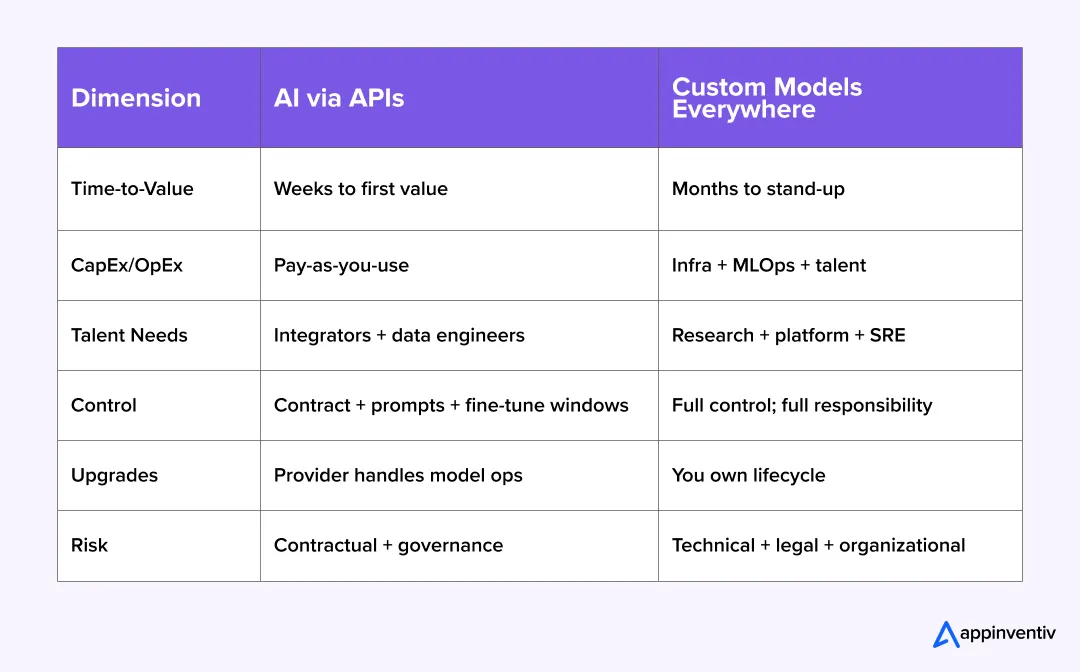
For a B2B software company, a common strategy is to start with APIs for speed and validation, and only invest in custom models for capabilities that are core to your unique value proposition.
A Key Integration Pattern: Retrieval-Augmented Generation (RAG)
One of the most powerful and popular patterns for B2B SaaS today is Retrieval-Augmented Generation (RAG). Instead of training a massive model from scratch, RAG allows you to take a powerful foundational model (like GPT-4) and give it access to your own private data to generate contextual, relevant answers.
This is perfect for features like:
- An in-app chatbot that can answer questions about a user's specific data.
- A search function that understands natural language and finds relevant information in your company's knowledge base.
- An automated report-writer that can summarize a customer's unique usage patterns.
The AI Product Management Masterclass [Complete Roadmap 2025]
The 'AI Product Management Masterclass' video by HelloPM provides an excellent, clear explanation of the RAG architecture and why it's so dominant in modern AI applications.
Please watch two clips from this video: Examples of RAG in Action (42:31 - 47:12): See how major companies like Notion, Stripe, and Atlassian use this pattern to make their products smarter using their own data. This will make the concept very concrete. How RAG Works (47:12 - 51:44): Focus on understanding the flow: a user's prompt is used to 'retrieve' relevant information from your private database, this context is 'augmented' to the prompt, and then sent to the LLM to 'generate' a response. This is a crucial technical concept for any modern product leader.
Understanding the RAG pattern is critical because it offers a practical path to creating highly differentiated AI features without the prohibitive cost of training your own foundational models. Your technology blueprint should explicitly call out where this pattern will be used.
4. Deep Dive: Phasing the Roadmap
You can't do everything at once. A successful roadmap sequences initiatives in logical phases, moving from low-risk validation to full-scale deployment. This iterative approach allows you to learn, manage risk, and demonstrate value early and often.
Enterprise AI Roadmap: The Complete 2026 Guide
Let's return to the RTS Labs article, which provides a well-structured, five-phase model for executing an AI roadmap over a 12-18 month horizon.
Please read the section 'Step-by-Step AI Roadmap for Enterprises'. Pay attention to the objectives and typical duration of each phase. This provides a tangible project plan.
The phased approach described in the article is a standard best practice in large-scale program management:
- Phase 1: Discovery & Alignment (Weeks 1-8): Focus on strategy, stakeholder agreement, and defining success metrics.
- Phase 2: Use Case Selection & Business Case (Weeks 6-12): Prioritize opportunities based on value vs. effort and build the ROI model.
- Phase 3: Data & Infrastructure Foundations (Months 3-6): The heavy lifting of preparing your data and tech stack.
- Phase 4: Pilot Prototypes & PoCs (Months 6-12): Build small-scale, functional models to test assumptions and prove value in a controlled environment.
- Phase 5: Deployment, Scale & Continuous Optimization (Months 12-18+): Roll out successful pilots to the broader user base and establish processes for monitoring and retraining.
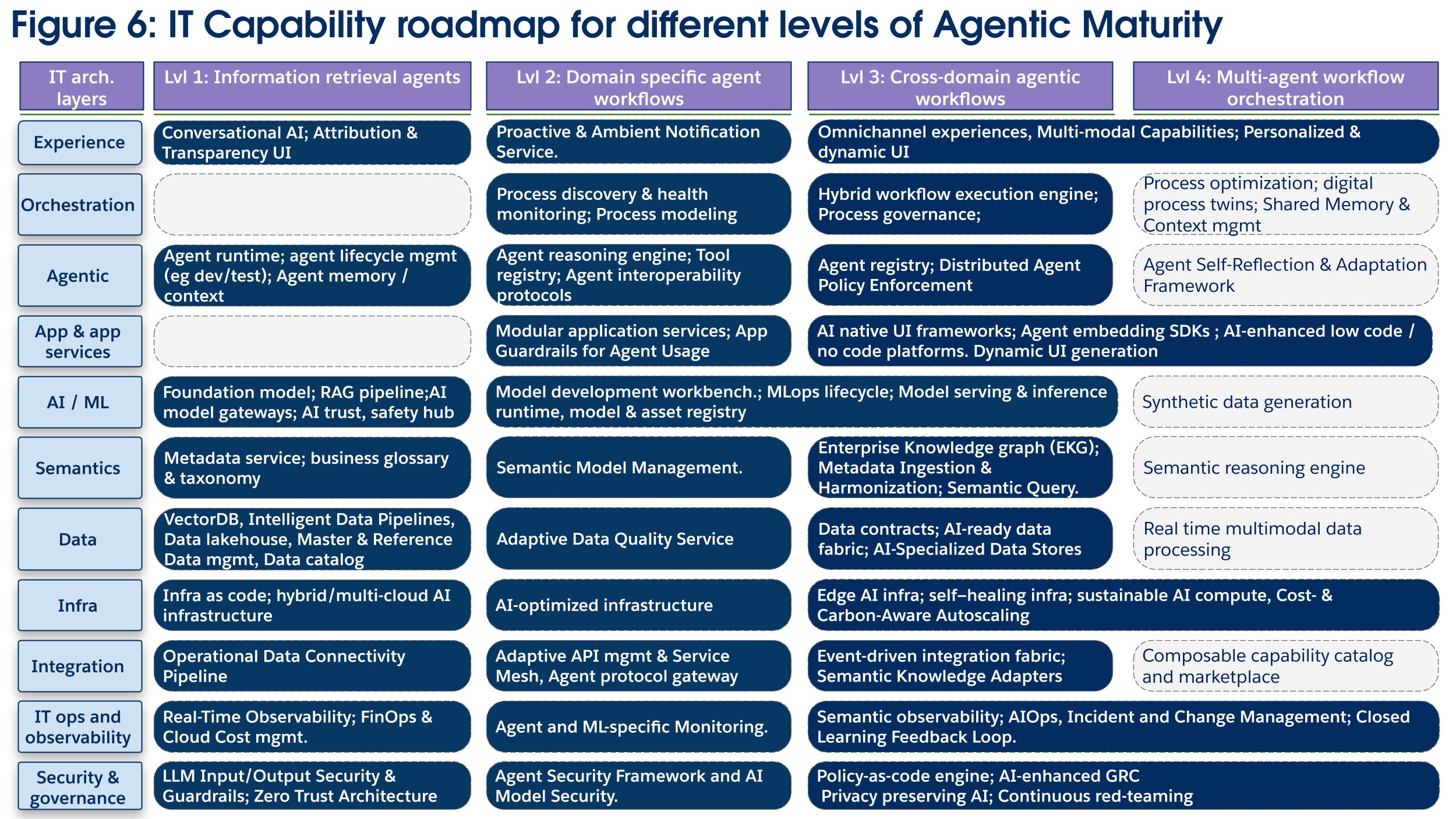
As you scale, your capabilities will mature. The roadmap should reflect this evolution.
5. Practical Application: Outline a Roadmap for a Use Case
Let's put this all together. In the previous lesson, you identified three potential AI use cases for a Loan Origination System. Choose one of those use cases (e.g., "AI-powered document classification") and outline the key roadmap elements for it.
Exercise (Approx. 15 minutes):
For your chosen use case, briefly answer the following questions to create a mini-roadmap outline.
-
Data Strategy (Phase 1-3 Focus): Based on the IBM 6-step framework, what would be your first critical action?
- (Example Answer: "Start with Assess. I would initiate a deep-dive assessment of our existing loan application documents to understand their formats (PDFs, JPEGs), quality, and completeness. This is crucial before any model can be built.")
-
Integration Pattern (Phase 3-4 Focus): Would you recommend an "AI via API" or "Custom Model" approach for the initial pilot? Justify your choice based on the trade-offs.
- (Example Answer: "For the pilot, I'd recommend AI via API, using a service like AWS Textract or Azure Form Recognizer. The goal is fast time-to-value to prove the concept. If it's successful and we need to handle unique, proprietary document types, we can consider a custom model in a later phase.")
-
Phasing (Phase 4 Focus): What would be the specific, measurable goal of your "Pilot Prototype"?
- (Example Answer: "The pilot goal is to build a prototype that can automatically classify three key document types (pay stubs, bank statements, driver's license) from a test set of 100 loan applications with at least 90% accuracy. The prototype will be used by two selected loan officers to measure the reduction in manual sorting time.")
This exercise helps you practice translating high-level strategy into the concrete, phased decisions required to build and execute a successful AI roadmap.
Conclusion
Today, you've learned how to structure and outline an AI adoption roadmap, moving from a strategic vision to a concrete plan. This is a fundamental skill for leading any technology-driven transformation.
Key Takeaways:
- A Complete Roadmap has Five Pillars: A strong roadmap addresses Business Objectives, Data, Technology, People, and Governance.
- Data Strategy is Foundational: Use a structured process (like Listen, Assess, Apply, Test, Execute, Scale) to ensure your data is ready for AI.
- Integration Involves Strategic Choices: You must consciously decide between using APIs for speed and custom models for differentiation. The RAG pattern is a key tool for creating contextual AI in B2B SaaS.
- Phasing De-Risks and Builds Momentum: Execute your roadmap in stages, from discovery and pilots to full-scale deployment, to manage risk and demonstrate value along the way.
Preview of the Next Lesson
We've now covered the what, why, and how of the technology side of your AI transformation. But as your experience in organizational design suggests, technology is only half the battle. In our next lesson, we will focus on the crucial "People" and "Governance" pillars by exploring how to identify change management challenges specific to AI adoption including skills gaps, data governance, and trust.