Introduction
Welcome back. In our last lesson, you did an excellent job outlining the key technical elements of an AI adoption roadmap, focusing on data strategy, integration patterns, and phasing. You now have a solid framework for the what and how of implementing AI technology.
However, as you know from your extensive experience in organizational design and learning & development, technology is only one part of the equation. The more significant challenge often lies with the people and processes. As MIT's George Westerman aptly puts it, "Technology changes quickly, organizations change much more slowly. The hard part is not the digital, it's the transformation."
This lesson pivots to the human side of the transformation. We will focus on the learning outcome: Identify change management challenges specific to AI adoption including skills gaps, data governance, and trust. Mastering this is essential for your goal of leading a large-scale transformation, as failing to manage the human element is a primary reason why technology initiatives fail.

The Three Core Challenges of AI Adoption
While AI adoption presents many hurdles, they can be distilled into three deeply interconnected change management challenges. Understanding these is the first step to overcoming them.
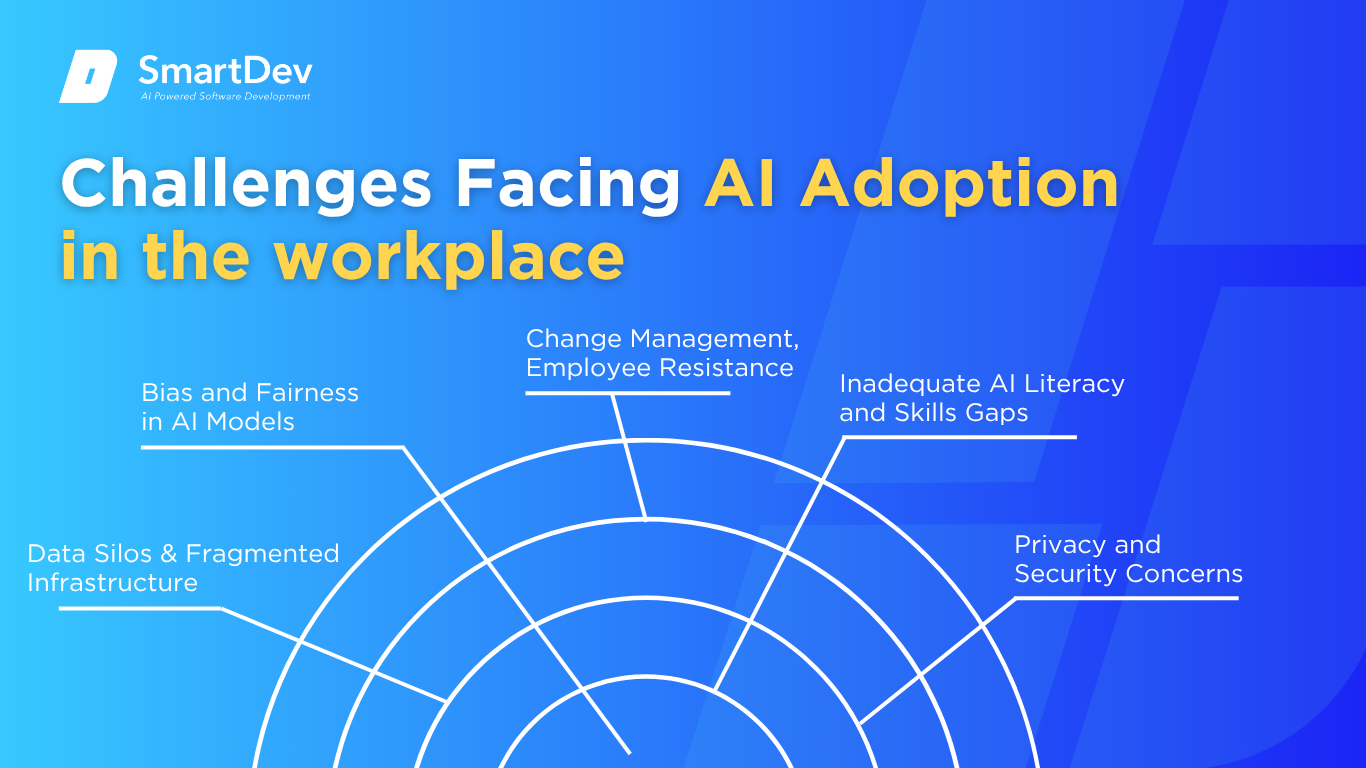
To frame this, let's look at what recent industry research says.
CIOs tackle the AI change management challenge
The article 'CIOs tackle the AI change management challenge' from CIO.com provides excellent context on the primary barriers organizations face. It confirms that the people-centric issues are paramount.
Please read the section titled 'A problem of alignment'. Focus on the top three hurdles identified by Kyndryl's research.
As the article confirms, the top three hurdles are:
- Organizational Change Management: Getting employees invested and committed to reimagining how they work.
- Lack of Employee Trust in AI: Addressing fears around job loss, inaccuracy, and unethical use.
- Workforce Skills Gaps: The mismatch between current capabilities and the skills needed to collaborate effectively with AI.
For the remainder of this lesson, we will explore each of these in more detail, focusing on practical strategies to address them.
1. Addressing Skills Gaps and Job Displacement Fears
The fear that "AI will take my job" is one of the most significant barriers to trust and adoption. As a change leader, you must address this head-on with empathy and a clear strategy.
Let's watch a segment from Dr. George Westerman of MIT, who frames the problem and offers a powerful way to rethink it.
Integrating Generative AI Into Business Strategy: Dr. George Westerman
In this clip from 'Integrating Generative AI Into Business Strategy,' Dr. Westerman directly confronts the issue of job displacement and provides a more constructive narrative focused on augmentation.
Watch the segment from 00:32:38 to 00:35:41. Pay close attention to the 'Moneyball effect' analogy and the pivot from job replacement to job augmentation.
Dr. Westerman's key point is that while AI will automate tasks, it doesn't have to replace people. The most effective change strategy is to frame AI as a tool that can:
- Augment capabilities: Handle repetitive, "boring" tasks, freeing up humans for more strategic and creative work.
- Enhance creativity: Act as a creative partner or a tool for rapid iteration.
- Serve as a teacher: Provide a new way for employees to learn and grow their skills.
This shifts the narrative from threat to opportunity. To make this real, you need a structured reskilling program.
What Are the Most Effective Strategies for AI Workforce Reskilling?
The article 'What Are the Most Effective Strategies for AI Workforce Reskilling?' provides a practical framework for turning this strategy into action. It aligns perfectly with your L&D background.
Please read the sections 'Strategic Planning for AI Reskilling' and 'Managing Human and Cultural Aspects.' Focus on the actionable steps for diagnosing skill gaps and managing the cultural shift.
Based on the article, your strategy for addressing skills gaps should include:
- Skills Diagnosis: Conduct an audit of current skills and map them against future needs.
- Transparent Communication: Address job security concerns openly, emphasizing how AI will expand human potential.
- Focus on Human Skills: Prioritize training in critical thinking, collaboration, creativity, and ethics—skills that AI cannot replicate.
- Role Redesign: Proactively restructure roles to create a synergy between AI-automated tasks and human oversight and creativity.
By combining a positive narrative with a concrete reskilling plan, you can turn fear and resistance into engagement.
2. Data Governance as a Change Management Discipline
In our last lesson, you defined the data strategy for your AI roadmap. Now, we must consider the change management required to implement it. Good data governance isn't just a technical back-end process; it's a set of behaviors and policies that everyone who touches data must adopt. This is fundamental to building trust.
Data Governance Explained in 5 Minutes
This short IBM Technology video uses a simple analogy to demystify data governance, breaking it down into understandable components.
Please watch the entire video. As you watch, think about how each step—Discovery, Classification, Policies/Rules, Metadata—requires people to change their behavior regarding data.
Connecting the video's concepts to AI change management reveals why this is a critical human challenge:
- Discovery & Classification: If your teams don't consistently and accurately classify data (e.g., tagging customer feedback correctly), the AI models trained on that data will be unreliable. This fosters distrust in the AI's output ("garbage in, garbage out").
- Policies & Rules: Enforcing rules, such as masking Personally Identifiable Information (PII), is crucial. A single failure can lead to a major data breach, instantly destroying both customer and employee trust. This is a matter of company-wide discipline, not just a technical control.
- Metadata (Labeling the Bins): When people create clear, consistent metadata, they make it easier for colleagues (and AI systems) to find and use the right data. This collaborative effort prevents errors and builds confidence in the data foundation of your AI.
Your role as a change leader is to champion these behaviors and ensure the necessary processes and training are in place to make them part of the daily workflow.
3. Building and Maintaining Trust
Trust is the currency of change. With AI, it's a multi-faceted challenge that encompasses trust in the technology's competence, the organization's intentions, and the process's security.
First, it's vital to set realistic expectations about what AI can and cannot do.
Integrating Generative AI Into Business Strategy: Dr. George Westerman
Let's return to Dr. Westerman's talk. This short clip offers a crucial mental model for thinking about AI's capabilities, which is key to building trust through understanding.
Watch the segment from 00:06:58 to 00:08:03, focusing on the concept of 'artificial idiots'.
Viewing AI as a powerful tool that lacks human context—an "artificial idiot"—helps demystify it. This framing encourages healthy skepticism and verification, which paradoxically builds more robust trust than blind faith does. It gives people permission to question the AI's output, which is an essential part of a "human-in-the-loop" process.
Second, trust is built through inclusion and demonstrating clear benefits.
Integrating Generative AI Into Business Strategy: Dr. George Westerman
This final clip from Dr. Westerman's presentation provides a mini-case study on how to foster adoption and trust by involving employees in the process.
Watch from 00:35:31 to 00:37:48. Notice how Dentsu Creative made the change with their people, not to their people.
Drawing from the videos and articles, here are actionable strategies to build trust:
- Educate and Experiment: Launch AI literacy campaigns and provide controlled "sandbox" environments (like Liberty Mutual's internal GPT) where employees can learn and experiment without fear.
- Involve and Empower: Create forums for sharing ideas and use cases. Identify internal influencers within business units to champion the change, as discussed in the CIO.com article.
- Encourage, Don't Push: Frame AI as a tool to help employees achieve their goals more effectively.
- Start Small and Prove Value: Begin with small, low-risk pilots. A successful pilot is your most powerful tool for building momentum and convincing skeptics.
Practical Application
Let's apply these concepts to a scenario relevant to your company context.
Scenario: You are tasked with rolling out an AI-powered code completion tool (like GitHub Copilot) to your engineering teams. There is significant skepticism. Some engineers fear it will devalue their craft, while others worry it will be used to monitor their productivity or introduce insecure code.
Exercise (Approx. 10 minutes):
Based on what you've learned, briefly describe one key action you would take to address each of the three core challenges in this scenario.
- Skills Gap: What specific training or support initiative would you propose to help engineers adapt?
- Data Governance: What is one clear policy you would need to establish regarding the code generated by the AI?
- Trust: What is the very first step you would take to begin building trust with the skeptical engineering teams?
Take a few minutes to think through your response for each point. This exercise will help solidify how these concepts translate into concrete leadership actions.
Conclusion
Today we've unpacked the critical human challenges at the heart of any AI transformation. While your technical roadmap from the last lesson provides the blueprint, your ability to manage the people side of change will ultimately determine its success.
Key Takeaways:
- AI Adoption is a Transformation Challenge: The primary hurdles are not technical but human: managing change, building trust, and closing skills gaps.
- Reframe the Narrative: Proactively address job displacement fears by focusing on an "augmentation" strategy, where AI enhances human creativity and strategic capacity. This requires a robust reskilling program.
- Governance is a People Process: Effective data governance is a shared responsibility that requires changes in behavior across the organization to ensure data is clean, secure, and used ethically.
- Trust is Earned: Build trust through transparency, education, inclusion, and starting with small, successful pilots that demonstrate tangible benefits to employees.
Preview of the Next Lesson
Having explored the transformation of your product with AI, we now turn to transforming how you deliver it. In the next module, we will begin by looking at the delivery process itself. The first lesson will be: "Compare Agile delivery frameworks suitable for enterprise scale (SAFe, LeSS, Spotify model)." This will be crucial for creating an operating model that can support the new, more modular product architecture you are building.