Introduction
Hello, and welcome back. In our previous lesson, we established the core strategies for a safe, incremental migration. You learned about the Strangler Fig and Branch by Abstraction patterns for extracting services, and most importantly, how to use a Value vs. Complexity matrix to prioritize which parts of your monolith to tackle first. This prioritization is the first step in de-risking a massive transformation.
Today, we will build upon that foundation. Knowing the "what" and "why" of prioritization is essential, but a change leader must translate that into a coherent plan that aligns the entire organization. Our learning outcome for this lesson is to draft a high-level, phased migration roadmap sequencing the rollout and defining key business milestones.
Think of this roadmap not as a rigid, unchangeable project plan, but as a strategic communication tool. It's the master narrative that shows where you are, where you're going, and what business value you will deliver at each step of the journey. For someone with your background in product and project management, this will feel familiar, but we'll focus specifically on the nuances of a major architectural transformation.
1. The Anatomy of a Strategic Migration Roadmap
Before we start building, let's define what a good migration roadmap looks like. It's more than just a timeline of technical tasks; it's a strategic document that provides clarity, facilitates alignment, and manages expectations.
A well-structured roadmap should contain a few key elements: a clear vision, a phased approach, a sequence of activities, and most critically, milestones that resonate with the business.
Application Modernization Roadmap: A Step-by-Step Guide
To understand the strategic importance of this document, please read the introductory sections of the article 'Application Modernization Roadmap' from Evinent.
Read the sections 'What is the Application Modernization Roadmap?' and 'Importance of an Application Modernization Roadmap'. Focus on how the roadmap serves as a governance tool that provides strategic direction, cross-functional alignment, and risk mitigation.
As the article highlights, a roadmap turns a potentially chaotic effort into a "guided, strategic evolution." To achieve this, we need to think like product managers, not just technologists. This means being deliberate about how we frame time, what we choose to show, and how we describe our goals.
Best Practices for Product Roadmap —Jeff Lash
Jeff Lash's talk 'Best Practices for Product Roadmap' offers excellent insights into creating roadmaps as communication tools. While his focus is on product features, the principles are directly applicable to our migration roadmap.
Please watch two key segments of this video: Time Horizons (13:57 to 16:30): Pay attention to the idea of using flexible timelines like 'Now, Next, Later' or quarters instead of specific dates to manage uncertainty. Focus on Value (20:54 to 22:57): Absorb the critical distinction between features (what we're building), capabilities (what it does), and value (why it matters). This is the key to defining business milestones.
2. Structuring Your Roadmap: Phases and Sequencing
A large-scale migration is best visualized as a series of phases. This breaks the journey into manageable stages, each with its own focus and goals. While every context is unique, a typical migration roadmap follows a logical progression.
Let's look at a concrete example.
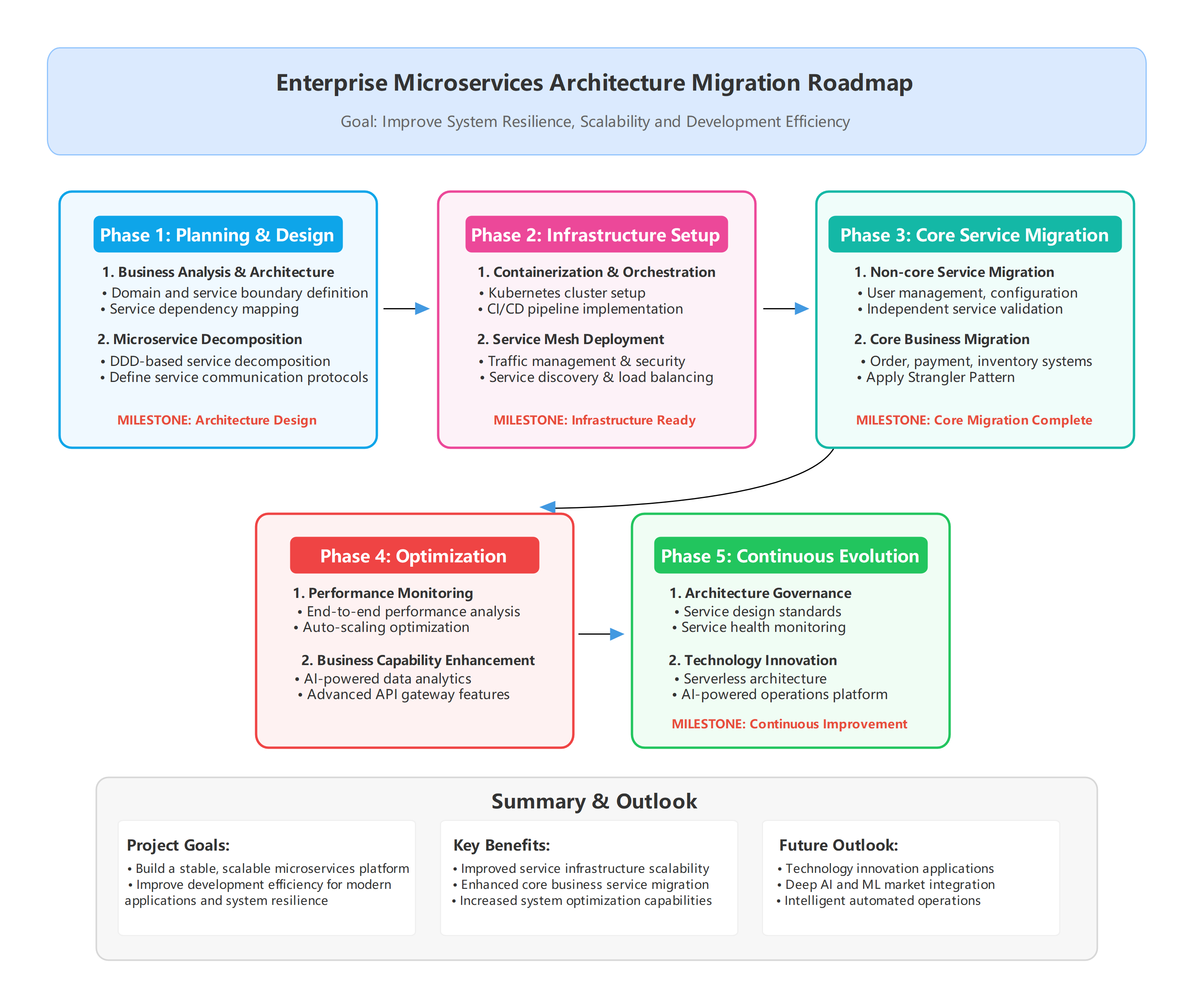
Based on this example and common industry practice, we can define a standard set of phases:
-
Phase 1: Foundation (or Planning & Design)
- Focus: Preparation. This isn't about writing application code, but setting the stage for a successful migration.
- Key Activities: Assembling the core team, defining the target architecture, setting up CI/CD pipelines, establishing infrastructure (e.g., Kubernetes), and choosing observability tools.
- Milestone: Infrastructure Ready.
-
Phase 2: The Pathfinder Migration
- Focus: Learning and building momentum. This is where you migrate your first, carefully selected service—ideally an "easy win" (high value, low complexity) from our matrix in the last lesson.
- Key Activities: Applying the Strangler Fig pattern, decomposing the first service and its data, deploying it to the new infrastructure, and gathering metrics.
- Milestone: First Service Live & Value Proven.
-
Phase 3: Scale the Migration
- Focus: Execution and acceleration. With the patterns and processes validated, you now begin migrating the sequence of services you prioritized. You might run multiple migration efforts in parallel.
- Key Activities: Systematically carving out services based on your priority list (e.g., by business domain), managing data synchronization, and retiring monolithic code.
- Milestone: Core Business Capabilities Migrated.
-
Phase 4: Optimization & Evolution
- Focus: Refining and improving. The migration may be largely complete, but the work isn't done. The focus shifts to optimizing performance, managing costs, and enhancing capabilities. The monolith might still exist for legacy functions.
- Key Activities: Performance tuning, auto-scaling, fine-tuning security, and exploring new opportunities unlocked by the new architecture (like AI).
- Milestone: Continuous Improvement Cycle Established.
This phased approach provides a clear narrative for stakeholders and a logical flow for the technical teams.
3. Defining Milestones That Matter
As Jeff Lash emphasized in the video, focusing on value is paramount. The milestones on your roadmap must speak to business outcomes, not just technical completion. This is how you maintain executive sponsorship and organizational buy-in.
Let's explore how to measure the success of your migration and translate those measurements into compelling milestones.
Decompose Your Monolith: Strategies for Migrating to Microservices
In this video, Chris Richardson, author of 'Microservices Patterns', discusses the 'why' of microservices and how to measure success. His insights are perfect for defining our business milestones.
Please watch two clips from 'Decompose Your Monolith': What to Extract (25:21 to 27:58): Listen for how to prioritize based on return on investment (ROI), such as accelerating software delivery for a module that's constantly under development. Measuring Success (40:53 to 42:27): Note the key DevOps metrics mentioned: lead time (commit to production) and deployment frequency. These are excellent, quantifiable indicators of business agility.
By combining these concepts, we can define powerful milestones. Compare the following:
| Weak Milestone (Technical Completion) | Strong Milestone (Business Value) |
|---|---|
| "Credit Scoring Engine service deployed." | "Credit Scoring Engine migrated, reducing rule update deployment time from 3 months to 1 week." |
| "Document Management service migrated." | "Document Management migrated, improving document upload performance by 40% and reducing infrastructure costs." |
| "Phase 3 complete." | "Core platform services migrated, achieving an average lead time of <1 day for critical bug fixes." |
Your role as a change leader is to constantly translate the technical effort into this language of business value.
4. Practical Application: Draft Your Migration Roadmap
It's time to put these principles into practice. Based on the exercises from our last two lessons, you will now draft a high-level migration roadmap for your B2B Loan Origination System.
Scenario:
Your company is migrating its monolithic Loan Origination System. From the previous lesson, you have already prioritized two initial candidates for migration:
- Document Management: A low-complexity, medium-value component. It's a performance bottleneck but changes infrequently. This is your Pathfinder candidate.
- Credit Scoring Rules Engine: A high-complexity, high-value component. The business desperately wants to update rules more frequently. This will be tackled after the pathfinder.
Exercise (Approx. 15 minutes):
Using the structure below (inspired by the roadmap image), draft a high-level roadmap. Use a flexible time horizon like "Now," "Next," and "Later" (or Q1, Q2-Q3, Q4 and beyond).
Roadmap Template:
Transformation Goal: To modernize our Loan Origination System to increase development velocity, improve system performance, and enable future innovation (e.g., AI-driven decisioning).
| Phase | Time Horizon | Key Activities | Business Milestone |
|---|---|---|---|
| 1. Foundation | Now | (List 2-3 key prep activities) | (Define a milestone for this phase) |
| 2. Pathfinder | Next | - Migrate the Document Management service. - (List 1 other activity) |
(Define a specific, value-based milestone for the Document Management service) |
| 3. Scale: Core Logic | Later | - Migrate the Credit Scoring Rules Engine. - (List 1 other activity) |
(Define a specific, value-based milestone for the Credit Scoring Engine) |
| 4. Evolution | Beyond | (List 1-2 activities) | (Define a forward-looking milestone) |
Take your time to fill in the italicized sections. Focus on crafting clear, value-oriented business milestones.
Conclusion
In this lesson, you've moved from a prioritized list of tasks to a strategic, phased roadmap. This document is your primary tool for aligning teams, managing stakeholder expectations, and telling a compelling story about your transformation.
Key Takeaways:
- A Roadmap is a Strategic Tool: It's for communication and alignment, not just project tracking.
- Use Phases to Structure the Journey: A phased approach (e.g., Foundation, Pathfinder, Scale, Evolve) breaks down a daunting project into a logical narrative.
- Focus on Business Value: Your milestones must articulate the "why" in business terms—faster delivery, lower costs, better performance—not just technical completion.
- Embrace Uncertainty: Use flexible time horizons (Now/Next/Later, or quarters) to communicate direction without committing to dates you can't guarantee.
Preview of the Next Lesson
Having a modular, microservices-based architecture doesn't just solve today's problems; it unlocks tomorrow's opportunities. One of the most significant opportunities is the integration of Artificial Intelligence. In our next lesson, we will begin to explore this by focusing on how to describe common AI capabilities relevant to B2B software products and identify strategic use cases aligned with business objectives. You will see how the hard work of architectural transformation paves the way for a new wave of innovation.