Introduction
Welcome back! In our previous lesson, you designed the blueprint for the "Project Phoenix" guiding coalition, identifying the "who" needed to drive your transformation. You now have a model that combines sponsors, promoters, and activators, ensuring leadership representation at every level of the organization.
However, assembling a group of influential people is only the beginning. A list of names on a slide does not create momentum. This lesson focuses on the critical next step: learning how to lead your guiding coalition to drive and sustain transformation momentum. We will move from design to execution, exploring the strategies that turn a powerful group into an effective, high-energy team that can navigate the long and challenging road of large-scale change.
This topic directly addresses your goals of building "Change Agility" and ensuring the sustainability of your transformation, preventing the dreaded "snap back" to old ways of working.
Part 1: Activating the Coalition - From a Group to a Team
Once you've recruited your coalition members, your first task is to formalize their role and establish a clear operating rhythm. A coalition without a charter is just a committee; one with a clear, shared purpose becomes a change engine.
The resource from Umbrex provides excellent, practical guidance on how to do this effectively.
Kotter 8-Step Change Model - Umbrex
The article 'Kotter 8-Step Change Model' from Umbrex offers concrete advice on formalizing the coalition. We'll focus on the specific actions you can take to give your coalition structure and purpose.
Please read section '5. How to Apply the Kotter Model: Step-by-Step,' focusing only on point #2, 'Build a guiding coalition.' Then, read section '8. Common Pitfalls,' focusing on the pitfall 'Weak guiding coalition.' Pay close attention to the specific suggestions like establishing a charter, defining decision rights, setting a cadence, and enforcing norms.
As the Umbrex article highlights, turning your group into a team requires three core components:
- A Charter: This document formally establishes the coalition's purpose. It should clearly define its scope, decision rights, and operating cadence (e.g., weekly stand-ups, monthly reviews).
- Shared Norms: How will the team behave? Establishing norms like "truth-seeking" and a "bias to action" creates psychological safety and encourages proactive problem-solving.
- Shared Metrics: How will the coalition measure its own success? Defining shared metrics ensures everyone is pulling in the same direction.
A Modern Framework for Your Coalition: Using OKRs
To provide a modern, agile structure for your coalition's work, consider framing their mission using Objectives and Key Results (OKRs). Your product management background likely gives you some familiarity with this goal-setting framework. In this context, the guiding coalition becomes the cross-functional team responsible for executing the top-level strategic OKRs of the transformation.
This approach shifts the coalition's focus from just "managing change" to actively "driving strategic outcomes."
OKRs (Objectives and Key Results), OKR, OKR Framework - ZOKRI
This article from ZOKRI, 'OKRs (Objectives and Key Results)', explains how OKRs function as a framework for strategic change driven by empowered teams. We'll look at how this applies to a guiding coalition.
Please read the following three short sections: 'The Strategic Shift': Notice how it describes creating 'dedicated cross-functional groups for strategic OKRs.' 'The Cross-Functional Dynamic': Focus on the challenges it lists, like managing matrix conflicts and defining decision rights. 'What's the role of leadership in OKR management?': This succinctly summarizes your role in leading the coalition.
The key takeaway is that your role as the transformation leader is to set the direction, provide resources, remove obstacles, and participate in the coalition's regular check-ins. The OKR framework provides the rhythm and focus for these activities.
Part 2: Driving Momentum - The Coalition's Core Activities
With the coalition activated and structured, what is its primary work? According to Kotter's model, the coalition is responsible for leading the next, crucial steps of the transformation to build momentum.
This video provides a clear overview of these core activities.
Kotter's 8-Step Change Model Explained
We'll return to the 'Kotter's 8-Step Change Model Explained' video from EPM. This time, we'll focus on the specific steps the coalition must lead to engage the organization and build momentum.
Please watch from 03:59 to 07:06. This covers three steps: Communicate the Vision: What is the coalition's role in this? Empower Others: What barriers must the coalition remove? Create Quick Wins: Why are these so important for momentum?
To summarize the coalition's core jobs for driving momentum:
- Communicate the Vision (Step 4): The coalition doesn't just approve the message; they are the chief messengers. They must consistently and frequently communicate the "why" of the transformation through every available channel.
- Empower Action (Step 5): The coalition must use its collective power to remove barriers that prevent people from adopting new ways of working. This could involve changing outdated policies, restructuring teams, or providing necessary training and tools.
- Generate Short-Term Wins (Step 6): Nothing builds momentum like success. The coalition must plan for and celebrate early, visible, and meaningful wins that are clearly attributable to the transformation effort. This proves the change is working and energizes the organization for the marathon ahead.
This sample newsletter is a great example of what "communicating the vision" looks like in practice. It's an artifact that your guiding coalition would create and disseminate.
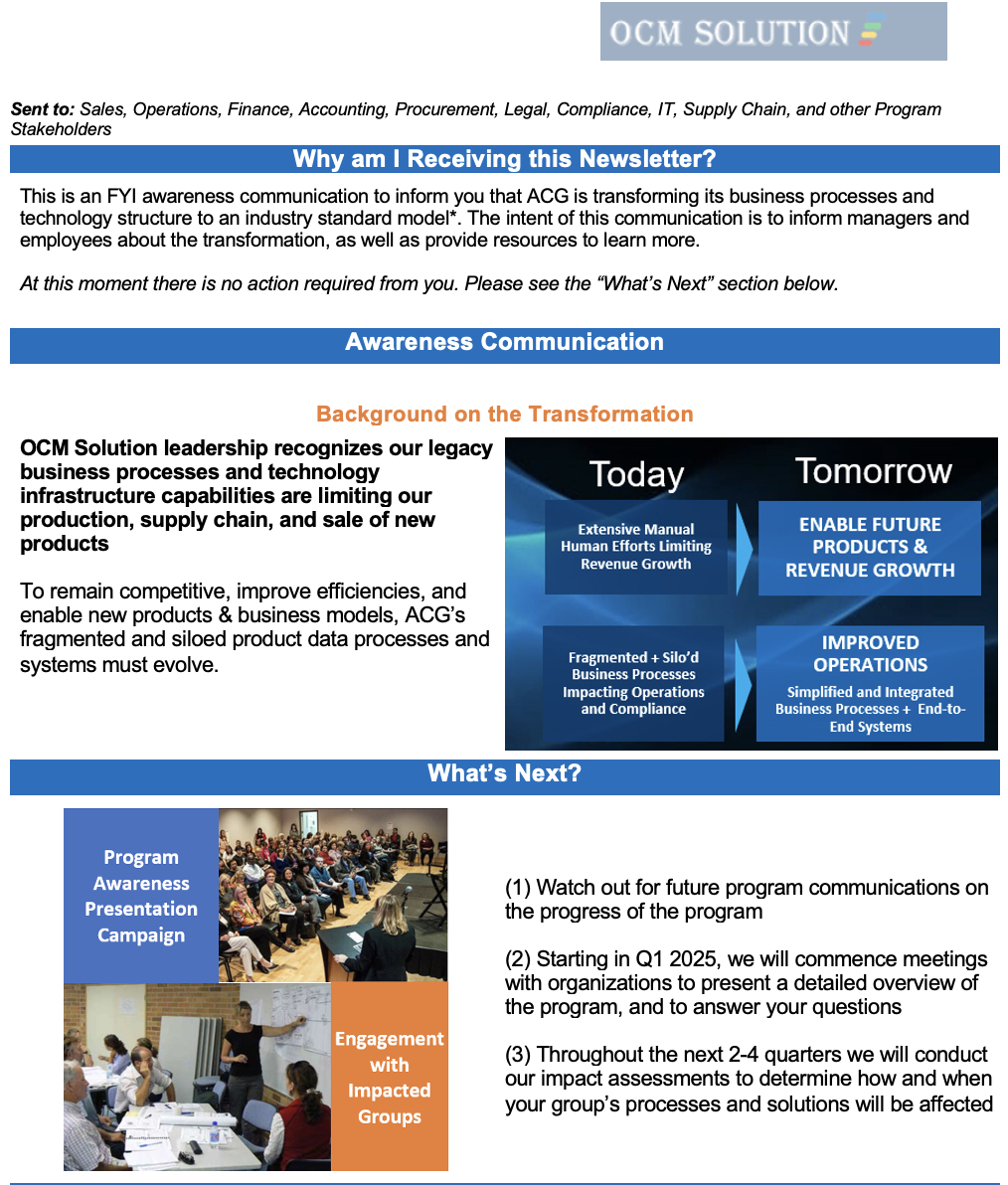
Part 3: Sustaining Momentum - Playing the Long Game
Gaining momentum is hard; sustaining it is harder. Many transformations fail because they stall after the initial excitement fades or leaders declare victory too soon. A key responsibility of the guiding coalition is to ensure the pressure and focus are maintained over the long term.
Kotter 8-Step Change Model - Umbrex
The Umbrex article on Kotter's model has an excellent section on the pitfalls of failing to sustain momentum.
Please read section '7. Sustain acceleration' under 'How to Apply the Kotter Model.' Then, review the pitfall 'Declaring victory too soon' in section '8. Common Pitfalls.' Focus on the actions needed to keep the change going.
Two strategies are critical for sustaining momentum:
- Leverage Early Wins: Use the credibility gained from short-term wins to tackle more significant and complex problems. Each success should be a stepping stone, not a final destination.
- Avoid Premature Victory: Resist the temptation to declare victory after the first positive results. As the resources point out, new approaches are fragile and can easily regress. The coalition must keep pushing until the changes are deeply embedded in the culture.
From Change Champions to Resilience Builders
A modern and highly effective strategy for sustaining momentum involves evolving the coalition's role from simply "selling" the change to actively building resilience within the organization. This directly addresses your goal of managing "change fatigue" and maintaining psychological safety.

Instead of just promoting the change, a resilience-building coalition focuses on:
- Discussing the 'How' and 'What': Helping employees understand the practical details of the change.
- Motivating Employees to Own Change: Shifting from compliance to commitment by involving people in the process.
- Embedding Psychological Safety: Creating an environment where it's safe to ask questions, raise concerns, and even fail while learning the new ways of working.
Adopting this "Resilience Builder" mindset is a powerful strategy for your coalition to sustain energy and commitment throughout your organization.
Application Exercise: Charter for the "Project Phoenix" Coalition
It's time to put these principles into practice. Your task is to draft a simple charter for your "Project Phoenix" guiding coalition. This document will serve as the foundation for activating your team.
Your Task (15 minutes):
Create a brief charter for your coalition by filling out the sections below. Be specific and action-oriented.
Project Phoenix Guiding Coalition Charter
- Mandate/Purpose: (A single sentence defining the coalition's ultimate goal. Example: To lead the successful transformation of AlphaTech into an agile, AI-first B2B software leader.)
- Your Answer:
- Key Responsibilities: (List 3-5 primary duties. Think about communication, barrier removal, and monitoring.)
- Your Answer:
- Operating Cadence: (Define the rhythm of meetings. Be specific.)
- Your Answer:
- Core Metrics (Sample OKR): (Define one strategic Objective and one measurable Key Result for the coalition itself.)
- Objective: Your Answer:
- Key Result: Your Answer:
- Resilience-Building Norm: (State one specific behavioral norm the coalition will adopt to build organizational resilience, based on the Gartner model.)
- Your Answer:
Click here for a sample answer after you've completed your own.
Project Phoenix Guiding Coalition Charter
- Mandate/Purpose: To steer and energize the successful transformation of AlphaTech's product architecture, delivery processes, and GTM strategy, ensuring sustainable growth and market leadership.
- Key Responsibilities:
- Consistently communicate the transformation vision and progress to all stakeholders.
- Identify and remove organizational, process, and technical barriers to adoption.
- Monitor progress against transformation milestones and report to the executive sponsor.
- Champion and celebrate short-term wins to build and sustain momentum.
- Model the desired new behaviors and mindsets.
- Operating Cadence:
- Weekly 30-minute stand-up for tactical barrier-busting.
- Bi-weekly 1-hour meeting for reviewing progress on OKRs.
- Monthly 1-hour review with the executive sponsor (CTO).
- Core Metrics (Sample OKR):
- Objective: Successfully launch the first customer on a migrated microservice to prove the value of the new architecture.
- Key Result: Achieve a customer satisfaction (CSAT) score of 9/10 or higher from the pilot customer within 30 days of go-live.
- Resilience-Building Norm: In all communications, we will dedicate as much time to the "how" (practical steps, support available) as we do to the "why" (strategic rationale) to reduce uncertainty and build employee confidence.
Conclusion
In this lesson, we've detailed the strategies for transforming your designed coalition into a high-impact leadership team. You now have a playbook for leading this group to not only initiate change but, more importantly, to sustain it over the long haul.
Key Takeaways:
- Activate with a Charter: A guiding coalition needs a formal charter, clear norms, and shared metrics (like OKRs) to be effective.
- Drive Momentum with Action: The coalition's core work is to communicate the vision, empower the organization by removing barriers, and generate credible short-term wins.
- Sustain Momentum by Playing the Long Game: Lasting change requires leveraging early wins to tackle bigger challenges, avoiding the "premature victory" trap, and actively managing change fatigue.
- Build Resilience, Not Just Buy-in: The most effective coalitions evolve from being change "sellers" to becoming "resilience builders," fostering ownership and psychological safety.
Preview of the Next Lesson
You've now learned how to build and lead the team that will drive the transformation. A core responsibility of this coalition is to form and communicate a compelling vision. But what does a "compelling" vision actually look like in the context of a complex business and technology transformation?
In our next lesson, we will begin the "Crafting the Transformation Vision and Strategy" module. You will learn how to define a compelling transformation vision statement aligned with business objectives. This will be the North Star for your guiding coalition and the entire organization.