Hello! Welcome to your fifth lesson in the Foundations of Business Analysis module.
In our last lesson, we delved into the detective work of root cause analysis. You learned how to use techniques like the 5 Whys and Fishbone diagrams to move past surface-level symptoms and uncover the true, underlying reasons for a problem. This deep understanding of "what is happening and why" gives us a crystal-clear picture of the current state.
Now, we'll build directly on that foundation. Knowing where you are is essential, but you also need to know where you're going. Today's lesson is about bridging the divide between the present and the future. Your learning outcome is to conduct gap analysis to compare current and desired business states.
This technique is the heart of strategic business analysis. It transforms problem diagnosis into a concrete plan for change, making it a critical skill for creating roadmaps, justifying projects, and succeeding in BA interviews.
From Problem to Opportunity: The Essence of Gap Analysis
At its core, gap analysis is a straightforward but powerful concept. It helps organizations understand three things:
- Where are we now? (The Current State)
- Where do we want to be? (The Future State)
- What do we need to do to get there? (The Gap)
Let's start with a short video from the International Institute of Business Analysis (IIBA) that introduces this core idea.
What is Gap Analysis? Current State & Future State – Business Analysis Live by IIBA
This clip from the IIBA's 'Business Analysis Live' series clearly explains the fundamental concept of gap analysis and the simple but powerful equation that defines it.
Watch from the beginning (00:28) until 06:55. Pay close attention to the hosts' discussion of the 'Future minus Current equals Gap' equation and the crucial point that the gap itself is not the solution, but the starting point for further analysis.
As the video highlights, the "gap" represents the space between your reality and your ambition. For a business analyst, this gap isn't a problem; it's an opportunity to create value.

The Step-by-Step Guide to Performing a Gap Analysis
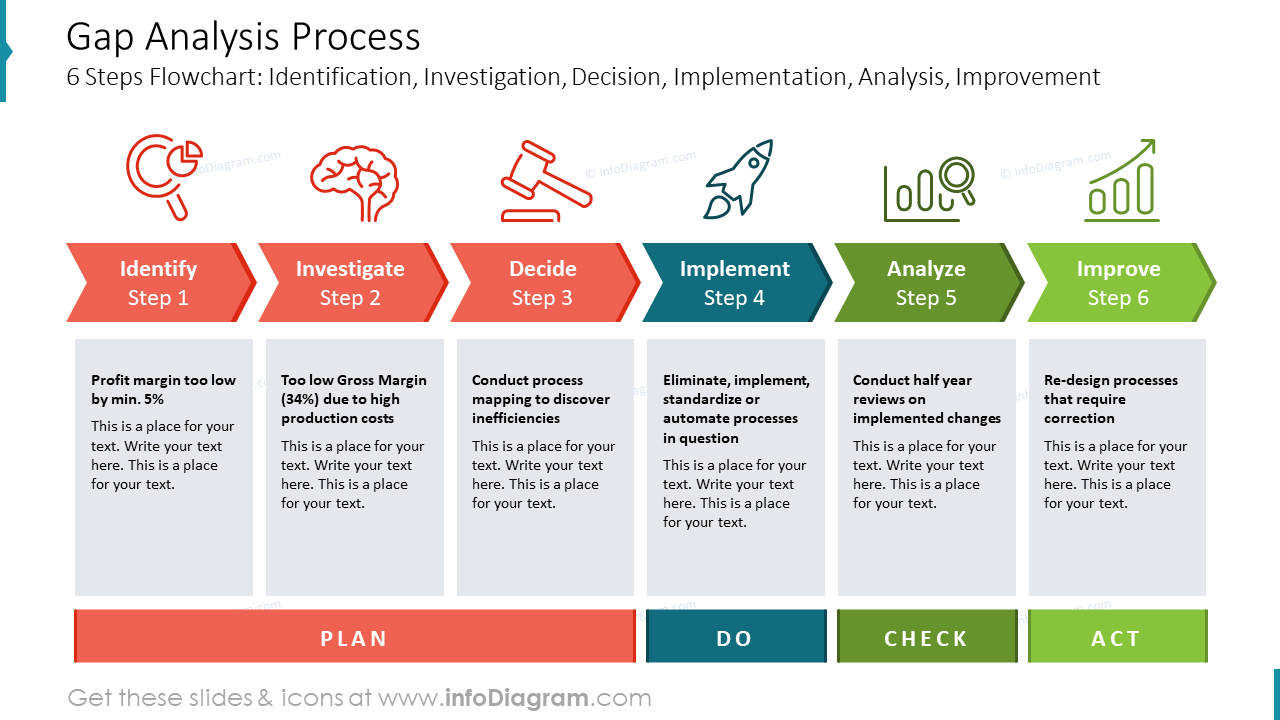
While the concept is simple, a structured process ensures your analysis is thorough and actionable. We'll follow a practical, step-by-step guide that you can apply directly to your work and in case study interviews.
Gap analysis: the step-by-step guide for IT [with template]
The article 'Gap analysis: the step-by-step guide for IT' from Plixer provides an excellent, detailed process for conducting a gap analysis. It's written for an IT context, making it very relevant for a BA role in a tech-adjacent field like AdTech.
Please read the following sections: 'What is gap analysis?' and 'Why is gap analysis important?' to solidify your understanding. The main section 'How to perform gap analysis, step-by-step'. Focus on understanding the purpose of each of the six steps, from defining the goal to narrowing down solutions.
Let's summarize and contextualize those steps:
- Define the Goal/Area: Start with a clear focus. Are you looking at a process, a system, a team's performance, or a product offering?
- Analyze the Current State: This is where your work from the previous lesson comes in. Use process maps, data from your RCA, stakeholder interviews, and performance metrics to document "where we are now." This must be based on evidence, not assumptions.
- Define the Desired Future State: This is the "to-be" state. It should be specific, measurable, and aligned with strategic business objectives. This isn't a wish list; it's a well-defined target. Where do you get this from? It can come from executive goals, competitor benchmarks, new regulations, or customer feedback.
- Identify the Gap: Compare the current and future states. Document the differences both quantitatively (e.g., "a 2-day gap in processing time") and qualitatively (e.g., "a gap in process standardization").
- Brainstorm Solutions to Close the Gap: Based on your understanding of the gap, generate a list of potential actions or projects. This is a creative step where you explore all possibilities.
- Analyze and Prioritize Solutions: Evaluate your brainstormed solutions. A simple and effective tool for this is the Impact/Effort Matrix, mentioned at the end of the Plixer article. This helps you identify "quick wins" (high impact, low effort) and prioritize what to work on first.
To see this process in action with a different example, the following video provides a helpful walkthrough.
This video, 'How to Do a Gap Analysis' from EPM, walks through a five-step process with a concrete example of improving customer satisfaction. It's a great way to see the theory put into practice.
Watch from 02:18 to 10:46. Observe how the presenter applies the steps to a specific business problem, moving from identifying improvement areas to creating a final action plan.
Gap Analysis in Your AdTech World
Let's apply this framework to a scenario from your background.
Scenario: A programmatic advertising agency is struggling with client churn.
-
Step 1: Define the Goal: Reduce client churn by 20% within the next 6 months. The focus area is the client reporting and communication process.
-
Step 2: Current State Analysis:
- After interviewing account managers and surveying past clients, you find:
- Reports are generic, using a one-size-fits-all template.
- Reports are delivered monthly, but clients want more frequent, on-demand access to data.
- Account managers spend ~8 hours per client per month manually creating these reports.
- Root cause analysis (5 Whys) on a lost client reveals the final straw was "a feeling that they didn't know where their money was going."
-
Step 3: Desired Future State:
- Clients have access to a self-serve dashboard with real-time campaign performance data.
- Monthly reports are replaced with automated, weekly summary emails highlighting key insights and trends.
- Account managers use the time saved to have strategic conversations with clients about campaign optimization, not just to report data.
-
Step 4: Identify the Gaps:
- Technology Gap: Lack of a client-facing dashboard tool.
- Process Gap: Reporting process is manual and low-frequency instead of automated and high-frequency.
- Skill/Role Gap: Account managers are acting as data pullers, not strategic advisors.
-
Step 5 & 6: Brainstorm and Prioritize Solutions:
You plot your brainstormed ideas on an Impact/Effort Matrix:
| Impact/Effort Matrix | Low Effort | High Effort |
|---|---|---|
| High Impact | Quick Win: - Develop a standardized, improved report template in Google Sheets/Tableau and share it via a link. |
Major Project: - Procure and implement a full-scale client dashboard software (e.g., Tableau, Power BI, or a specialized tool). |
| Low Impact | Fill-in: - Send the current PDF reports more frequently. |
Thankless Task: - Manually build custom Excel reports for every single client. |
This analysis makes the path forward clear. The "Quick Win" can be implemented immediately to stop the bleeding, while the "Major Project" becomes the long-term strategic initiative that the business analyst will now need to scope out.
Answering the Interview Question
Given your goal of landing a BA role, you will almost certainly be asked about this. Here's how to structure your answer, armed with what you've learned.
Top 65+ Business Analyst Interview Questions and Answers
The popular interview prep site Simplilearn provides a concise, direct answer to the question 'What do you understand by Gap Analysis?'. This is the kind of clear definition you should have ready for an interview.
Read Question 19 and its answer. Note how it defines Gap Analysis and gives examples of different types of gaps (Profit, Manpower, etc.). This adds depth to your understanding and your vocabulary.
Test your understanding!
An interviewer asks you, "Tell me about a time you used gap analysis." Even if you haven't formally done it, how could you reframe your past project management experience using the 6-step framework we discussed today? Think of a project where you improved a process or implemented a new system.
Show answer
You could structure your answer like this:
"In my role as a project manager, we faced a challenge with [describe the problem]. To solve it, I effectively followed a gap analysis process."
- (Define Goal): "Our goal was to [state the project's objective]."
- (Current State): "First, I analyzed the current situation. I discovered that [mention a key finding about the old process/system]."
- (Future State): "We defined a future state where [describe the ideal outcome, e.g., the process would be 50% faster]."
- (Identify Gap): "The gap was clear: we had a [e.g., technology gap, process efficiency gap] that was costing us time and money."
- (Brainstorm Solutions): "We brainstormed several options, including [mention one or two options]."
- (Prioritize & Act): "We decided the most effective solution was [describe the chosen solution] because it offered the highest impact. I then managed the project to implement this change, which resulted in [state the positive outcome]."
This approach demonstrates your strategic thinking and shows you understand the formal BA methodology, even if you previously used different terminology.
Conclusion
You've now learned how to connect the dots from problem diagnosis to a strategic action plan. Gap analysis is the bridge that allows you to take your findings from root cause analysis and turn them into a compelling business case for change.
Key Takeaways:
- Formula for Change: The core of gap analysis is the simple equation: Future State - Current State = Gap.
- A Structured Process is Key: Following a systematic process (Define, Current, Future, Gap, Brainstorm, Prioritize) ensures your analysis is robust and credible.
- The Gap is an Opportunity: Your job as a BA is to identify the gap and then define the projects and actions needed to close it.
- Communicate Visually: Use charts and matrices to make your findings clear and compelling for stakeholders.
Preview of the Next Lesson:
Defining the "desired future state" and getting approval to close the gap isn't something you do in isolation. It requires buy-in, input, and support from many people across the organization. In our next lesson, we will focus on how to identify key stakeholders and analyze their influence and interests using a stakeholder map. This will equip you with the tools to navigate the human side of driving change.